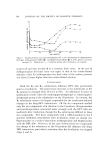
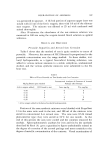
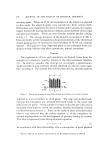
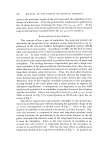
160 JOURNAL OF THE SOCIETY OF COSMETIC CHEMISTS 42 40 80 120 160 AREA/MOLECULE, ,•z Figure 3. Surface pressure versus area per molecule for L-a-dipalmitoyl lecithin on acetic acid-sodium acetate buffer (pH 5.9) at 25øC and ionic strength 0.1. Key: O, zero concentra- tion of prochlorperazine dihydrochloride, irradiated and nonirradiated I, 1 X 10-sM pro- chlorperazine dihydrochloride, nonirradiated a•, 1 X 10-.•M prochlorperazine dihydro- chloride, irradiated fiuphenazine-DPI. system responded the same way, except at areas smaller than 88A -• the film exhibited surface pressures greater than the nonir- radiated film at corresponding areas (Fig. 5). By determining the surface pressure at periodic time intervals it was established that these effects, ob- served only with the trifiuoperazine and fiuphenazine-DPL systems, were a function of elapsed time after irradiation rather than of the increasing pressure. Thus, while the surface pressure of these irradiated films de- creased initially, several minutes after the irradiation was stopped the surface pressure began to increase even when the area/DPL molecule (film area) was maintained constant. In the case of the trifiuoperazine- DPL system this increase continued until the surface pressure was ap- proximately equal to the nonirradiated film. However, in the case of •he fiuphenazine-DPL system, this increase continued until the surface pressure exceeded that of the nonirradiated film by 6-7 dynes/cm. Thus, it appears that the photospecies produced initially by the irradiation is less film active than the starting compounds. With time, apparently, componnds form that interact with the DPL film either to about the

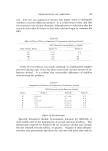
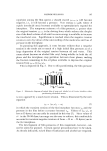
PHOTOSENSFI'IZED REACTIONS 16'1 42 40 80 120 160 AREA/MOLECULE, .•' Figure 4. Surface pressure versus area per molecule for L-o•-dipalmitoyl lecithin on acetic acid- sodium acetate buffer (pH 5.9) at 25øC and ionic strength 0.1. Key: e, zero concentration of trifiuoperazine dihydrochloride, irradiated and nonirradiated l, 1 X 10-sM trifiuoperazine dihydrochloride, nonirradiated &, 1 X 10-'•M trifiuoperazine dihydrochloride, irradiated same degree as the starting compound (trifiuoperazine) or to a consider- ably greater degree (fluphenazine). The kinetic studies were conducted in the absence of a DPL film in order to determine if the observed photoinduced changes in drug-film interactions were the result of changes in the surface activity of the drugs. The same six phenothiazine drugs were used for this part of the study. However, in order to obtain a measurable surface pressure in the absence of DPI, either before or after irradiaton, the concentration of the drug in the acetate buffer had to be increased to 1 X 10⁻⁴M. Under these con- ditions the initial surface pressures of prochlorperazine, trifiupromazine, trifiuoperazine, and fiuphenazine prior to irradiation were 1.6, 4.4, 9.4, and 6.6 dynes/era, respectively. Chlorpromazine and promazine exhib- ited no initial surface pressure at this concentration. Each drug solution was irradiated for a 25-minute period during which time its surface pressure was recorded at convenient intervals. The surface pressure was also recorded periodically for approximately 25 minutes after the irradiation lamp was shut off. Chlorpromazine and prochlorperazine both exhibited a rapid initial increase in surface pressure lasting' two or three minutes, followed by a
Purchased for the exclusive use of nofirst nolast (unknown)
From: SCC Media Library & Resource Center (library.scconline.org)