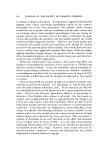
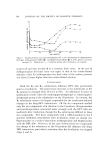
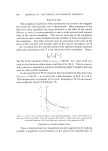
164 JOURNAL OF THE SOCIETY OF COSMETIC CHEMISTS O / .•e" •10 / / •J - i I I I • I , I i 0 I0 20 30 40 TIME, MINUTES Figure 7. Surface pressure versus time of irradiation of 1 X 10⁻⁴M solutions of triflupromazine HC1 (,) trifluoperazine diHC1 (0) and fluphenazine diHC1 (I) at 25øC, pH 5.9, and ionic strength 0.1. Dashed line (---) indicates period after irradiation was stopped turned off and then leveled off to a constant, final, value. In the case of trifiupromazine this final value was equal to that of the nonirradiated solution, while for trifluoperazine the final value of the surface pressure was about 2 dynes higher than the nonirradiated solution. CONCLUSIONS Both the R2and R•0 substituents influence DPL film penetration prior to irradiation. The penetration increases as the substituent at the R,position is changed from H to C1 to CF:4. An additional increase in penetration results when the methylpiperazinylpropyl or ethanolpipera- zinylpropyl group is the substituent on the 10 position. In contrast, the R,substituent seems to be largely responsible for the irradiation-induced changes in the drug-DPL interactions. Of the six compounds studied only the two compounds with chlorine in the 2 position, chlorpromazine and prochlorperazine, interacted more strongly with the DPL film im- mediately after irradiation, though the R•0 substituents differed in these two compounds. The three compounds with a trifluoromethyl in the 2 position exhibited, immediately after irradiation, either no change (tri- flupromazine) or a weaker interaction (trifluoperazine and ttuphenazine) with the DPL film. However, in the case of these latter two compounds the change in the substituent at the 10 position did influence the drug- DPL interaction, particularly sometime after the irradiation was stopped (Figs. 4 and 5).

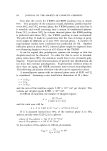
PHOTOSENSITIZED REACTIONS 165 The results obtained in the kinetic studies in the absence of DPL, in general, parallel those of the film studies in spite of differences in drug concentration and irradiation time. This indicates that the initial changes in surface activity induced by the irradiation determine the ex- tent of drug-film interaction. Thus, chlorpromazine and prochlorpera- 7 ..... hi(.l• l•ot-r•rno much more surface ncti,,o an irrndinticm interact with the DPL film much more strongly following irradiation, while for triltupromazine, trifiuoperazine, and ttuphenazine, irradiation reduces surface activity and similarly either reduces or leaves unchanged the drug-film interaction (at least initially). Furthermore, this suggests that in vivo it is not a phenothiazine photo- excited species or free radical that interacts with cellular or membrane components but rather a new, stable, more surface active product of the photoreaction. The high degree of surface activity of this new compound would increase its tendency to accumulate at the membrane-liquid inter- face and conceivably produce the membrane disruption generally associ- ated with the observed clinical sympto. ms of photosensitivity. Willis et al. (7) recently demonstrated that stable photooxidation products of tetrachlorsalicylanilide, rather than free radicals of photoexcited species, are responsible for the observed photosensitized response to this anti- bacterial. To permit comparison of the five phenothiazine derivatives, a photo- toxic index (PI) was calculated using the relationship below. The PI values listed in Table I were calculated at an arbitrarily selected area/ molecule of 75 A •. where: PI • (/xrr•//xrrt) X 100 is the difference between the surface pressure of the irradiate drug- DPL film and that of nonirradiated drug-DPL film is the difference between the surface pressure of the irradiated drug- DPL film and that of the pure lecithin film Thus, PI represents the percentage of the total increase in surface pressure which is due to irradiation of the drug-DPL film. Table I shows that 60% of the total increase in surface pressure that develops in a DPI. film when spread over a subphase containing 1 X 10-•M chlorpromazine and irradiated is due directly to the effect of the irradiation. In the case of prochlorperazine, 50% of the total increase is due to this effect. Irradiation of the other four drug-DPL systems did not produce any initial increase in surface pressure. In fact, in the case
Purchased for the exclusive use of nofirst nolast (unknown)
From: SCC Media Library & Resource Center (library.scconline.org)