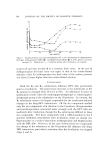
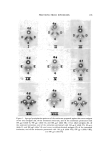
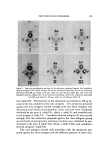
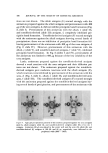
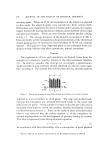
MICROEMULSIONS 195 Figure 1. Electronmicrograph of alkyd-in-water microemulsion stained with osmium te- troxide. Magnification 280,000 X taken at 80,000 X. Average diameter of droplets, 300 •

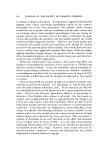
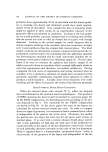
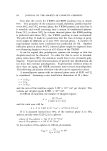
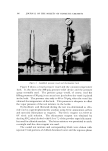
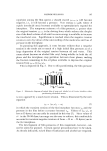
196 JOURNAL OF THE SOCIETY OF COSMETIC CHEMISTS staining agent. When an O/W microemulsion of the alkyd was exposed to this agent, the alkyd droplets were turned into little cannon balls. When these were exposed to the electron beam under vacuum, the organic matter burned off, leaving behind an osmium metal skeleton of the origi- nal spherical droplets. These are seen directly, without shadow casting, in Fig. 1.* The average diameter of the droplets is estimated at 300 •. One can clearly see the hexagonal packing characteristic of the theoretical closest packing ratio of internal to external phase of 74/26, for uniform spheres. This picture of the dispersed phase in microdroplet form con- stitutes strong evidence that these systems are, indeed, emulsions. THEORY The explanation of how such emulsions are formed stems from the concept of a transient, r•egative tension at the microemulsion interface (5). In order to visualize this concept, let us consider a mixed mono- molecular film of soap and fatty alcohol adsorbed at a fiat oil/water inter- [ace, as in Fig. 2. For reasons that will become obvious, this film shall be 'o%111 Ilto,oo, OIL Figure 2. Schematic diagram of mixed film of soap and alcohol at oil/water interface referred to as an ir•terphase or third phase. The soap and alcohol mole- cules in this interphase are oriented with their heads in the water and tails in the oil phase. As the number of these molecules per unit area is increased, they begin to crowd one another, thereby developing a lateral two dimensional pressure, •-. Early in the study of these monomolecular tilms it was observed that the surface tension, •q, of the interphase creased in proportion to this development of pressure among its tenants. This idea is expressed in the thermodynamic equation % = •o/w -- •r (1) In accordance with this relationship, if as a consequence of great physical Picture taken by Dr. Walther Stocckenius at the Rockefeller Institute in 1958 (4).
Purchased for the exclusive use of nofirst nolast (unknown)
From: SCC Media Library & Resource Center (library.scconline.org)