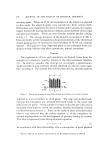
MICROEMULSIONS 197 repulsion among the film species ,• should exceed yo/w, yi will become negative, i.e., it will become a pressure. Now energy (--yidd, where d equals interfacial area) becomes available to spontaneously expand the interphase. The temporary existence of a film pressure, ,•, greater than the original tension, yo/w, is the driving force which reduces the droplet size of the fixed volume of oil until no more energy is available to increase the interfacial area. Equilibrium is reached when the negative tension returns to zero by virtue of the uncrowding of the molecules and loss of pressure in the interphase. In pursuing this approach, it soon became evident that a negative tension is the result not so much of a high initial film pressure as of a large depression of the original tension between oil and water. This comes about because an alcohol like cetyl, being soluble in both the oil phase and the interphase, may partition between these phases, making the fraction remaining in the oil phase available to depress the original tension from 7o/•v to (7o/w)•. This is depicted in Fig. 3. Due to this partitioning, the film pressure Oil Oil. Figure S. Schematic diagram of mixed film of soap and alcohol at oil/water interface when partitioning of alcohol occurs is now opposed by a much lower tension. This is illustrated by the new equation 70 = (?o/w)• - •ro (2) in which the transient tension of the fiat interphase becomes y½ and the pressure in the film before curvature becomes T 0. Values of (7o/w)• as low as 15 dynes/cm can easily be attained in this way (5). Since values of =c• in the 30-50 dyne/cm range are also easy to achieve, this comfortably accounts for transient negative tensions of from --15 to --35 dynes/cm in the fiat interphase. The development of film pressures of this magnitude, however, can- not be taken for granted. Certain special precautions have to be taken. As already indicated, mixed films of surfactant and alcohol are required.

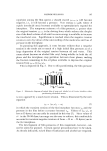
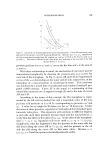
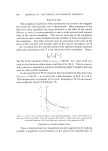
198 JOURNAL OF THE SOCIETY OF COSMETIC CHEMISTS Moreover, it has been found that the maximum pressure is only developed when the ratio of soap to alcohol in these films is between 1:1 and 1:4. On either side of this range, the pressure falls off rapidly. In the case of O/W microemulsions, the nature of the soap cation is also critical. This picture of events at the interface is essentially a mechanical one. It differs from a rigorous thermodynamic treatment in that it requires a stepwise process rather than a single, unified one to account for film cur- vature. In this view, soap in the fiat interphase is penetrated by alcohol derived from the oil phase. This increases the film pressure, tending to expand the fiat film. Acting by another route but in the same direction, the alcohol remaining in the oil phase is available to adsorb to the oil/ water interface and to reduce its tension and thus its tendency to contract. The reality of these forces is apparent in macroemulsions where the excess of (7o/w)•, over =• is the force which shrinks the total interfacial area, caus- ing the two phases eventually to separate. This approach to microemulsion formation leads to a mechanism of film curvature which not only accounts for O/W and W/O emulsions but also for the magnitude of curvature. About fifty years ago, Bancroft (6, 7) proposed that a curved soap film at an emulsion interface was duplex in nature, i.e., it possessed different tensions at each of its sides. Accord- ingly, the side with the higher tension would be concave and would envelop the liquid on that side, making it the internal phase. In Fig. 4 such a duplex film is treated as a fiat interphase with different tensions or pressures at each of its sides. (8). Due to these stresses, curvature occurs, dissipating the pressure •adient until both sides are finally at the same pressure or tension. During this process, the original tension, (7o/w)a, op- posing the pressures does not change. Tw WATER '• x.(• • x, Figure 4. Schematic diagram of mechanism of curvature of flat, duplex film of microemulsion. Stress of pressure gradient due to •ro' and •rw' is relieved by bending until •ro = •rw or •r = (•'o/w)a- Direction of curvature is determined by relative magnitude of •ro' and •rw' The total pressure in these films is equal to the sum of the pressures at each side. Thus, ,r0 is the initial, transient pressure resulting from the
Purchased for the exclusive use of nofirst nolast (unknown)
From: SCC Media Library & Resource Center (library.scconline.org)