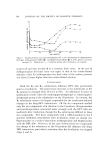
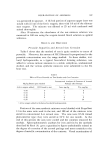
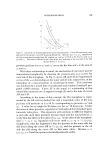
MICROEMULSIONS 199 i E 40? 201 C 10 L % 8o • • 2o Figure 5. Curves of •-• of mixed film of oil/water microemulsion. Curve AB represents water side and CD the oil side curve EF is sum of AB and CD. Because vO (7o/w)•, expansion of the film occurs spontaneously from the original vw • and vo • at 50 • to the final vw and vo at vw and vo. Curvature is effected as the ratio of the area/molecule at the two sides of the film changes from 1/1 to vw/vo pressure •adient due to •o' and •w' across the fiat film and • is the sum o[ =o and =w. With these relationships in mind, the mechanism o[ curvature may be demonstrated graphically by drawing the pressure-area (=-•) curves [or each side o[ the interphase. In Fig. 5, curves AB and CD are hypothetical curves o.[ the =-• relationships at the water and oil side, respectively, o[ the interphase of a microemulsion of octadecane-in-water. This emulsion was stabilized by a mixed film of octadecanol and 2-amino-2-methyl-l-pro- panol (AMP) stearate. Curve EF is the actual =-• relationship o[ this mixed film measured on a Langmuir trough (2) and is the sum o[ curves AB and CD. According to the terms o[ this concept, the fiat interphase is repre- sented by the le[t vertical dashed line and a reasonable value o[ the area per [arty acid molecule in it is 50 •, corresponding to pressures =w' and =o'. A value [or =w' might be 30 dynes/cm [or =o', 10 dynes/cm. Under the stress of these pressures, expansion at both sides o[ the interphase spon- taneously takes place. This expansion will continue, to different degrees, at each side until these pressures become equal and the total pressure, =, in the film has [allen to the value o[ (7o/w)•. At the sides of the interphase, since = = =o + •, expansion will occur until =o: =w -- */2 (7o/w)•. Graphically, what has happened is that the pressure at the water side has slid down along the curve AB to */• (7o/w)• and the pressure at the oil side has slid along the curve CD to this same value. Because = -- (7o/w)•, 7 -- 0 and the system is thermodynamically stable.

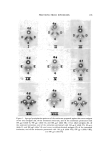
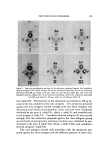
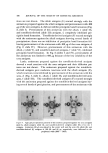
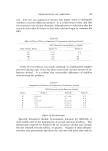
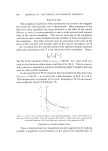
200 JOURNAL OF THE SOCIETY OF COSMETIC CHEMISTS PARTICLE SIZE This graphical exposition of the mechanism of curvature also suggests the means by which particle size is determined. After pressures in the film have been equalized, the areas/molecule at the sides of the curved film are trw and fro, or more generally tr0 and tri at the external and internal sides of the curved interphase. The areas at each side of the interphase will thus be these terms multiplied by the number of fatty acid species in the interphase. Now film curvature may be expressed as the ratio of the areas of the external and internal sides of the curved interphase, (R/R -- T) e, in which R is the external radius of the spherical droplet (internal phase plus interphase) and T is the thickness of the interphase. Hence, (Yi For the O/W emulsion of Fig. 5, (•w/(•o -- 100/60. If a value o[ 25 • is used [or the thickness o[ the stearic acid •lm, • is 110 •. This is a reason- able value [or a translucent emulsion exhibiting slight Tyndall scattering, such as a •oor polish emulsion. In the hypothetical W/O emulsion him represented by Fig. 6 the ratio o• •o/•w = 168/42 = 4, so that with a film thickness of 25A, R is 50 •. This droplet size co•esponds to the clear, transparent, W/O microemul sions originally made by Schulman (9). %' c ____••___ ( y2)• 6'- Figure 6. Curvcs of ,r-o- of mixed fihn of water/oil microemulsion. Curve AB represents oil side and CD the water side curve EF is sum of AB and CD. Large ratio of o'o/aw arises from condensed behavior of CD and high area/molecule at low pressures of AB GRAPHICAL CHARACTERIZATION These considerations have imznediate practical application by making possible a graphical characterization of the process of emulsification in
Purchased for the exclusive use of nofirst nolast (unknown)
From: SCC Media Library & Resource Center (library.scconline.org)