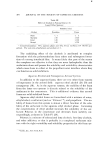
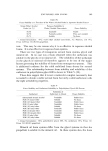
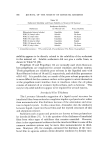
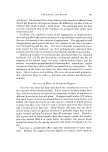
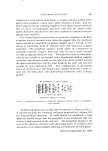
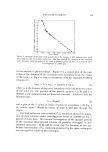
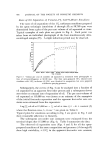
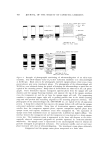
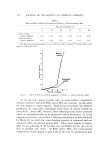
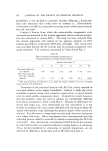
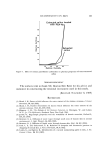
374 JOURNAL OF THE SOCIETY OF COSMETIC CHEMISTS others overshadowed the effect ot• spreading and produced the apparent contradiction. Emulsion stability is, of course, a very complex function of many variables. Although in this series of experiments better stability was generally found when the surfactants were initially placed in the oil phase, the limited data presented here do not permit generalization of the results with respect to emulsion stability. CONCLUSIONS The experimental data indicated that determination of the "required HLB" of an oil to form an O/W emulsion using the emulsification tech- nique described could vary as much as three HLB units depending on where the surfactants were initially placed. In the systems studied, plac- ing of the suffactant blend in the oil phase always resulted in a higher value ot• required HLB than the same system measured by initially plac- ing the surfactant blend in the aqueous phase. This effect is consistent with the earlier finding that placing the surfactant in the aqueous phase tended to make the surfactant behave as though it were more hydrophilic on the HLB scale than placing the same surfactant in the oil phase of the same system. The experimental data on emulsion stability showed that placing the suffactants in the oil phase resulted in a better stability than the same system prepared by initially placing the suffactants in the aqueous phase. This result did not support the theory based on spreading advanced by Ross, Becher, and coworkers. Apparently the differences in the spread- ing due to the suffactant locations were not as important as other factors controlling the emulsion stability of the systems studied. Although the limited data presented here do not permit generaliza- tion beyond the scope of the experiments, it is quite clear that suffactant location is an important factor controlling stability as well as physical properties of the emulsions. In manufacturing practical emulsions, the amounts of the suffactants initially present in the aqueous and oil phases can be varied therefore, the surfactant location should be regarded as an important preparative variable along with others such as emulsification temperature, rate of shear, cooling rate, etc. ACKNOWLEDGMENT The author gratefully acknowledges the experimental assistance of John C. Lambrechts and Tony Lew of Max Factor •c Co. (Received September 15, 1969)

SURFACTANT LOCATION 375 REFERENCES (1) Griffin, •V. C., Classification of surface-active agents by HLB, J. Soc. Cosmetic Chemists, 1,311-26 (1949). (2) Griffin, W. C., Calculation of HLB values of nonionic surfactants, Ibid., 5, 249-56 (1954). (3) Becher, P., Emulsification, in Schick, M. J., Nonionic Surfactants, Marcel Dekker, Inc., New York, 1967, pp. 604-26. (4) Sherman, P., Emulsion Science, Academic Press, New York, 1968, pp. 140-53. (5) Becher, P., and Birkmeier, R. L., The determination of HLB by gas-liquid chromatog- raphy, ]. Am. Oil Chemists' Soc., 41, 169-72 (1964). (6) Gorman, W. G., and Hall, G. D., Use of dielectric constants in the classification of sur- factants, J. Pharm. Sci., 52, 442-6 (1963). (7) Ross, S., Chen, E. S., Becher, P., and Ranauto, H, J., Spreading coefficient and hydrophile- lipophile balance of aqueous solutions of emulsifying agents, ]. Phys. Chem., 68, 1681-3 (1959). (8) Becher, P., Spreading, HLB, and emulsion stability, ]. Soc. Cosmetic Chemists, 11, 325-32 (1960). (9) Davies, J. T., A quantitative kinetic theory of emulsion type, I. Physical chemistry of the emulsifying agent, Proc. Intern. Congr. Surface Activity, 2nd, London, 1957, 1, 426-38. (10) Davies, J. T., and Ridcal, E. K., Int'erfacial Phenomena, Academic Press, New York, 1963, pp. 359-83. (11) Sbinoda K., and Saito H., The stability of O/W type emulsions as function of tem- perature and the HLB of emulsifiers: the emulsification by PIT-method, J. Colloid In- terface Sci., •0, 258-63 (1969). (12) Becher, P., Emulsions: Theory and Practice, 2nd Ed., Reinhold Publishing Corp., New York, 1965, pp. 249, 422. (13) The Atlas HLB System, Atlas Chemical Industries, Wilmington, Del., 1963, pp. 5-8. (14) Ohba, N., Hydrophile-lipophile balance values for O/W emulsions stabilized by non- ionic surfactants, I. Hydrophile-lipophile balance values of nonionic surfactants de- termined by emulsification, Bull. Chem. Soc. Japan, •5, 1016-20 (1962). (15) Ohba, N., Hydrophile-lipophilc balance values for O/W emulsions stabilized by non- ionic surfactants, II. "Required hydrophile-lipophile balance" values of the oil mix- ture, Ibid., •5, 1021-5 (1962). (16) Griffin, W. C., Ranauto, H. J., and Adams, A.D., Further studies on emulsion systems, Am. Per[umer Cosmetics, 81, 31-42 (1966). (17) Lin, T. J., Effect of initial surfactant locations on the viscosity of emulsions, J. Soc. Cosmetic Chemists, 19, 683-97 (1968). (18) Lin, T. J., and Lambrechts, J. c., Effect of initial surfactant location on emulsion phase inversion, Ibid., 20, 185-98 (1969). (19) Lin,T. J., and Lambrechts, J. C., Migration of surfactants in a two-phase system, Ibid., 20, 627-38 (1969). (20) Becher, P., Present status of hydrophile-lipophile balance, Am. Per[umer, 76, No. 9, 33-8 (1961). (21) Riegelman, S., and Pichon, G., A critical re-evaluation of factors affecting emulsion sta- bility, I. The hydrophilic-lipophilic balance postulate, Ibid., 77, No. 2, 31-3 (1962).
Purchased for the exclusive use of nofirst nolast (unknown)
From: SCC Media Library & Resource Center (library.scconline.org)