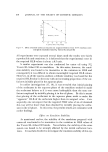
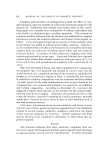
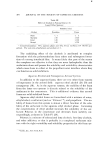
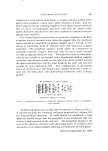
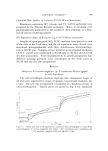
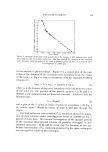
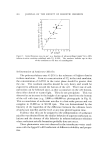
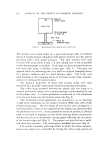
422 .JOURNAL OF THE SOCIETY OF COSMETIC CHEMISTS Table I Effect of RH on Physical Properties of Native rs. Water-Extracted Skin Relative Humidity, 0 11 32 57 75 85 Native callus relative softnessa 1.00 1.07 1.36 1.98 6.72 8.40 Extracted callus relative softnessa 1.07 1.09 1.31 1.50 2.13 2.47 •[ The data have been normalized so as to make the relative softness (p2) of the native callus equal to 1.00 at 0% Rlt. 8.0 7.1) 6O Native / c [ Extracted 20 40 60 80 Relative Humidity Figm'e 6. Effcct of RH on physical properties of native rs. water-extracted callus As can be seen, native keratin with its water-soluble components remains relatively stiff until RH's above 60% are reached. At this point lhe skin begins to soften rapidly. With extracted keratin, the physical properties are essentially unchanged from those of native keratin at lower R1 l's. Above 60•o however, little softening occurs in the extracted callus in contradistinction to its properties be[ore extraction. It is not surprising' that these curves show a striking resemblance to data obtained by Blank (2), in which the water-binding capacity of extracted and un- extracted callus are plotted against RH. Since water uptake is respon- sible for the softening of the keratin, it is reasonable for the two sets of data to parallel each other. At RI-t's below 60%, the water-soluble components of skin appear to play little if any role in maintaining skin

MEASUREMENTS ON SKIN 423 softness. If it is to be argued that these components are vital to main- taining skin softness in an in vivo situation, then it follows that the skin under normal environmental conditions should behave as if it had moisture contents comparable to values over 60% RH as seen in Fig. 6. At most relative humidities the skin is constantly losing water to the air. Thus it is apparent that the skin has a higher moisture content at any RH than would be achieved by simply equilibrating the skin irt vitro with air at that same RH. Studies by Beuttner (o r, 6) have indi- cated that under normal environmental conditions the skin has a mois- ture content comparable to equilibrating it to 86% Rt[. As can be seen in Fig. 6, the presence of the water-soluble components is of vital importance in maintaining skin softness in this RH region. In addition, in this region small changes in RH or moisture content can produce large changes in skin softness. This latter phenomenon may explain why often small changes in climatic conditions can alter the physical properties of the skin (7). With respect to measurements of damping, most of the curves ob- tained exhibited a maximum in damping usually sotnewhere between or0-80% RH, depending upon the treatment and source of callus used. The data indicated that the keratin was highly elastic at the lower and higher humidities and became more plastic at the intermediate humidi- ties. These results can be explained when one considers the phenomena occurring during hydration of the keratin. At lower humidities, the keratin chains are relatively immobile and therefore highly elastic. As the moisture content increases and secondary bonds are broken, the keratin chains are more mobile and slippage can occur when a de[or•ning force is applied. Therefore, plastic flow occurs and damping increases. At high moisture content, most of the secondary bonds have been broken and much of the keratin-chain slippage has already occurred, and there- fore little additional chain slippage occurs when a deforming force is applied. The keratin acts very elastic although much softer. While the physical significance of this data is interpretable, its relationship to the maintenance of a "healthy" stratum comeurn at varying humidities is not at present clearly understood. Thus, it is not apparent whether it would be more desirable to have a highly elastic or a highly plastic stratum corneum for the maintenance of normal skin functions. Since these studies demonstrated that the naturally occurring humectants in skin were necessary to maintain skin softness at the higher
Purchased for the exclusive use of nofirst nolast (unknown)
From: SCC Media Library & Resource Center (library.scconline.org)