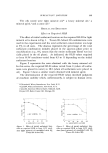
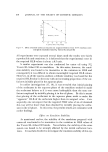
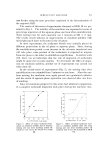
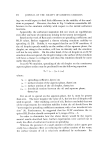
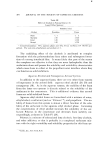
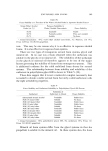
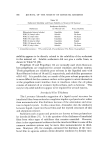
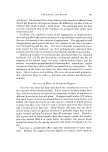
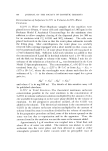
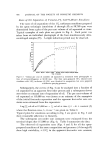
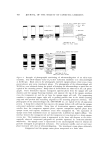
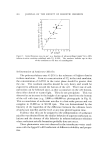
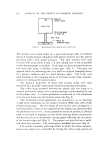
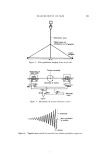
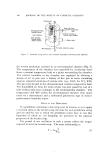
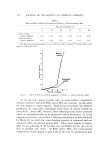
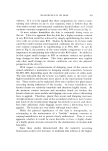
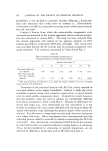
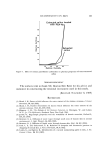
EMULSION STABILITY 409 h, and --7.5% in the apparent terminal zero-order rate. Variations in spraying pressures (E through H) do affect the rates of oil separation and must be held constant for the preparation of reproducible emulsions. The difference between the apparent rate constants for emulsions aged one and 11 days (Table I) indicates that this degree of aging decreased the rates of oil separation under equivalent ultracentrifugal stress. DISCUSSION Ultracentrifugation of 50/50 Toluene-Water-G-21 51 Surfactant Emulsion The observed ultracentrifugal phenomena can be correlated with changes in the body of the emulsion. The emulsions made by the present spray technique have reasonably reproducible rates of oil separation in the ultracentrifuge (Table I). The ultracentrifugal behavior of emulsions can be divided into four parts. Flotation The flotation of oil particles in the toluene emulsion of low surfactant concentration (1%) was too rapid at 50,000 rpm for a quantitative study. The studies were possible with the 7% surfactant and plots of the dis- tam:e of the water phase-cream boundary from the center of rotation vs. time (Fig. 3) based on photographic monitoring (Fig. 6, 20-250 second photographs) suggest at least two distinct phenomena. The first represents an initial rapid flotation of particles which obeys Svedberg's law (Eqs. 1 and 2, Figs. 3 and 7). It seems likely that this is the centrif- ugal movement of the relatively small unhindered particles. This rate should not depend on the oil/water ratio, but rather on the size of the smallest particles (1). However, the duration of this phase should be dependent on the oil/water ratio since compressed oil particles would hinder free flotation (26). The second distinct phase of flotation (Fig. 3) is a relatively slow movement over short distances in the ultracentrifugal cell and can be interpreted as packing of the oil particles with concomitant drainage of residual water from the cream (26). When the emulsion was treated at relatively low centrifugal speeds (13,000 rpm), plots such as Fig. 3 showed intermediate transition rates between the two phases which can be assigned to the movement of particles as aggregates before packing.

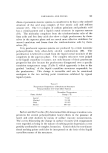
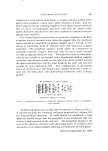
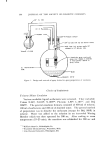
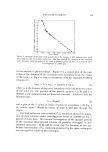
410 JOURNAL OF THE SOCIETY OF COSMETIC CHEMISTS ii / 42 \ / ß--4• 43----. i / "----47 / ß/•o / / ß --55 i i i • i i i i 3 4 5 G '7 8 9 I0 I0 e Figure 7. Initial flotation rates in sec -• as a function of ultracentrifugal (rpm? for a 50% toluene-in-water emulsion stabilized with 7% G-2151. The numbers indicate age in days of the emulsions at lhe time of centrifugation Sedimentation oI SurIactant Micelles The polyoxyethylene ester G-2151 is the substance of highest density in these emulsions. Even at a concentration of 1% in the total emulsion, the concentration of G-2151 in the water phase should be greater than the cmc. The resultant micelles should be very heavy and would be expected to sediment toward the bottom of the cell. Their rate of sedi- mentation can be followed since, as they accumulate on the cell bottom, they either absorb or scatter light. They do not precipitate. This was observed as an increase in the height of an opaque layer from the bottom of the cell with time (e.g., 3,000 to 600,000 sec photographs in Fig. 6). This accumulation of surfactant micelles is a first-order process and was complete in 15,000 sec at 50,740 rpm. This was demonstrated by the linearity of the logarithm of the difference between the ultimate levels of surfactant micelles and the level at any time plotted against time. Evidence that this can be assigned to the sedimentation of sur[actant micelles was obtained from the similar behavior of aqueous surfactant so- lutions and the absence of this behavior in toluene-sur[actant solutions where surfactant micelle formation probably does not occur. These phenomena were not observed in the tetradecane-water emul- sions with the Igepal Co-610 sur[actant of different solubility and proper- ties.
Purchased for the exclusive use of nofirst nolast (unknown)
From: SCC Media Library & Resource Center (library.scconline.org)