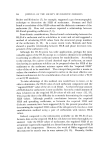
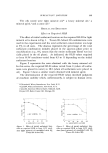
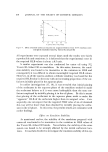
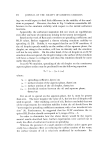
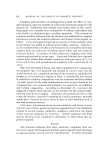
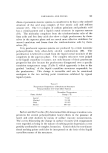
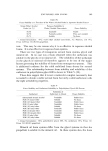
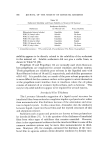
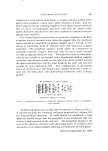
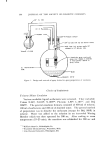
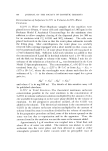
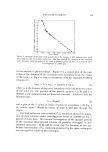
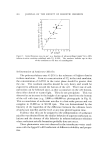
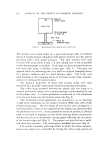
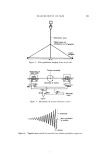
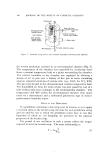
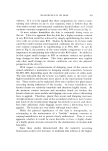
JOURNAL OF THE SOCIETY OF COSMETIC CHEMISTS '4 b•• I/1• W•ter in•et from [•. I•11iM•II•dA_•.•L •-•constant temperature humidity sensor• '• •IUUP•J )1 II I J Co.st•.t humidity air Inner chamber• • •• • L • inlet tø inner chamber Outer chamber Ihrough whic• .... / • Water outlet water circulates • •• Wire Pendulum• lJ To motion detection system Figm'e 5. Constant tcmpcratttre and constant hutnidity environmental chamber the torsion pendulum enclosed in an environmental chamber (Fig. 5). The temperature of the chamber was controlled by circulating water from a constant temperature bath to a jacket surrounding the chamber. The relative humidity in the chamber was regulated by allowing a stream of air to pass over a battery of five jars in series containing aqueous saturated solutions of various salts (e.g., CaCI2for 31% RH). The jars were located in the aforementioned constant temperature bath. The humidified air from the series of jars was next passed by way of a tube-within-a-tube heat exchanger to the environmental chamber. The temperature and RH within the environmental chamber were moni- tored via a thermometer and a sulfonated polystyrene type of electro- psychrometric humidity sensor. RESULTS AND DISCUSSION II a pendulum containing a skin strip is set in motion, so as to apply a t•n'sional stress to the keratin strip, the time for each pendulum swing (period) and the rate at which the pendulum comes back to rest (the logarithm of which we call damping) are governed by the physical properties of the keratin strip. 'l'he period of one oscillation in such a system reflects the torque •'cquircd to twist the kcratin strip. The exact relationship is: v = • Lo

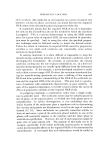
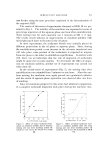
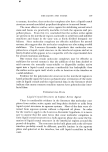
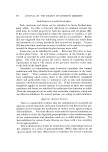
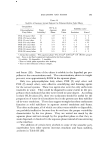
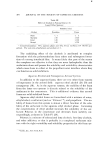
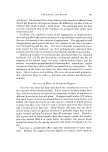
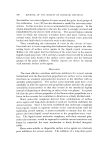
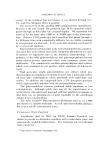
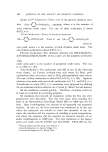
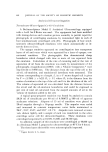
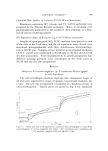
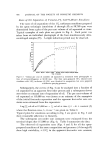
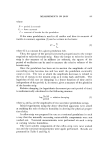
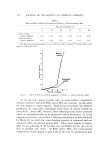
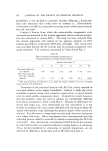
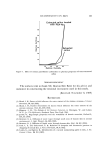
MEASUREMENTS ON SKIN 421 where P = period in seconds Lo = force moment I = moment of inertia for the pendulum If the same pendulum is used in all studies and thus its moment inertia is constant, equation (1) can be written in the form: K p2_ (2) Lo where K is a constant for a given pendulum bob. Thus, the square of the period is inversely proportional to the torque required to twist the keratin strip. Since the torque to twist the keratin strip is also measure of its stiffness (or softness), the square of the period of oscillation can be used to measure the relative softness oF the keratin strip. Once the pendulum has been set in motion the amplitude of each succeeding swing becomes less and less until the pendulum eventually comes to rest. The rate at which the amplitude decreases is related to the loss of energy in the keratin strip as it twists back and forth. The logarithm of this rate (or damping) is a linear function of time and is independent of the period it, in essence, gives a measure of the plasticity ot• the keratin strip. Relative damping (or logarithmic decrement per unit period ot • time) is mathematically calculated in the following manner: log (a•/a2 _ relative dmnping (3) period where a• and a2 are the amplitudes of two successive pendulum swings. Initial experiments using the above described apparatus were aimed at studying the role ot• relative humidity in altering the physical proper- ties of skin. A callus strip was prepared for use as a torsional pendulum in such a way that the naturally occurring water-soluble components were not washed out. Torsional measurements were performed on such a strip at varying relative humidities. The water-soluble components of the callus strip were next washed out and the torsional measurements were again performed. Results are presented in Table I and Fig. 6.
Purchased for the exclusive use of nofirst nolast (unknown)
From: SCC Media Library & Resource Center (library.scconline.org)