388 JOURNAL OF THE SOCIETY OF COSMETIC CHEMISTS the interface can orient dipoles of water around the polar head groups of the surfactants. Low (42) has also discussed a model for ion-water inter- actions. In this structure an ion is surrounded by three regions. In the region immediately adjacent to the ion, the water is strongly oriented and immobilized by the electric field of the ion. The second region contains water in which the structure is broken down and more random than normal water, while the third region consists of normal water polarized by the ionic field which is relatively weak at this distance. Thus, considering the orientation of water in the vicinity of inter- [aces and ions, it is not surprising that hydration layers separate the alter- nating layers of surface active agents in the liquid crystal structures. Boffey et al. (12) report that the thickness of the ,rarer layer in the smectic liquid crystal may reach 110 A and they consider that it is held by solution forces to the ionic heads of the surface active agents and the hydroxyl groups of the polar additives. Similar regions are shoxvn by systems with nonionic surface active agents. DISCUSSION The most effective emulsion and foam stabilizers for aerosol systems formulated with the fiuorocarbon propellants are surface active materials that form an oriented, polymolecular structure at the interface with es- sentially solid properties. The surface active materials must have a low solubility in both the aqueous and propellant phases and also the proper wettability characteristics so that they remain in the interfacial regions instead of dispersing or dissolving in either of the t,vo phases. It is possi- ble that the poor solvent properties of the fluorocarbon propellants are a factor in the necessity for a stabilizer to function as a finely divided solid. Many molecular complexes derived from combinations of surface active agents and long-chain alcohols or acids are excellent stabilizers for aerosol systems. Since it has been established that molecular complexes form liquid crystals in aqueous systems at the concentrations used for stabilizing aerosol systems, it seems reasonable to assume that the com- plexes also form liquid crystal structures at the propellant-water inter- [ace. The liquid crystal molecular complexes, with their oriented poly- molecular structure, would be expected to stabilize aerosol emulsions and foams by somewhat the same mechanism as finely divided inorganic solids. Many water-soluble or dispersible surface active agents are relatively poor stabilizers for aerosol systems. The addition of a long-chain polar

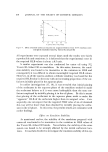
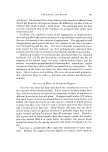
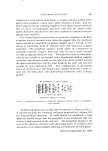
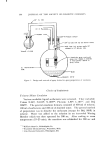
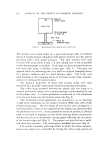
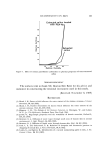
EMULSIONS AND FOAMS 389 compound to such systems often forms a complex with the surface active agent which produces a much more stable emulsion or foam. The evi- dence suggests that the resulting complexes form liquid crystal structures that are much less hydrophilic and more solid than the surface active agents themselves and therefore have more tendency to remain at the pro- pellant-water interface. The oriented liquid crystal nature of molecular complexes with their attendant layers of oriented water molecules suggests that the interfacial region around an emulsified propellant droplet can be viewed as con- sisting of alternating shells of oriented water and molecular complex molecules. The propellant interface would consist of a monolayer of adsorbed molecular complex molecules with the polar heads oriented towards an adjacent hydration layer. The hydration layer of water mole- cules in turn would be surrounded with a bimolecular shell of complex molecules with the polar heads on one side of the shell oriented towards the inner hydration layer and the polar heads on the other side oriented towards an outer hydration shell. This configuration of alternating layers of oriented water and bimolecular complex molecules would ex- tend into the bulk phase with diminishing orientation until it disap- peared. ß '-- SURFACTANT O• FATTY ALCOHOL ii,,,!i,i • ,,:[ • .• ' PHASE INTERFACIAL REGION Figure 1. H•pothetical structure of a molecular complexed interfacial fihn at a propellant- water interface An idealized illustration of this type of structure is shown in Fig. 1. It is patterned after the interfacial structures proposed by Cockbain (33) for soap-stabilized emulsions. It could almost be considered a large spherical micelle except that the propellant is not solubilized and con- stitutes a major portion of the structure. The propellant droplet is the core of the spherical structure with alternating layers of oriented water and surface active agent complex radiating outwards into the bulk phase. (Received September 24, 1969)
Purchased for the exclusive use of nofirst nolast (unknown)
From: SCC Media Library & Resource Center (library.scconline.org)