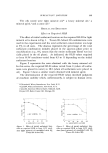
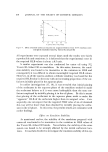
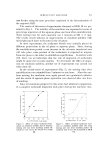
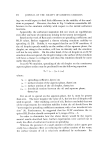
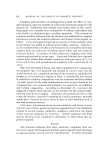
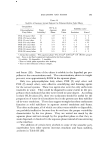
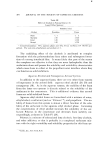
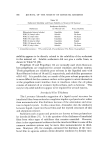
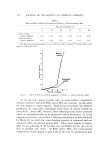
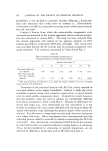
386 .JOURNAL OF THE SOCIETY OF COSMETIC CHEMISTS Table VI Surfactant Solubility and Foam Stability in Mineral Oil Systems a Surfactant Solubility Surfactant in Mineral Oil Foam Stability Ethoxylated stearyl alcohol Insoluble Stable POE (4) lauryl ether Soluble No foam POE (2)cetyl ether Soluble No foam POE (10) cetyl ether Insoluble No foam POE (2) stearyl ether Insoluble Stable POE (10) stearyl ether Insoluble No foam POE (2) oleyl ether Soluble No foam Aerosol formulation: 79% mineral oil, 60,70 surfactant, 15% Freon 12 propellant. stability appears to be directly related to the solubility of the surfactant in the mineral oil. Soluble surfactants did not give a stable foam, as shown in Table VI (30). Propellant 12 and Propellant 114 are normally used when fiuorocar- bon propellants are employed for aerosol emulsion and foam systems. These propellants are relatively poor solvents in the liquefied state with Kauri-Butanol values of 18 and 12, respectively, and solubility parameters of 6.1-6.2. It is possible that, as a result of the poor solvent properties, it is more difficult for the common surface active agents to orient themselves at the propellant-water interface than at interfaces where the oil phase consists of mineral oil or aromatic hydrocarbons, such as benzene. This may be why solid stabilizers appear to be required for aerosol systems. Inter/aciaI Film Thichness The Lawrence-Alexander suggestion of a liquid crystal structure for interfacial films from molecular complexes implies a polymolecular rather than monomolecular film thickness because of the orientation and struc- ture in liquid crystals. In this connection, Alexander cites the similarity between liquid crystal interfacial films and the layered structures of zinc and aluminum stearate. Stabilizers such as gums and proteins are known to form polymolecu- lar interfacial films (31). It is the question of the thickness of interfacial films from other types of stabilizers that remains unsettled. However, there is also experimental evidence that the interfacial films in some of the common emulsion systems may be more than monomolecular in thick- ness. Martynov (32), for example, estimated the thickness of the inter- Facial film in aqueous sodium oleate-benzene emulsion by density mea-

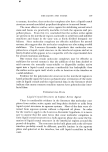
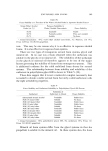
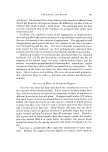
EMULSIONS AND FOAMS 387 surements. He assumed that if the density of the emulsion differed from that of the benezene and aqueous phases, the difference was due to the in- terfacial fihn which formed a third phase. He concluded from his data that the interfacial film in the emulsion was polymolecular rather than monomolecular. Cockbain (33) reported a study of the aggregation of dispersed ben- zene and paraffin hydrocarbon droplets in soap stabilized emulsions using the rate of creaming as the criterion of aggregation. The aggregation and disaggn:egation phenomenon became very complex as the soap concentra- tion increased beyond the cmc. The most reasonable explanation Cock- bain found for this behavior was that polymolecular adsorbed films formed when the soap concentration exceeded the micelle concentration. Additional evidence for polymolecular interfacial films was obtained by Dixon et al. (34, 35) who showed by a radiotracer method that the ad- sorption of the anionic agent, di-n-octyl sodium sulfosuccinate, and the cationic stearamido-propyldimethyl-2-hydroxyethyl ammonium sulfate was greater than that which could be accounted for by a monolayer. The adsorption of the latter was about ten times that calculated for a mono- layer. Other workers, such as Delay (36), have also postulated polymolec- ular interfacial fihns in order to interpret and explain interfacial phe- nomena. Structure of Water in Interfacial Regions Thus far very little has been said about the contribution of water to the structure of the interfacial films. There seems to be little doubt, how- ever, that the structure of water in the immediate vicinity of interfaces is different from that in the bulk phase. Derjaguin and Landau (37) believe that thick layers of water are immobilized at interfaces while Davies and Rideal (38) report that layers of water may be oriented at liquid surfaces to form what they term "soft ice" with a viscosity about like that of butter and a density greater than one. Drost-Hansen (39) states that the thick- ness of surface layers at aqueous interfaces is probably larger than is gen- erally realized and may be greater than 20 molecular layers. Henniker (40) reports that in many liquids other than liquid crystals, the orienta- tion may extend 1000 A or more below the surface, the precise depth being determined by the specific material with which the liquid is in con- tact. Ions have a considerable effect upon the orientation of water mole- cules. McBain (41) suggests that the dipoles of a surface active agent in
Purchased for the exclusive use of nofirst nolast (unknown)
From: SCC Media Library & Resource Center (library.scconline.org)