EMULSION STABILITY 401 toluene remained. The flask was brought to volume and 2 ml of the solution was placed in a 10-ml volumetric flask. Five ml of 2 x 10⁻⁴M I2 and KI was added, the solution was brought to volume, and the absorbaucc was determined within 5 min of the I2-KI addition. The concentration ot: the G-2151 was determined from this absorbance as previously described for G-2151 in the water phase. At least partial vaporizatiou of the toluene was necessary to avoid obscuring the I,,-I-- (G-2151) absorption spectra below 290 m/•. Assay of Tetradecane in Tetradecane-Water-Igepal Co-610 Emulsions Ten ml of the emulsion was placed in a vial and 10 ml of 10% aqueous Na.,..q()4 solution was added. The vials were capped, shaken, and maintained in an oven at 80øC. The emulsion was completely broken withiu 7 hours. Ten ml of ether was added to the cooled emul- sion and the mixture was shaken. A ml of the ethereal layer was added to 0.10 ml of the dodecane to be used as an internal standard in a 50-ml voltanettie flask. The flask was filled to volume and 0.005 ml was in- jeered in an F and M Gas Chromatograph equipped with a flame ioniza- tion detector. The settings were: injection port temperature, 160øC detector temperature, 250øC and column oven temperature, 90øC. The range setting was 102 and the attenuation at 2. The column was an 8-ft circular column containing 20% Carbowax 20 M on 60 to 80 mesh Chromosorb W. The gas chromatogram consisted of three peaks: the first due to ether, the second due to dodecane, and the last due to tetra- decane. The gas chromatogxams were evaluated by obtaining the ratio of tetradecane peak height, ht, to that of dodecane, ha. The plot ot5 this ratio against tetradecane concentration was linear so that ht/ha -- 0.0269 Con q- 0.109 when Con is in grams of oil/100 ml of emulsion. The stan- dard deviation about regression was 8.1 x l0 -a and the standard deviation ot5 the slope was 3.43 x 10 -4. Determi•t. ation of S•tr[actant Igepal Co-610 in Tetradecane-Water- Igepal Co-610 Emulsions This surfactant had ultraviolet absorption maxima at 270 mv and 220 rev. The absorbance ot5 aqueous solutions obeyed Beer's law at the latter wavelength. For a concentration ot5 0.018 g/1., the 95% confidence limits by spectral assay at 220 mv were less than 5%. The equilibrium concentration of suffactant in the aqueous phase of the emulsion was determined by assaying the aqueous phase after creaming by centrifuga- tion at 3,000 rpm.

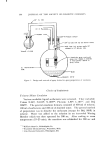
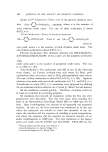
402 JOURNAL OF THE SOCIETY OF COSMETIC CHEMISTS Analytical Ultrace•ltri[ugation Tetradecane-Water-tgepal Co-610 oem ulsions A Beckman-Spinco Model E Analytical Ultracentrifuge equipped with a 4-cell An-F-Rotor was used. The equipment had been modified with timing devices and a motion picture assembly to permit repetitive photographs of centrifuging emulsions by transmitted light in each of four simultaneously centrifuged cells (25). Photographs of four simul- taneously ultracentrifuged emulsions were taken automatically at in- tervals down to 2 sec. The opaque emulsion separated on centrifugation into transparent layers of oil and water which were separated by a layer of opaque, con- centrated emulsion. The photographic film demonstrated sharp boundaries which changed with time as more oil was separated from the emulsion. Calculation of the rate of creaming and/or the rate of separation of oil from the emulsion was made by measurement of the photographs (magnification 2.2005) with a Nikkon Comparator,* read- {no, ttlroctl tn n n02 '•'" The A .......... r .... the top of air-oil, oil-emulsion, and emulsion-oil interfaces were measured. The volume corresponding to a length, L, in a 4 ø sector shaped cell is given by V -- (4/3{50) X = h(2L R,, d- L2) where R• is the distance from the center of rotation to the top of the cell and h is the thickness of the cell. The volume of separated oil was calculated from the distance between the air-oil and the oil-emulsion boundaries and could be expressed as per cent of total oil calculated from the assayed amounts of oil in the volume of emulsion added to the cell. A typical spray-prepared emulsion was found by analysis to contain 20.28 ml of tetradecane per 80 ml of 0.500{575 g/100 ml of aqueous surfactant solutions. Aliquots of 15 ml of emulsion were placed in 20-ml ampules through a l{5-gauge needle. The ampules were sealed and immersed in constant temperature water baths maintained at 2{5.0 ø, 35.0 ø, 45.0 ø, and 55.0 ø --+0.1øC. Ampules were removed at inter- vals, shaken lightly, and a sample of each was transferred to the ultra- centrifuge sector cell for ultracentrifugation. These emulsions were centrifuged sequentially at 10,589, 35,600, and 50,740 rpm. In addition, samples of this emulsion,were centrifuged at 40,000 rpm in a Beckman Model L preparative ultracentrifuge at 40øC for 8 hours. The three layers discernible were microscopically inspected. Nippon Koyaku K. K., Japan.
Purchased for the exclusive use of nofirst nolast (unknown)
From: SCC Media Library & Resource Center (library.scconline.org)