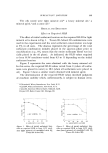
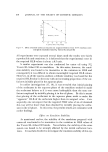
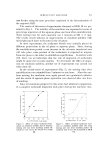
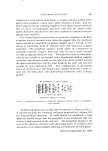
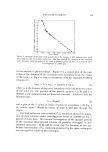
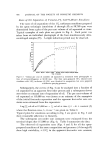
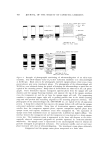
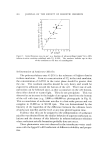
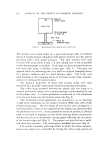
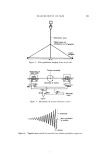
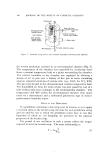
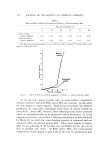
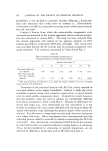
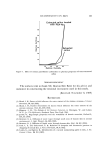
EMULSION STABILITY 411 Characteristics o[ Creams Shortly at:ter the completion ot: flotation in emulsions of low surt:ac- tant concentrations, the optical properties ot: the cream changed. Ini- tially no light is transmitted (0-250 sec photographs in Fig. 6). Subse- quently, the transmittance of a percentage of the incident light is ob- served. Generally, about 80% of the cream shows partial light trans- mittance with 2,000 sec of centrifugation at 50,740 rpm. The amount of cream exhibiting this phenomenon remains constant for approxi- mately 250,000 sec and then very slowly increases (Fig. 6). This phe- nomenon has not been observed in high 7% surfactant concentration emulsions where the excess surfactant has been shown microscopically to precipitate in the cream and prevents coalescence. Any toluene which separates most probably comes from this semitransparent cream since the amount of opaque cream remains constant. The fact that discrete toluene particles exist in the cream was shown by their rapid dispersibility in water, but not in toluene. Also, discrete oil particles in the cream were observed under the microscope. The translucent cream may represent toluene particles packed tightly to- gether and covered with monomolecular surfactant films from which the continuous medium (water) has been eliminated to minimize light scat- tering optical properties. The small fraction of the cream which never transmits light, i.e., opaque cream (Fig. 6), is probably a region of tightly packed particles with a relatively high concentration of trapped or precipitated surfac- tant. The prepared tetradecane emulsion showed rapid creaming and no such variations in opacity of the cream phase. Separation of Oil Toluene appeared at 3,000 sec at the top of the cell (Fig. 6) when the 1% G-2151 toluene-in-water emulsions were centrifuged at 50,740 rpm. The rate of oil separation could be analyzed, after an initial lag period, into an initial accumulation at a first-order rate for approximately 115,000 sec with a subsequent constant rate of oil separation (Figs. 4 and 5). In one experiment continued for 11 days of ultracentrifugation, only slight terminal diminution was noted. The initial lag period before the ap- pearance of toluene demonstrates that certain phenomena must occur in the body of the cream before oil separation. There may be a surfactant- film strength that must be exceeded, i.e., a "yield" value (1). There may

412 JOURNAL OF THE SOCIETY OF COSMETIC CHEMISTS be a time-dependent filtration o[ coalesced toluene through the cream to the top o[ the cell Large toluene particles may be entrapped in the cream o[ such a high O/W ratio emulsion. The extent o[ the lag period does exceed, although it is complicated by, the time necessary to bring the ultracentri[uge up to speed. Possible Coalescence Processes on Ultracentrifugation Two processes for the coalescence o[ oil in the ultracentrifuged emul- sion should be possible: (a) coalescence at the oil-emulsion inter[ace (6), and (b) coalescence throughout the body o[ the creamed emulsion (1). The first process should be dependent upon the number, size, and prop- erties o[ the particles present at the inter[ace. It should lead to a rea- sonably constant rate o[ oil separation i[ the cream is not stratified and the particle sizes maintain the same distribution throughout the cream. The changing o[ the position o[ oil-cream boundary with time may slightly perturb this rate o[ oil separation since the pressure on the par- ticles will decrease with the slow moving o[ the boundary toward the cen- ter o[ the rotor. If stratification o[ the cream occurs on flotation, then the largest and presumably most easily coalesced particles should be uppermost. If the rate o[ coalescence with the continuous oil phase at the oil-cream inter- [ace is rate determining, then a pseudo first-order rate o[ oil separation may be observed. This would be due to the decreasing abilities of the deeper and smaller particles to coalesce as the volume of cream diminishes with layer rupturing. This may be expected in the flotation o[ dilute emulsions where the stratification o[ particles in accordance to size is permitted. The second process, where coalescence occurs throughout the body o[ the cream, may also lead to an apparent first-order rate o[ oil separa- tion. The larger particles in a nonstratified cream may pre[erentially coalesce under ultracentrifugal stress and possess sufficient flexibility to drain through the cream to the top o[ the cell. The numbers o[ such large particles and the resultant rate of oil separation would decrease with time. The initial lag period could be assigned to the time interval necessary [or the initial coalescence o[ large particles and/or the achieve- ment of a steady state of coalescence in the body o[ cream and transport to the oil-cream interphase. The 50/50 toluene/water emulsion demonstrates the lag period and an initial rate of oil separation (Fig. 4 and 5) to 50-60% of the total that
Purchased for the exclusive use of nofirst nolast (unknown)
From: SCC Media Library & Resource Center (library.scconline.org)