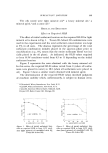
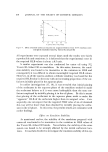
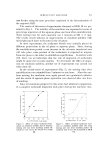
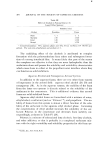
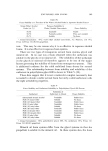
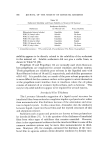
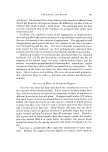
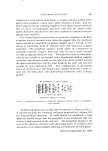
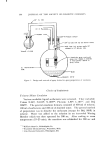
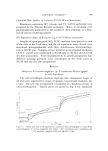
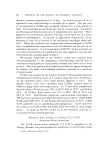
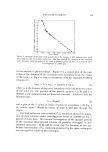
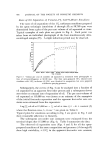
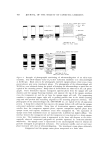
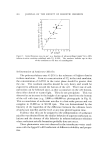
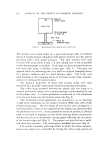
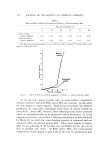
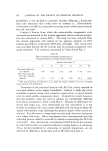
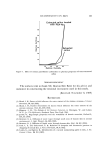
EMULSION STABILITY 41B can be characterized as a first-order process. This first-order process may be attributed either to the increasingly difficult coalescence of layers of stratified particles at the oil-cream interphase or to the preferential co- alescence and drainage into the separated oil of larger particles in the body of the unstratified cream. The former process may be anticipated for ultracentrifuged dilute emulsions and for the initial oil separation of concentrated emulsions where some initial stratification is possible. The latter process may explain such first-order processes of oil separation in concentrated emulsions. The subsequent and terminal constant rate of oil separation may be attributed to the fact that the cream ultimately consists of similarly sized particles coalescing at the oil-cream interphase. Ultracentrifugation of 20/80 Tetradecane-Water-Igepal Co-610 Surfactant (1.5%) Emulsion The tetradecane-water emulsion is a coarser emulsion than the toluene-water and shows an initial oil separation at low centrifugal speeds (Fig. 2). The amount of oil separated is a function of the magni- tude of the ultracentrifugal stress. A new lag period appears with each elevation in the rpm the rate of oil separation increases and then de- creases to a value related to the rpm. This provides an ultracentrifugal method to classify particles in an emulsion. The stepwise levels of tetra- decane oil separation (Fig. 2) with increased sequential rpm's indicate that large particles are squeezed out of the body of the cream and are forced to coalesce at the cream-oil interface. Increase in centrifugal speed permits other particles to coalesce and separate. At a constant rpm, coalescence of a new class of particles in the cream with subsequent separation is a time-dependent process. Eventually, the water is removed from the packed, small, similarly sized particles. This was observed microscopically. The subsequent and terminal constant rate of oil separation may be attributed to the coalescence of the packed, similarly sized particles at the oil-cream interphase. Temperature effects on storage of the tetradecane emulsions are com- plicated. The amount of easily separated oil at 10,589 rpm increases and then decreases with increasing temperature (Fig. 2). However, the emulsion stored at 55øC shows a higher amount of oil separated at 35,- 000 rpm than at other temperatures. Temperature effects on storage must introduce new equilibria among particle sizes and modify the

414 JOURNAL OF THE SOCIETY OF COSMETIC CHEMISTS resistance of particles to ultracentrifugal coalescence. Systematic studies o1: the effect of temperature and time on the solubilities of the surfactant and oil and on the cmc of the surfactant may permit fuller understand- ing of these thermal effects. Specific surface areas and equilibrium sur[actant concentrations for such emulsions showed no significant varia- tion with storage time nor with temperature of storage. Only the cen- trifugal studies provided quantitative estimates of emulsion changes. ACKNOWLEDGMENTS The author wishes to give appropriate credit to Rafael Cazali, Bahram Farhadieh, and George H. Miller who worked on this project at various intervals. (Received October 13, 1969) REFERENCES (1) Garrett, E. R., Prediction of stability in pharmaceutical preparations, VIII. Oil-in- water emulsion stability and the analytical ultracentrifuge, J. Pharm. Sci., 51, 35 (1962). (2) Rehfeld, S. J., Stability of emulsions to ultracentrifugation discontinuity at the critical micelie concentration, J. Phys. Chem., 66, 1966 (1962). (3) Vold, R. D., and Groot, R. C., An ultracentrifugal inethod for the quantitative determi- nation of emulsion stability, Ibid., 66, 1969 (1962). (4) Vold, R. D., and Groot, R. C., Parameters of emulsion stability, J. Soc. Cosmet. Chem., 14, 233 (1963). (5) Vold, R. D., and Groot, R. C., The effect of electrolytes on the ultracentrifugal stability of emulsions, J. Colloid Sci., 19, 384 (1964). (6) Vold, R. D., and Groot, R. C., The effect of varying centrifugal field and interfacial area on the ultracentrifugal stability of emulsions, J. Phys. Chem., 68, 3477 (1964). (7) Garrett, E. R., Stability of oil-in-water emulsions, J. Pharm. Sci., 54, 1557 (1965). (8) Nichols, J. B., and Bailey, E. D., Determinations with the Ultracentrifuge, in Weissber- ger, A., Technique of Organic Chemistry, Vol. 8. Physical Methods of Organic Chem- istry, Part 1, 2nd Ed., Interscience Publishers, Inc., N.Y., 1949, pp. 673-9. (9) Greenwald, H. L., Theory of emulsion stability, J. Soc. Cosmet. Chem., 6, 164 (1955). (10) Merrill, R. C., Jr., Determining the mechanical stability of emulsions, Ind. Eng. Chem., Anal. Ed., 15, 743 (1943). (11) Cockton, J. R., and Wynn, J. B., The use of surface active agents in pharmaceuticaI preparations: The evaluation of emulsifying powder, J. Pharm. Pharmacol., 4, 959 (1952). (12) King, A., and Mukherjee, L. N., The stability of emulsions, I. Soap-stabilized emulsions, J. Soc. Chem. Ind., 58, 243 (1939). (13) Cheesman, D. F., and King, A., Electrical double layer in relation to the stabilization of emulsions with electrolytes, Trans. Faraday $oc., 86, 241 (1940). (14) Cockbain, E.G., and McRoberts, T. S., The stability of elementary emulsion drops and emulsions, J. Colloid Sci., 8, 440 (1953). (15) King, A., and Mukherjee, L. N., The stability of emulsions, II. Emulsions stabilized by hydrophilic colloids, J. Soc. Chem. Ind., 59, 185 (1940). (16) Kraemer, E. O., and Stamm, A. S., A new method for the determination of the distribu- tion of size of particles in emulsions, J. Amer. Chem. Ass., 46, 2709 (1924).
Purchased for the exclusive use of nofirst nolast (unknown)
From: SCC Media Library & Resource Center (library.scconline.org)