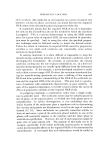
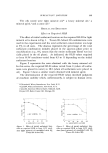
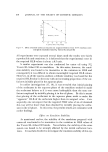
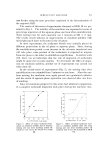
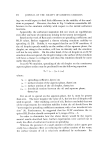
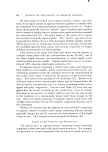
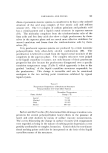
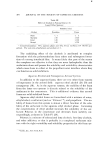
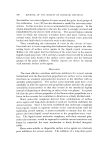
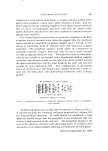
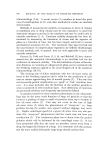
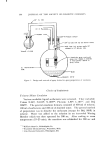
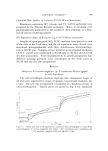
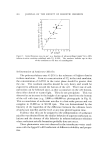
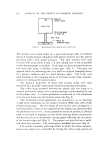
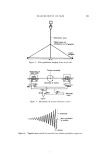
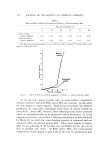
EMULSION STABILITY 403 Flotation Rate Studies of Toluene-G-2151-Water Emulsions Emulsions containing 50% toluene and 7% G-2151 surfactant were prepared by the Waring Blendor technique. Rates of creaming were photographically monitored in the analytical ultracentrifuge as a func- tion of various centrifugal speeds. Oil Separation Rates of Toluene-l% G-2151-Water Emulsions Samples of spray-prepared 50% O/W emulsion were placed in each of the cells of the 4-cell rotor and the oil separation rates of each were monitored photographically with their simultaneous ultracentrifuga- tion at 50,740 rpm. Samples of four identical spray-prepared emulsions (A, B. C, and D) were centrifuged at 50,740 rpm on the first and eleventh day after preparation. Four emulsions (E, F, G, and H), prepared at four different spraying pressures, were centrifuged in the 4-cell rotor at 50,740 rpm one day after preparation. RESULTS Analytical Ultracentrifugation o[ Tetradecane-Water-IgepaI Co-610 Emulsions The ultracentrifuged emulsion separates into transparent layers of oil and water separated by a layer of opaque concentrated emulsion, the cream. The per cent oil separated was plotted as a function of time of ultracentrifugation. Typical plots are given in Fig. 2 for emulsions __ 50740 R PM • 35,600 R PM . .• •e•. • • // / •,•9 R P M I •1'•* •• 0 45 • o•*-•* • •o ,•o ,• • •¾• •oo Time in I0 $ Second• Figure 2. Volume per cent of oil separated as monitored frotn photographs rs. time of ul- tracentrifugation at various sequential rpm values. The tetradecane-water emulsions with 5% surfactant, Igepal Co-610, were aged for 11 days

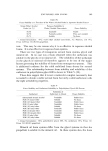
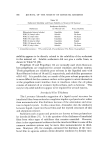
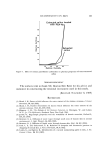
404 JOURNAL OF THE SOCIETY OF COSMETIC CHEMISTS stored at various temperatures for 11 days. An initial fraction of oil is separated as the ultracentrifuge is brought up to speed. The per cent of oil separated at 10,000 rpm remained constant for a long period of time. Increased rpm increased the per cent of oil separated. Sequential accelerating and decelerating rates of separation were observed. There appears to be a maximum amount of oil that can be spun out at a given speed of centrifugation. Eventually an apparently constant rate of ap- pearance of clear oil is reached at the maximum centrifugal speed pos- sible. When the emulsion was continuously ultracentrifuged at 40,740 rpm, an instantaneous separation of oil was observed and the rate of oil separation decreased. A total separation of 60-70% of the available oil was observed before the oil separated by the same apparent constant rate observed in the terminal phase of Fig. 2. Microscopic inspection of the resilient cream that resulted from ultracentrifugation in the preparative ultracentrifuge showed that it consisted of small particles of practically constant size which were closely packed. This close packing had caused the particles to appear polygonal. In contrast, the fresh, uncentrifuged emulsion consisted of a spectrum of particle sizes. Particle size studied by the Coulter Counter* demonstrated that the emulsion had a diameter mode of 3 v with a range between 1.0 and 2.0 v. As the emulsions aged, a new mode became apparent at 4.0 •. The specific surface areas were calculated from Coulter Counter plots at different aging times and temperatures. At 17 days after preparation, derived values (10%m2/g) were 29.1 at 26øC, 28.4 at 35øC, and 26.8 at 55øC. At 24 days, these values were 27.7 at 26øC, 26.9 at 35øC, and 26.8 at 55øC. Equilibrium surfactant concentrations (absorbance at 222 m• by the analytical procedure described) were at 26øC: 0.625, 0.600, 0.610, and 0.580 at 0, 6, 11, and 24 days after preparation at 35øC: 0.603, 0.597, and 0.581 at 6, 11, and 24 days after preparation. At 45 ø and 55øC the values were 0.599, 0.582, and 0.589, 0.577 for 6 and 11 days, respec- tively. As much as 70-95% of the oil in the emulsion could be ac- counted for by the counted particles. Flotation Rate Studies o/ Tohtene-7% G-2151 Sur/actant-Water Emulsions The 50/50 toluene-water emulsion, 7% G-2151, prepared in the Waring Blendor was photographically monitored at several rpm vah•es Coulter Electronics, Hialeah, Fla.
Purchased for the exclusive use of nofirst nolast (unknown)
From: SCC Media Library & Resource Center (library.scconline.org)