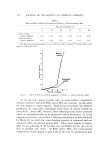
382 JOURNAL OF THE SOCIETY OF COSMETIC CHEMISTS Stabilization by Solid Emulsifiers Both emulsions and foams can be stabilized by finely divided inor- ganic solids. In order to function effectively in emulsion systems, the solid must be wetted properly by both the aqueous and oil phases (22). If the solid remains suspended in either the aqueous or oil phase, it will not concentrate at the oil-water interface and act as a stabilizer. Becher (23) has suggested that the stabilizing action of solids may result from the formation of a strong interfacial film around the droplets. Verwey (24) has noted that emulsions increase in stability as the interfacial regions around the dispersed emulsion droplets become more solid. Foams also can be stabilized by solids. Bikerman (25) refers to these as three-phase foams. In such foams, coalescence of the bubbles is pre- vented or retarded by solid substances partially immersed in the liquid phase. The solid must possess the correct degree of wettability by the liquid phase so that it will remain at the gas-water interface rather than in the bulk ot• the liquid phase. Alexander, in commenting upon Lawrence's postulate that ionized surt•actants and fatty alcohols form liquid crystal structures at the inter. face, stated: "Thus, instead of a mixed monolayer at the interface, we have something which comes closer to the solid stabilizers considered above and particularly close to substances such as zinc and aluminum stearates, which form layered structures" (8). If the Lawrence-Alexander hypothesis applies to aerosol systems, it is necessary to show that aerosol emulsions and foams are stabilized by surfactants that function as solids. Then the assumption can be made that molecular complexes, which also are effective stabilizers for aerosol systems, are acting as solid stabilizers. Aqueous Aerosol Systems There is considerable evidence that the stabilization of essentially all aqueous aerosol emulsions and foams formulated with fluorocarbon pro- pellants occurs through the mechanism of surface active agents acting as solid stabilizers. The most effective surt•actants for aerosol emulsions are not soluble in either the liquefied gas propellants or the continuous phase at use concentrations and therefore must act as solid stabilizers. The best stabilizers for aerosol foams likewise are those with a low solubility in the aqueous phase. This is illustrated by Table II, which shows the relationship between the solubility of a series of polyoxyethylene (POE) fatty ethers in the aqueous phase and their effectiveness as stabilizers for aerosol emulsions

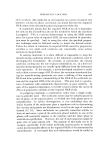
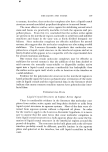
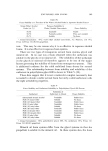
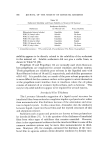
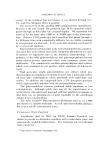
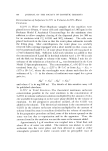
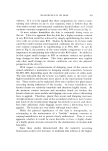
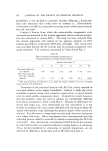
EMULSIONS AND FOAMS 383 TABLE II Stability of Aqueous Aerosol Systems" by Polyoxyethylene Fatty Ethers Composition Wt % in Polyoxyethylene Water Aqueous HLB Fatty Ether Solubility ø Phase Value POE (4) lauryl ether D POE (23) lauryl ether S POE (2) cetyl ether I POE (10) cetyl ether D POE (20) cetyl ether S POE (2) stearyl ether I POE (10) stearyl ether D POE (20) stearyl ether D 1 8 60 1 6 33 54 1 8 34 55 Stability (min) Emulsion c Foam a 9.7 1 5 16.9 1 5 5.3 30 120 12.9 1 15 15.7 1 5 4.9 3O 120 12.4 1 15 15.3 5 5 • Aerosol formulation: 90% aqueous phase-10% Freon © 12/Freon © 114 (40/60) propel- ]ant. Freon is du Pont's registered trademark for its fluorocarbons. 0 S, soluble D, dispersible I, insoluble. c Time to initial phase separation after shaking. a Time to first indication of foam collapse. and foams (26). None of the ethers is soluble in the liquefied gas pro- pellant at the concentrations used. The concentrations, shown in weight per cent, were approximately 0.05M in the aqueous phase. Only two polyoxyethylene fatty ethers, POE (2) cetyl ether and POE (2) stearyl ether, were effective emulsifying and foaming agents for the aerosol systems. These two agents also were the only surfactants insoluble in water. They could be dispersed to some extent in the pro- pellant which indicated that they were wetted to some degTee. According to their HLB values (27), these two sur[actants should be useful for the preparation of water-in-oil emulsions but in the present case they stabilize oil-in-water emulsions. These data suggest strongly that these surfactants function as solid stabilizers in aqueous aerosol emulsions and foams. The other surfactants, all o[ which are either water-soluble or dispersible, are probably ineffective because they do not have the proper wettability characteristics by the two phases. They are wetted too much by the aqueous phase and not enough by the propellant phase so that they re- main dispersed or dissolved in the aqueous phase instead of concentrating at the interface. The addition of certain fatty alcohols to some o[ the unstable poly- oxyethylene fatty ether systems increases emulsion and foam stability, as shown in Table III (26).
Purchased for the exclusive use of nofirst nolast (unknown)
From: SCC Media Library & Resource Center (library.scconline.org)