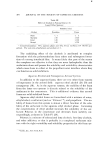
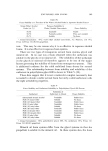
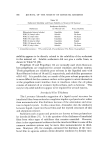
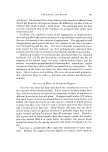
EMULSIONS AND FOAMS 379 to assume, therefore, that molecular complexes also have a liquid crystal structure around emulsified propellant droplets or in aerosol foams. The most effective surface active agents for stabilizing aerosol emul- sions and fomns are practically insoluble in both the aqueous and pro- pellant phases. From this it is concluded that the surface active agents are present in the interfacial regions essentially in solid form and stabilize emulsions and foams in the same way as finely divided inorganic sta- bilizers. Since molecular complexes are effective stabilizers for aerosol systems, this suggests that the molecular complexes are also acting as solid stabilizers. The Lawrence-Alexander hypothesis that molecular com- plexes have a liquid crystal structure in the interfacial regions and act as finely divided solids appears to be compatible with the experimental data for aerosol emulsions and foams. One reason that certain molecular complexes may be effective as stabilizers for aerosol systems is that the addition of the fatty alcohol or acid converts the normally water-soluble or dispersible surface active agent into a liquid crystal structure considerably less hydrophilic than the surface active agent itself which is able to function at the interface as a solid stabilizer. Evidence for the polymolecular structure in the interfacial regions is based primarily upon the known polymolecular orientation o.f the mole- cules in liquid crystals and the experimental data in the literature which indicate that many common emulsion systems have polymolecular inter- facial films. EXPERIMENTAL DATA Liquid C•ystal Structures of Surface Active Agents There is considerable evidence in the literature that molecular com- plexes from surface active agents and long-chain alcohols or acids form liquid crystal structures in aqueous systems. Most of the data were ob- tained from aqueous systems without a dispersed oil phase. In order for the results to apply to the Lawrence-Alexander hypothesis, it is neces- sary to assume that the same forces that cause molecular complexes to form liquid crystal structures in a bulk aqueous phase also cause the for- mation of liquid crystal structures in the interfacial regions around dis- persed oil droplets. The structures in the bulk phase and at the oil-water interface probably would be different, possibly laminar in the aqueous phase and spherical at the interface, but still liquid crystalline in both cases.

380 JOURNAL OF THE SOCIETY OF COSMETIC CHEMISTS All three types of surface active agents (anionic, cationic, and non- ionic) form liquid crystals in aqueous systems regardless of whether they are co•nplexed with a long-chain polar compound or not (9-11). Surface active agents generally form the "s•nectic" type of liquid crystal structure which consists of regular layers of surface active agent molecules separated by water •nolecules (12). The polar heads of the surface active agents are oriented towards the aqueous phase. The "smectic" type of structure is regarded by Mulley (13) as a fully developed McBain la•nellar micelie. There see•ns to be no convincing reason why the same type of structure in a •nodified spherical form cannot exist around a dispersed oil droplet and function essentially as a solid stabilizer. Ionic surface active agents with short alkyl chains may not separate as a liquid crystal phase until the concentration reaches 20-30%, but as the chain length increases, the concentrations at which liquid crystal structures form decrease rapidly. Liquid crystals may occur at concentra- tions of 1-2% when the chain length reaches C• (13). In aqueous systexns containing a surface active agent and long-chain fatty alcohol or acid complex, liquid crystal structures form at low con- centrations, possibly because the repulsion between the ionized heads of the surface active agent is reduced by the presence of the alcohol mole- cules. This allows closer packing of the molecules (13). Ekwall et al. (14) have indicated that mesomorphic phases xnay be formed below the critical xnicelle concentration (cmc) in systeIns containing surface active agents and polar cronpounds. Lawrence and Hyde (15) have also sug- gested that the breaks occurring in the conductivity curves of cationic detergents in the presence of organic additives near the cmc may be due to the formation of a •nesoxnorphic phase rather than changes in the cmc. When the third component is nonpolar, liquid crystals form only at high concentrations because the nonpolar component does not aid in the orientation. Mulley (13) visualizes that the addition of water-insoluble compounds to aqueous systexns of surface active agents containing Hartley xnicelles gradually changes the micelle structure until precipitation of the liquid crystal occurs. This concept has been discussed by Winsor (16). Liq•tid Crystal Structures and Pearlescence The pearlescence in aqueous systems containing certain molecular complexes is often associated with liquid crystal structures. For example, the pearliness in creams formulated with an excess of stearic acid in so-
Purchased for the exclusive use of nofirst nolast (unknown)
From: SCC Media Library & Resource Center (library.scconline.org)