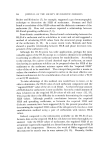
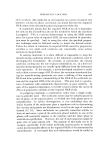
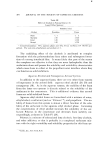
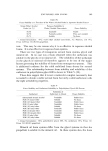
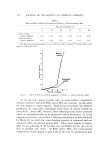
EMULSIONS AND FOAMS :385 'Cable IV Foain Stability as a Function of the Water/Alcohol Ratio in Aqueous Alcohol Foams,, Water/Ethyl Alcohol Ratio (wt %) Polawax Solubility in Water/Alcohol Concentrate Foam Stability 35/65 Insoluble Stable 30/70 Partially soluble Thin and unstable 25/75 Soluble No foam • Aerosol formulation: 87% water/ethyl alcohol concentrate, 3% Polawax, and 10% Freon 12/Freon 114 (40/60)propellant. tern. This may be one reason why it is so effective in aqueous alcohol foams. It is also effective in aqueous foam systems. There are two types of nonaqueous aerosol foam systexns, glycol and mineral oil. In no case was a foam obtained when the surfactant was soluble in the glycols or in mineral oil. The solubility of the suffactant in the glycols or mineral oil therefore appears to be one of the major factors governing the stability of foams from nonaqueous systems. This is additional evidence for the solid stabilized foam theory for aerosol systems. The relationship between foam stability and solubility of the surfactant in polyethylene glycol 400 is shown in Table V (30). These data suggest that it is not a molecular complex necessarily that is needed to obtain a stable aerosol foam but only a solid surfactant with the right wettability properties. Table V Foam Stability and Surfactant Solubility in Polyethylene Glycol 400 Foalns a Solubility of Surfactant Surfactant in Glycol Foam Stability Ethoxylated stearyl alcobol Insoluble Stable foam POE (4) lauryl ether Soluble No foam POE (23)lauryl ether Insoluble Stable foam POE (2)cetyl ether Insoluble Stable foam POE (10)cetyl ether Soluble No foam POE (20) cetyl ether Insoluble Stable foam POE (2) stearyl ether Insoluble Stable foam POE (10)stearyl ether Insoluble Stable foam POE (2) oleyl ether Soluble No foam POE (10)oleyl ether Soluble No foam • Aerosol formulation: 86% polyethylene Freon 114 (40/60) propellant. glycol 400, 4% surfactant, 10% Freon 12/ Mineral oil foam systems differ from the glycol systems in that the propellant is soluble in the mineral oil. In these systems also, the foam

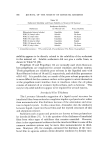
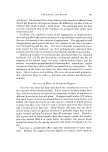
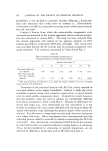
386 .JOURNAL OF THE SOCIETY OF COSMETIC CHEMISTS Table VI Surfactant Solubility and Foam Stability in Mineral Oil Systems a Surfactant Solubility Surfactant in Mineral Oil Foam Stability Ethoxylated stearyl alcohol Insoluble Stable POE (4) lauryl ether Soluble No foam POE (2)cetyl ether Soluble No foam POE (10) cetyl ether Insoluble No foam POE (2) stearyl ether Insoluble Stable POE (10) stearyl ether Insoluble No foam POE (2) oleyl ether Soluble No foam Aerosol formulation: 79% mineral oil, 60,70 surfactant, 15% Freon 12 propellant. stability appears to be directly related to the solubility of the surfactant in the mineral oil. Soluble surfactants did not give a stable foam, as shown in Table VI (30). Propellant 12 and Propellant 114 are normally used when fiuorocar- bon propellants are employed for aerosol emulsion and foam systems. These propellants are relatively poor solvents in the liquefied state with Kauri-Butanol values of 18 and 12, respectively, and solubility parameters of 6.1-6.2. It is possible that, as a result of the poor solvent properties, it is more difficult for the common surface active agents to orient themselves at the propellant-water interface than at interfaces where the oil phase consists of mineral oil or aromatic hydrocarbons, such as benzene. This may be why solid stabilizers appear to be required for aerosol systems. Inter/aciaI Film Thichness The Lawrence-Alexander suggestion of a liquid crystal structure for interfacial films from molecular complexes implies a polymolecular rather than monomolecular film thickness because of the orientation and struc- ture in liquid crystals. In this connection, Alexander cites the similarity between liquid crystal interfacial films and the layered structures of zinc and aluminum stearate. Stabilizers such as gums and proteins are known to form polymolecu- lar interfacial films (31). It is the question of the thickness of interfacial films from other types of stabilizers that remains unsettled. However, there is also experimental evidence that the interfacial films in some of the common emulsion systems may be more than monomolecular in thick- ness. Martynov (32), for example, estimated the thickness of the inter- Facial film in aqueous sodium oleate-benzene emulsion by density mea-
Purchased for the exclusive use of nofirst nolast (unknown)
From: SCC Media Library & Resource Center (library.scconline.org)