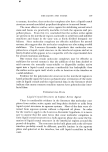
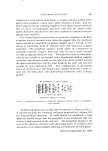
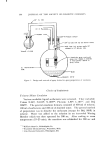
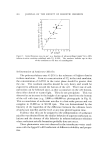
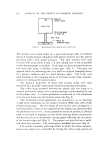
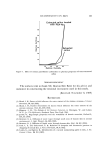
EMULSIONS AND FOAMS 389 compound to such systems often forms a complex with the surface active agent which produces a much more stable emulsion or foam. The evi- dence suggests that the resulting complexes form liquid crystal structures that are much less hydrophilic and more solid than the surface active agents themselves and therefore have more tendency to remain at the pro- pellant-water interface. The oriented liquid crystal nature of molecular complexes with their attendant layers of oriented water molecules suggests that the interfacial region around an emulsified propellant droplet can be viewed as con- sisting of alternating shells of oriented water and molecular complex molecules. The propellant interface would consist of a monolayer of adsorbed molecular complex molecules with the polar heads oriented towards an adjacent hydration layer. The hydration layer of water mole- cules in turn would be surrounded with a bimolecular shell of complex molecules with the polar heads on one side of the shell oriented towards the inner hydration layer and the polar heads on the other side oriented towards an outer hydration shell. This configuration of alternating layers of oriented water and bimolecular complex molecules would ex- tend into the bulk phase with diminishing orientation until it disap- peared. ß '-- SURFACTANT O• FATTY ALCOHOL ii,,,!i,i • ,,:[ • .• ' PHASE INTERFACIAL REGION Figure 1. H•pothetical structure of a molecular complexed interfacial fihn at a propellant- water interface An idealized illustration of this type of structure is shown in Fig. 1. It is patterned after the interfacial structures proposed by Cockbain (33) for soap-stabilized emulsions. It could almost be considered a large spherical micelle except that the propellant is not solubilized and con- stitutes a major portion of the structure. The propellant droplet is the core of the spherical structure with alternating layers of oriented water and surface active agent complex radiating outwards into the bulk phase. (Received September 24, 1969)

390 JOURNAL OF THE SOCIETY OF COSMETIC CHEMISTS REFERENCES (1) McBain, J. W., and Field, M. C., Phase rule equilibrium of acid soaps. I, J. Phys. Chem., 37, 75 (1933). (2) Schulman, J. H., and Rideal, I. K., Molecular interaction in monolaycrs. I. Complexes between large molecules. II. Action of hemolytic and agglutinating agents on lipo- protein monolayers, Proc. Roy. Soc. (London), 122B, 29, 46 (1937). (3) Schulman, J. H., and Cockbain, E.G., Molecular intcractions at oil/water interfaces. Part I. Molecular complex formation and the stability of oil in water emulsions, Trans. Faraday Soc., 36, 51 (1940). (4) Epstein, M. B., XVilson, A., Jakob, W. C. W., Conroy, L. E., and Ross, J. J., Film drainage transition temperatures and phase relations in the system sodium lauryl sulfate, lauryl alcohol and water, J. Phys. Chem., 58, 60 (1954). (5) Kung, H. C., and Goddard, E. D., Studies of molecular association in pairs of long-chain compounds by differential thermal analysis. I. Lauryl and tnyristyl alcohols and sul- fatcs, 1bid., 67, 1965 (1963). (6) Kung, H. C., and Goddard, E. D., Molecular association in fatty acid potassium soap systems. II, J. Colloid Interface Sci., 29, 242 (1967). (7) Kung, H. C., and Goddard, E. D., Interaction between ionized surfactants and long chain polar compounds, Soap Chem. Spec., 42, 61 (Feb., 1966). (8) Alexander, A. E., E•nulsions in theory and practice, Amer. Per[urn. Cosmet., 84, 27 (Jan., 1969). (9) Rosevcar, F. B., The microscopy of the liquid crystalline neat and middle phases of soaps and synthetic detergents, Amer. Oil Chem. Soc., 31• 628 (1954). (10) Roseyear, F. B., Liquid crystals: the mesomorphic phases of surfactant compositions, J. Soc. Cosmet. Chem., 19, 58 (1968). (11) Porter, R. S., and Johnson, J. F., Ordered fluids and liquid crystals, Advan. Chem. Set., No. 63• American Chemical Society (1967). (12) Boffey, J., Collison, R., and Lawrence, A. S.C., The solubility of organic substances in aqueous soap solutions, Trans. Faraday Soc., 55, 654 (1959). (.13) Mullcy, B. A., Solubility in .'ystems Containing ,' urface Active Agents, in Bean, H. S., Bechett, A. H., and Carless, ]. E., Advances in Pharmaceutical Sciences, Vol. I, Academic Press, London and New York, 1964. (14) Ekwall, P., Danielsson, I., and Mandell, L., Association and phase equilibrium in systems of aliphatic alcohol and aqueous solutions of associated colloids, Kolloid-Z., 169, 113 (1960). (15) Lawrence, A. S.C., and Hyde, A. J., The effect of additives on the electrical conductivity of aqueous solutions of some paraffin chain electrolytes, Proc. lntern. Congr. Surface Activity, 3rd, Cologne, 1960, Sect. A, Vol. I, 21 (1960). (16) Winsor, P. A., Solvent Properties of Amphiphilic Compounds, Butterworths, London, 1954. (17) Arkins, F., Pearliness in creams, Perrum. Essent. Oil Rec., 332 (Nov., 1934). (18) Kohlhaas, R., The structure of crystalline aliphatic compounds x-ray investigation of an acid sodium pahnitate, Chem. Bet., 82, 487 (1949). (19) Sanders, P. A., Molecular complex formation in aerosol emulsions and foams, ]. Soc. Cosmet. Chem., 17• 801 (1966). (20) Sanders, P. A., Molecular interactions in aerosol emulsion systems: III. Pearlescent structures, 1bid., 20• 577 (1969). (21) Becher, P., and De1 Vecchio, A. H., Film drainage transition temperatures by surface viscosity, ]. Phys. Chem., 68• 3511 (1964).
Purchased for the exclusive use of nofirst nolast (unknown)
From: SCC Media Library & Resource Center (library.scconline.org)