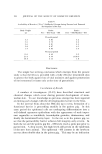
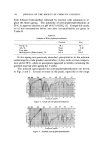
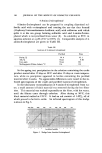
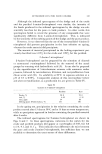
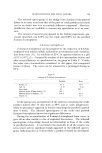
140 JOURNAL OF THE SOCIETY OF COSMETIC CHEMISTS EXPERIMENTAL To obtain meaningful results, it was necessary to establish a method of analysis that would give reliable and reproducible figures using the available analytical equipment. Titration of an aqueous hydrochloric acid solution of the intermediate with standard sodium nitrite at 0 to 5øC, using starch-iodide paper as an outside indicator, was tried as a method for determining the purity of these compounds. While fairly consistent results were obtained with nitro-p-phenylenediamine, the re- sults with the other four intermediates were far from satisfactory. Since all of these compounds contain high percentages of nitrogen (27.4 or 18.1%) it was decided to use a modified Kjeldahl method and base the % purity on the nitrogen content. It is necessary to reduce the nitro groups to amino groups before proceeding with the deter•nination. This is done by adding 2 g of granular zinc metal, 15 ml of deionized water, and 15 ml of concentrated hydrochloric acid to the accurately weighed sample in a Kjeldahl flask. It is treated over a low flame until the water has been driven off and the residue starts to splatter. The reduction is then complete and, after cooling, the balance of the determination is the regular Kjeldahl method with sodium alizarine sulfonate as the indica- tor. This gives total nitrogen. Volatile nitrogen is determined by add- ing/5 ml of 30% sodium hydroxide to a solution of the intermediate and determining nitrogen without digestion. This is necessary in order to correct for any ammonium salts that might be present. The value for volatile nitrogen is subtracted from the total nitrogen to give fixed ni- trogen from which the percentage purity of the intermediate is calcu- lated. The intermediates are also tested for the percentage ash and the iron content. Ash is determined by ignition in a platinum crucible and weight of the residue. Iron is determined by fusing the ash in a mixture of equal parts of borax glass, potassium carbonate, and sodium carbonate, and dissolving the mass in dilute hydrochloric acid solution from which the iron is determined gravimetrically and reported as parts of iron per million parts of sample. Each of the five compounds is reported separately. Because of the possible effect of the method of preparation on the impurities that might be found in the product, a brief description of a suitable method for manufacturing is given for each product. The solubility of each inter- mediate in aqueous solution at 25øC and a pH of 9.7, as previously re- ported in the literature (1), is also listed. This is the approximate pH at which these intermediates are applied in permanent hair coloring.

INTERMEDIATES FOR HAIR COLORS 141 Perhaps the most important difference in the behavior of these nitro dyes before and after recrystallization is their effect on ageing when dis- solved or dispersed in the dye base solutions. The composition of the base solution varies with each manufacturer of oxidation hair dyes. A detailed discussion of oxidation hair dye base solutions has been given in a prior publication (2). In the experimental work done for this paper the following base solution (amounts given in grams) was used: Dye 0.1 Oleic acid 20.0 Ethomeen S-12' 15.0 Propylene glycol 11.0 Isopropyl alcohol 12.5 Ammonium hydroxide (28 %) 10.0 Sodium sulfite 1.0 Hampshire DEG•' 1.5 Water (deionized) 29.0 The pH of the base solution is 10.4 and after the addition of an equal volume of hydrogen peroxide it is 9.7 to 9.9. The dye is dissolved in propylene glycol by heating. The Ethomeen and oleic acid are mixed together and the dye solution is added with stirring. Next, the isopropyl alcohol is added, then the ammonium hy- droxide. The sodium sulfite and Hampshire DEG are dissolved in the water and this solution is added slowly, with stirring, to the above solu- tion. Dispersions or solutions of the intermediates, before and after re- crystallization, were prepared at the same time. Results are discussed separately for each of the five compounds considered in this paper. In another test, the behavior of the crude and purified dyes on boil- ing in water was investigated by the following procedure: I g of dye was added to 400 ml of boiling deionized water and the solution was boiled on a hot plate for exactly 5 minutes. It was filtered through a weighed fritted glass filter with a base of medium porosity. The precipitate was washed by filling the crucible with boiling water, allowing it to drain completely between fillings, and continuing the washing until the tiltrate was no longer colored. The percentage residue was quantitatively de- termined after drying. Laboratory recrystallizations were performed with all five products and the substances removed during the hot filtra- tion were used for further examination. * Ethomeen S-12 is bis-2-hydroxethyl soybean amine, Armour Industrial Chemical Co., Chicago, Ill. * Hampshire DEG is diethanolglycine sodium salt, Hampshire Chemical Co., Nashua, N.H.
Purchased for the exclusive use of nofirst nolast (unknown)
From: SCC Media Library & Resource Center (library.scconline.org)