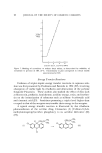
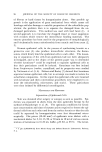
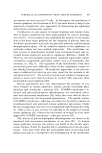
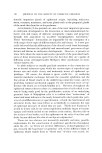
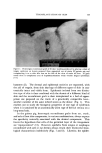
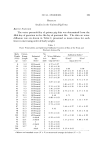
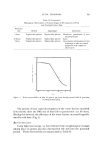
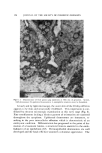
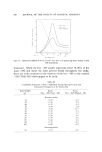
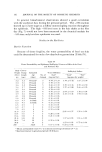
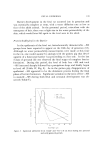
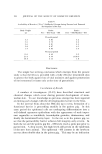
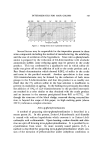
142 JOURNAL OF THE SOCIETY OF COSMETIC CHEMISTS RESULTS Nitro-o-phenylenediamine Nitro-o-phenylenediamine can be prepared by the reduction of 2,4- dinitroaniline with alcoholic ammonium sulfide (3). The solubility at 25øC in aqueous solution at a pH of 9.7 is 0.03% (1). Comparable analy- ses of this intermediate before and after recrystallization, as a production lot, are given in Table I. Table I Analyses of Nitro-o-phenylenediamine Purified Raw PuriW, % 99.5 95.4 Ash, % 0. 025 0.20 Iron, ppm 36 178 Melting point (Fisher-Johns), øC 202.5 199.4 Base solutions were prepared using the formulation previously shown under Experimental. One of these contained 0.1% of the crude nitro-o- phenylenediamine and the other, 0.1% of the purified product. Both solutions were clear and showed no precipitation at the time of bottling. They were aged in sealed bottles, at room temperature and at 50øC, and examined from time to time for precipitation. Precipitation in the solu- tion containing the crude product started after 24 hours, both at room temperature and at 50øC, while no precipitate appeared in bottles con- taining the purified material after ageing for four weeks. Infrared spec- trograms for crude and purified nitro-o-phenylenediamine did not show any differences. The material removed in the laboratory recrystallization of nitro-o- phenylenediamine during hot filtration of the isopropyl alcohol solution was washed repeatedly with hot isopropyl alcohol until the flitrate came through colorless. From the recrystallization of 100 g of crude nitro-o- phenylenediamine 0.5 g of sludge was obtained. After drying, it was a black powder with a melting point above 335øC, with an ash content of 16.3% and an iron content, determined as ferric oxide, of 3.77%. An infrared spectrogram of this black powder is shown in Fig. 1.* * All spectrograms presented in this paper were prepared on a Perkin-Ehner Model 137B Inoeracord spectrophotometer using the potassium bromide pellet method with slit N and a fast scan. A concentration of 0.5% intermediate and a pellet thickness of 0.022 in. was used.

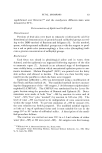
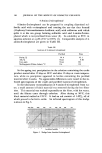
INTERMEDIATES FOR HAIR COLORS 143 4000 3000 2000 1500 CM -• 1000 900 800 700 100 : l! ' qil '- .... 7 i ": ",•:I. ]i 'i!:i' il ' iil 'i !: !t'T ,•'•I'ILI .i 11•i ' •'-'IH• 'H':i! : ..il. ' •00 ,•.f,,, '"- , -•--- •,•' • .... I • . .... • ..... •o • -.4:- J--:i : ,'• " " " ' ' •"• • •'•" :,-•' '4 .... •'::• -••• •: •'1 •/•M •-•'.:: •' •:'i ' .• • •-• : • • i 'ø 3 4 5 6 7 8 9 10 11 12 13 14 15 WAVELENGTH [MICRONS) Figure 1. Sludge from nitro-o-phenylenediamine Several factors may be responsible for the impnrities present in these nitro componnds inclnding the method of mannfactnring, the solnbility, and the ease of oxidation of the by-prodncts. Since nitro-o-phenylenedi- amine is prepared by the rednction of 2,4-dinitroaniline with alcoholic ammonium snlfide, some reducing agent may be present in the crnde prodnct. This was confirmed by a qnalitative test in which snlfnr di- oxide was given off on the addition of acid to the crnde product and a Parr Bomb determination which showed 0.28% of snlfnr in the crnde and none in the pnrified material. Another specnlation is that some 1,2,4-triaminobenzene may be formed by the rednction of both nitro gronps in the 2,4-dinitroaniline and that this prodnct is so readily oxi- dized that the 1% sodinto sulfite in the base solntion is insnfficient to prevent its oxidation on ageing. In the boiling test previonsly described, the addition of 10% of 1,2,4-triaminobenzene to the purified intermedi- ate resnlted in a color similar to that obtained with the crnde prodnct and an increase in the amount precipitated from 0.01 to 0.77%. A1- thongh the strnctnre of the black slndge, removed dnring recrystalliza- tion, is beyond the scope of this paper, its high melting point (above 335øC) indicates a complex structnre. Nitro-p-phenylenediarnine A method of preparing nitro-p-phenylenediamine is described in a recent patent (4). In this process, 2-nitro-l,4-dicarboxylic acid diamide is treated with sodinto hypochlorite which converts it to 2-nitro-l,4-di- carboxylic acid n-chloramide. Upon heating, carbon dioxide and chlo- rine are split off forming nitro-p-phenylenediamine. It is pnrified by re- crystallization from water. In more recently issned patents (5-7), a method is described for preparing nitro-p-phenylenediamine which con- sists of the nitration of p-fiuoroaniline nnder anhydrons conditions to
Purchased for the exclusive use of nofirst nolast (unknown)
From: SCC Media Library & Resource Center (library.scconline.org)