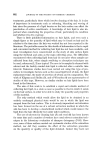
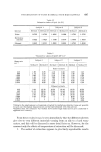
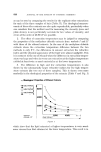
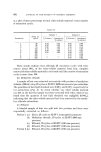
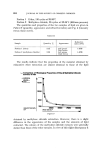
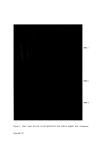
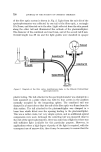
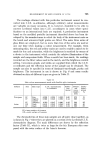
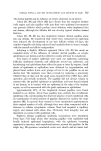
694 JOURNAL OF THE SOCIETY OF COSMETIC CHEMISTS Portion 1 Ether, 110 cycles at 32-35øC Portion 2 Methylene chloride, 25 cycles at 32-35øC (600 mm pressure) The quantities and properties of the two samples of lipid are given in Table IX (quantity, appearance and refractive index) and Fig. 4 (viscosity versus shear curve). Table IX Sample Portion 1 (ether) Portion 2 (methylene chloride) Quantity 2.22 2.09 Appearance Soft grease Pale brown Soft grease Dark brown Refractive index (17øC) 1.4725 1.4728 The results indicate that the properties of the material obtained by exhaustive ether extraction are almost identical to those of the lipid r g4. ComparJsorl of Rheological Properties of Ether& Methylene Chloride extracts of hair, 0 methylene cl'•oride ß ether 5OO apparent viscosity 7500 1 c.R shear rate sec Figure obtained by methylene chloride extraction. However, there is a slight difference in the appearance of the samples and the amounts of lipid extracted. The colours of the methylene chloride extracts were generally darker than those of the ether extracts. In view of this slight discrepancy it

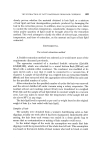
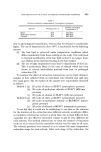
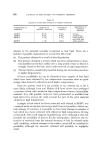
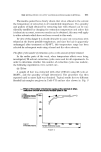
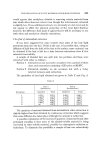
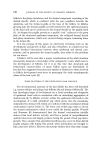
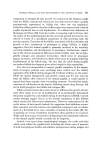
THE EXTRACTION OF FATTY MATERIALS FROM HAIR CLIPPINGS 695 would appear that methylene chloride is removing certain material from hair which ether does not extract even though the total amount extracted is slightly less. These additional extracts are obviously at a low level and do not appear to affect the physical properties of the total lipid fraction however, the difference does make it appear that it will be necessary to use both ether and methylene chloride extractions. The effect of intermittent extraction It has been suggested by some workers that some of the hair lipid penetrates deep into the hair. If this is the case, it is possible that, owing to diffusion of lipid from the bulk of the hair to the surface, more material can be obtained if the hair is left for a time between extractions than if it is extracted successfully. A sample of blended hair was split into two portions and these were extracted with ether as follows:- Portion 1 Extracted on six successive occasions over a period of three days, each extraction consisting of 25 cycles at 32-35øC. Portion 2 Extracted similarly on six occasions but with a 7-day interval between each extraction. The quantities of hair lipid obtained are given in Table X and Fig. $. Table X Extraction 1 2 3 4 5 6 , Part 1 (Successive) Quantity 3.72% 0.62% 0.26% 0.•5% o.os% nil Total 3.72% 4.34% 4.60% 4.75% 4.83% 4.83% Part 2 (Intermittent) Quantity 3.ss% 0.44% 0.34% 0.34% o,o6% Total 3.53% 4.02% 4.36% 4.so% $.o•% 5.07 % The quantity of material obtained from intermittent ether extraction is slightly higher than that obtained by continuous extraction which suggests that some diffusion has taken place although the amount is rather low. A possible explanation of the increased quantity of material found after prolonged standing is that some of the alcohol-soluble material is being converted to ether-soluble material, possibly by atmospheric oxidation or hydrolysis. To eliminate this possibility a sample of hair was exhaustively
Purchased for the exclusive use of nofirst nolast (unknown)
From: SCC Media Library & Resource Center (library.scconline.org)