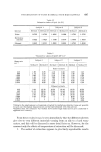
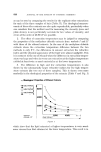
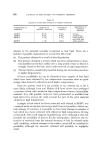
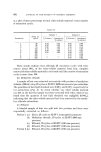
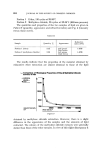
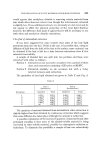
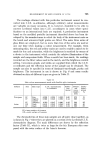
70• JOURNAL OF THE SOCIETY OF COSMETIC CHEMISTS Type 1 hairs Many hairs of this type finish their period of growth when the guinea- pigs are between 13 and 24 days old, with a peak in the number finishing growth at about 16 days. The definitive length of these hairs however pre- cludes the possibility that they had been produced entirely after birth. It is also apparent that follicles of this type enter anagen as early as day 13 and continue to do so until day 44, with the proportion becoming active reach- ing a peak at about day 32. Growth of these hairs is still in progress when they are plucked at 48 days. Type oe hairs Follicles of this type enter activity on every day from birth until 38 days, with a peak at about 14 days. Follicles finish their period of anagen from day 21 onwards, with a peak at about 43 days. As the duration of anagen of type 2 hairs was shown to be 33 days it is clear that some follicles must have become active before birth. Type 3 hairs No follicles of this type commenced anagen during the period studied. Follicles finish activity between 6 and 20 days, but with a marked peak at 15 days. Although the duration of anagen of type 3 hairs was not ascer- tained, their definitive length precludes the possibility that the hairs had been produced entirely after birth, and it is clear that once again the growth of this fibre type starts in utero. DISCUSSION It is quite clear that although there is no exact synchrony of follicles in a single region of the body, as in the pattern moult of other rodents, there is nevertheless a definite pattern of activity within each follicular type. However the follicles of one particular type are not in phase with those of any other type. While the present study confirms the finding of Bosse (11), that at birth and during the first 14 days of life all the hairs of the dorsal region are in anagen, it throws doubt upon the view that all synchrony breaks down after this time and that follicular activity takes on a mosaic pattern. The evidence of the present study, and from others at present in progress, suggests that there is a significant degree of synchrony within each fibre type over the first 150 days of life and possibly beyond. As yet we have not sufficient information to know whether the pattern of activity in the mid-side and ventral regions is similar to that in the dorsal.

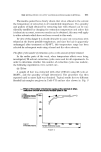
GUINEA-PIG HAIR FOLLICLE FOR EXPERIMENTAL OBSERVATION 707 The evidence of Tejima et al (21), however, suggests that there may be waves of hair growth in the guinea-pig as found in the rat and the mouse. These authors, using a wild strain of guinea-pig, plucked hairs from 30 different dorsal sites and found that the anagen/telogen ratio varied con- siderably. On the other hand Bosse (11) believed there to be only minimal regional differences in adult guinea-pigs of short haired varieties. Of greater significance, however, are the results obtained by Tejima et al (21) when the anagen/telogen ratio was measured once a week in five regions of two guinea-pigs over a period of five months. Obvious peaks of hairs com- mencing anagen were found in each region, and it appeared that the peak shifted with time from the cranial to the caudal region. Consequently it was concluded that a wave of hair growth is propagated from anterior to posterior in the guinea-pig, i.e. along the long axis of the body. Although the pattern of hair growth in man has also been described as a mosaic, relatively recent evidence has suggested that this may not be so, at least in the new born. Pecoraro, Astore and Barman (22) have calculated anagen/telogen ratios of hair taken from the occipital, parietal and frontal regions of 26 full-term children between 3 and 76 h after birth. They found that in any given region there was generally a predominant phase, usually anagen, of the hair cycle. They found that telogen was most abundant in the frontal region and least abundant in the occipital region, whilst catagen occurred most frequently in the parietal region and least frequently in the frontal region. The relative abundance of hairs in catagen led them to conclude that many hairs were synchronously passing through this stage of the hair cycle, and that there was a growth wave passing from the front to the back of the scalp at the time of birth. Our results therefore question the assumption that the guinea-pig, by reason of some supposed mosaic pattern of follicular activity, is necessarily superior to other rodents for the study of hair growth because it is more like the human scalp. They also emphasize, that in any studies of hair growth it is important to know the age of the animals, and to match con- trols of the same age to each experimental animal. It is essential that the hair follicle types are identified in any such study (23), and that when rates of growth are to be compared, they must be based on the whole of the period of anagen, or, if not, on comparable parts of it. (Received: 12th February 1971) REFERENCES (1) Slee, ]. and Carter, H. B. A comparative study of fleece growth in Tasmanian Fine Merino and Wiltshire Horn ewes. J. Agr. Sci. $7 11 (1961).
Purchased for the exclusive use of nofirst nolast (unknown)
From: SCC Media Library & Resource Center (library.scconline.org)