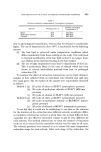
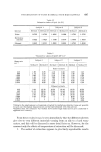
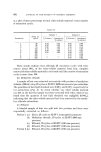
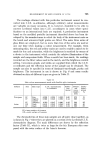
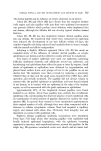
GAMMA RADIATION FOR PRODUCT STERILIZATION 715 ance of micro-organisms some examples are given in Table I. The influence of oxygen is obvious and other factors such as water content of organisms or chemical protection by the medium may also contribute. The situation is Table I. The influence of environment during irradiation on the dose required for reduction by a factor of 105 of populations of various vegetative bacteria and spores. Environment Organism Dose (Mrad) during irradiation S. typhimurium Strep. faecium A 21 0.1 0.3 0.5 0.6 1.9 3.0 buffer suspension in air buffer suspension anoxic dried in bone meal buffer suspension in air buffer suspension anoxic dried in serum I 0.9 buffer suspension in air B. pumilus 1.5 buffer suspension anoxic i 1.7 in grease Cl. tetani • 1.0 [ in talc in air further complicated by the fact that certain pre- and post-irradiation treatments of organisms can also influence inactivation. Aspects of radiation microbiology fundamental to sterilization are given in detail elsewhere (6). Choice of dose In practice the choice of dose for treatment of individual products has been made by combining a knowledge of the general resistance of organisms with the results of direct investigations on the products themselves. As a background to the choice of a dose of 2.5 Mrad for the sterilization of medical products, experiments involved inoculation with bacteria of items such as rubber gloves and plastic tubing (7), or materials simulating the situation which might occur with commercial products (8). However, it is impossible to exactly reproduce the natural situation of product contamination and the necessity for extrapolation from laboratory contrived situations has led to some disparity in the choice of dose for medical product sterilization (9). The margin of safety aimed at in sterilization is very high and it is difficult

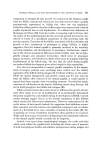
716 JOURNAL OF THE SOCIETY OF COSMETIC CHEMISTS to demonstrate its attainment. For example if products are each con- taminated with 100 organisms which are inactivated by a factor of 107 at the recommended dose, then only one survivor would be expected in 105 products. Sterility testing is not sensitive enough to detect such a low frequency of occurrence of contaminated items. New approach Recent theoretical studies by Tallentire, Dwyer and Ley (10) have been devoted to investigating the influence of various parameters, such as the initial numbers of contaminating organisms and their resistance, on the relationship between the probability of observing positive samples and radiation dose. The results of these studies will be published shortly but it is relevant to refer to them here since they were based originally on the concept that a microbiological quality control procedure could be devised based on the use of 'sub-sterilizing' doses of radiation given to samples taken from normal production and followed by sterility testing. Such testing after low dose treatment would be expected to reveal a number of positive samples from which conclusions can be drawn concerning the expec- tancy of positives at much higher doses. This approach is well suited to the determination of a dose for sterilization of individual cosmetic preparations. It makes full use of the fact that radiation doses can be delivered precisely and homogeneously, and a dose treatment given in one cobalt-60 source can be reproduced exactly in another so allowing preliminary investigations to be made using experimental facilities. Identification of organisms res- ponsible for positive growth in a small number of samples after 'sub- sterilization' doses gives an excellent indication of inactivation which would be expected at high doses as well as indicating the type of con- tamination which should be avoided in the product preparation. Information pertinent to the establishment of dose requirement may be summarized as follows: (a) initial number of viable organisms prior to treatment, (b) types of organisms involved, (c) influence of the nature of the product on radiation resistance, (d) margin of safety required in respect of the product taking into account its subsequent use. The procedure of 'sub-sterilization' treatment in initial investigations on the actual product and eventually as a quality control procedure appears to be the most straightforward and revealing in relation to (a), (b) and (c) above. The dose required for the sterilization of cosmetic preparations probably lies within the range 0.25-2.5 Mrad.
Purchased for the exclusive use of nofirst nolast (unknown)
From: SCC Media Library & Resource Center (library.scconline.org)