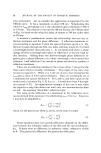
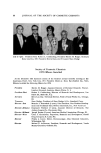
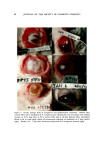
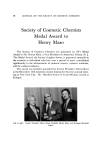
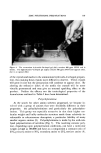
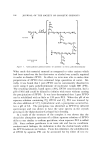
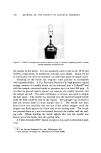
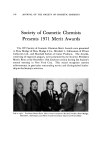
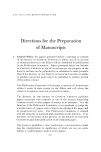
88 JOURNAL OF THE SOCIETY OF COSMETIC CHEMISTS LeJt to right: President-Elect Robert L. Goldemberg, President Martin M. Rieger, Secretary Betty Lou Day, 1971 President Morris Root, and Treasurer Shaw Mudge Society of Cosmetic Chemists 1972 Officers Installed At the December 13th luncheon session of the Society's annual scientific meeting at the Americana Hotel, New York City, 1971 President Morris J. Root, Barr-Stalfort Co., Niles, Illinois, installed the following Officers for 1972: President President-Elect Secretary Director--East Director--M idwest Director--Midwest Director--West Director Director Martin M. Rieger, Associate Director of Chemical Research, Warner- Lambert Research Institute, Morris Plains, N.J. Robert L. Goldemberg, Director of Research and Development, Van Dyk & Co., Belleville, N.J. Betty Lou Day, Technical Services, Polak's Frutal Works Inc., Chicago, Ill. Shaw Mudge, President of Shaw Mudge & Co., Stamford, Conn. Maurice L. Rosenthal (3 years), Vice President, New Product Develop- ment and Technical Sales, Robeco Chemicals, Inc., New York City Rosemarie Wallisch (3 years), Associate Director of Research, The Andrew Jergens Co., Cincinnati, Ohio Joseph Jerome (2 years), American Medical Association, Chicago, Ill. Chris A. Christensen, Supervisor, Research and Development, Rexall Drug Company, St. Louis, Mo. Phyllis J. carter, Editor, Chemmunique, Atlas Chemical Industries, Wilmington, Del. Maison G. deNavarre, President, Research and Development, Vanda Beauty Counsdor, Orlando, Fla.

]. Soc. Cosmet. Chem., 23, 89-97 (February 3, 1972) Induced Pseudomonas Keratitis as Related to Cosmetics F. N. MARZULLI, Ph.D.,* J. R. EVANS, M.S.,* and P. D. YODER, B.A.* Synopsis--The potential hazard to consumers from use of EYE-AREA COSMETICS contami- nated with PSEUDOMONAS AERUGINOSA was evaluated. The development of pseudo- monas KERATITIS in rabbit and monkey eyes could only be achieved consistently when or- ganisms were introduced into eyes whose corneal epithelium was not intact. Data are also presented which compare the effects of introducing viable organisms and ENDOTOXIN (a pscudomonas lipopolysaccharide) into CORNEA with those obtained on SCLERA and DERMIS by topical application and injecti,on techniques. The RABBIT EYE appears to be more sensitive to the virulent effects of P. aeruginosa than the MONKEY EYE. Finally, experimental results suggest that corneal destruction by P. aeruginosa results from the or- ganism's elaboration of a COLLAGENOLYTIC ENZYME, which may be activated in vivo during the infectire process. When endotoxin prepared from P. aeruginosa is injected into the cornea, it produces corneal changes resembling pseudomonas keratitis. The endotoxin also appears to be capable of stimulating the release of a collagenolytic enzyme. Further work is needed to establish the precise mechanisms of tissue destruction. INTRODUCTION Pseudomonas aeruginosa is an ubiquitous gram-negative, rod- shaped bacterium, which poses a serious threat to vision in the damaged or infected eye. Once the organism has established itself in the cornea, disease progresses rapidly, producing total corneal destruction and irre- versible visual loss in man within 24 to 96 hours (1-3). It is possible for this motile organism to enter the eye through the use of microbially contaminated eye-area cosmetics. If the cornea is not in- * Division of Toxicology, Bureau of Foods, Food and Drug Administration, U.S. Depart- merit of Health, Education, and Welfare, Washingtonl D.C. 20204. t Division of Microbiology, Bureau of Foods. Present address: Division of Drug Biol,ogy, Bureau of Drugs. 89
Purchased for the exclusive use of nofirst nolast (unknown)
From: SCC Media Library & Resource Center (library.scconline.org)