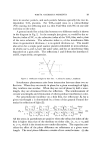
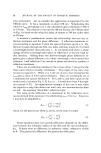
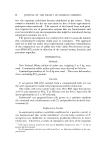
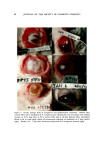
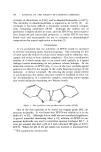
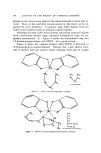
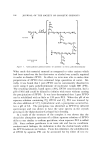
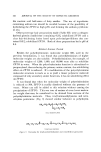
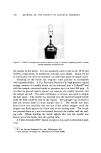
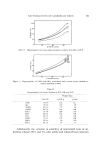
78 JOURNAL OF THE SOCIETY OF COSMETIC CHEMISTS haves optically like two platelets of TiO2, since the mica under most cir- cumstances makes little optical contribution. The thickness of the TiO2 layer determines the color of the nacreous pigment. A particle coated with a relatively thin layer of TiOe reflects bluish white. A slightly thicker TiOe layer reflects yellowish white. In- creasing thickness, so long as the thickness is uniform, produces reflections which are successively yellow, magenta, purple, blue, and green. A still greater thickness produces a second yellow, and so on. The colors are, of course, created by light interference. This paper will demonstrate that the reflectance and therefore the luster of white nacreous pigments are also interference phenomena. Figure 1 is a schematic diagram in cross section of TiOe-mica plate- Jets in a transparent film, such as a nail enamel film. For simplicity, the edges of the platelets are squared off, and bending ot5 light by refraction is omitted. The nacreous effect is derived primarily from the specular or mirrorlike reflection which is composed of light reflected simultaneously from many layers of platelets. Each TiOe layer acts like a transparent mirror which reflects a part and transmits the remainder of the incident light. Some light, which is reflected or scattered in random directions by platelet edges, imperfections in platelet surfaces, or disoriented platelets, gives rise to diffuse reflection. Visually, nacreous luster is high when specular reflection is high and diffuse reflection is low. Figure 1. Reflection o[ light by TiO2-coated mica platelcts. S, specular reflection D, diffuse reflection T, transmission Reflection from a Thin Film Each of the TiO2 layers in Fig. 1 is a thin film. These layers are all of the same thickness however, the thickness ot5 the mica platelet between the two TiOe films is uncontrolled. The optical contribution of the mica thickness in one particle therefore tends to cancel the contribution of the

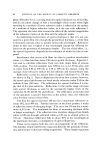
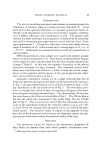
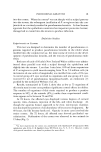
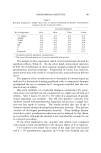
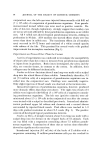
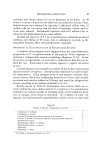
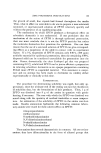
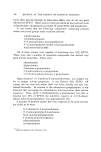
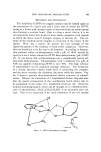
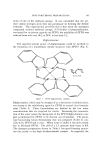
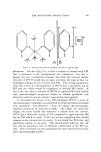
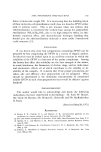
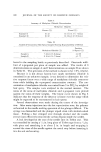
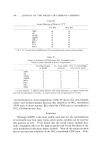
WHITE NACREOUS PIGMENTS 79 mica in another particle, and each particle behaves optically like two in- dependent TiO2 platelets. For TiOs-coated mica in a nitrocellulose (NC) coating, the reflecting unit is a thin TisO film with NC on one side and mica on the other. A general model for a thin film between two different media is shown in the diagram in Fig. 2. In the example just given, n0 would be the re- fractive index of NC, n• the refractive index of the TiO2 film, and ns that of the mica substrate. The refractive index n• of the interference film times its geometrical thickness, t, is its optical thickness n•t. The model also serves for a simple pearl essence platelet embedded in nitrocellulose, in which case no and ns have the same value, and for an interference film deposited on a glass slide. The reflections 1 and 2 from the interfaces I and II, respectively, are specular. n• Fdm Substrate Figure 2. Reflection of light by thin film. n, refractive index t, thickness Interference phenomena arise from interaction between these two re- flections. When they are exactly in phase for a given wavelength of light, they reinforce one another. When they are out of phase by half a wave- length, they are eliminated from the reflection. The reinforcement of certain wavelengths and elimination of others produce interference color. For perpendicular incidence on a thin film, the reflectance Rx for a given wavelength X is determined by a form of the general Fresnel for- mulas for reflection of light (2): cos (nx -- nO'•2(n• -- n•'• 2 _ 2[/n• -- no'•(n• -- n•) 4rn•t l+ + no/ + x,n + no/Xn + cos-- All the terms in parentheses are positive when the refractive index of the film is higher than that of the medium on either side, i.e., n• 2 no and n• n2, which is the situation now under discussion. The equation con- siders the effect of the phase difference on reflectance at a given wave- length. The total phase difference consists of two contributions: (a) the
Purchased for the exclusive use of nofirst nolast (unknown)
From: SCC Media Library & Resource Center (library.scconline.org)