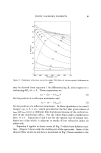
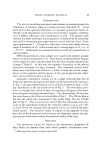
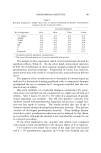
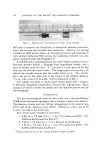
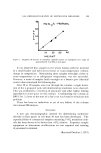
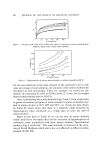
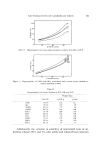
80 JOURNAL OF THE SOCIETY OF COSMETIC CHEMISTS phase difference 4•rnlt/X arising from the optical thickness nit of the film, and (b) the phase change of half a wavelength which occurs when light traveling in a medium of lower refractive index is reflected at the surface of a medium of higher refractive index, as is the case with reflection 1. The equation also takes into account the effect of the relative magnitudes of the refractive indices of the film and the adjacent media. An interesting characteristic of optical thickness is that it is not con- stant for a given film even though the geometrical thickness, t, of the film is obviously constant, since nl usually varies with wavelength. Refractive index in that case is higher at low wavelength (except for different be- havior in the proximity of absorption bands). The size of this effect, i.e., the optical dispersion, depends on the substance of which the film is com- posed. Interference also occurs with films too thin to produce interference colors, i.e., films less than about 190 nm in optical thickness. Equation 1 was used to calculate reflectance from very thin single films of anatase TiO2 on glass. For this example, no is 1.00 for air, n2 is 1.50 for glass, and nl varies from 2.86 at 400 nm to 2.49 at 700 nm for anatase, using the average of the refractive indices for the ordinary and extraordinary rays. Reflectance curves for anatase films of optical thickness 0 to 170 nm are shown in Fig. 3. Optical dispersion was taken into account however, the stated optical thicknesses are based on the refractive index 2.54 for the sodium D line (589 nm). The reflectance for optical thickness 0 is sim- ply that of the glass substrate. Reflectance in the visible range increases with optical thickness, as seen by the successively higher levels of the curves for 10, 20, 40, 60, 80, and 100 nm. The reflectance at the blue end of the spectrum is greater than that at the yellow thus, the reflection color for these curves is blue-white. The film for optical thickness 100 nm has a maximum reflectance at about 46% near 400 nm. Further increases in thickness produce a series of reflection curves of changing shape. The curve for 110 nm has a maxi- mum at 415 nm. The maximum for films of increasing thickness shifts to longer wavelength. The reflection color therefore changes from bluish white at 100 nm through yellowish white at 150 nm to whitish yellow at 170 nm. Maximum reflectance falls to about 40% as the wavelength of the maximum increases, a consequence of optical dispersion. These curves express both the color and magnitude of the reflection. The familiar simple interference equations describe the positions of max- ima and minima without providing magnitudes. These simple equations

WHITE NACKEOUS PIGMENTS 81 45- 40- 55- 50- 25- 20- 15- I0- •o ,½oo ,½.•o 5bo 53o 6bo c•o •o0 Wovelenqth (rim) Figure 3. Calculated reflectance curves for single TiO.films of various optical thicknesses on glass may be derived from equation 1 by differentiating Rx with respect to x and setting dRx/dx: O. These expressions are ntt= (2m-- 1)X ... /4 (2) for the position of a reflection maximum, and n½ = 1)Xm,/2 (3) for the position of a reflection minimum. In these equations rn is a small integer, e.g., 1, 2, 3, etc., which provides for the fact that given values of kmax and Xmin recur at different film thicknesses because of the cyclical na- ture of the interference effect. For the white films under consideration here, m is 1. Equations 2 and $ are for the special case of normal inci- dence on a film which is adjacent to media of low refractive index on either side. Equation 2 applies to those curves of Fig. 3 which have definite max- ima. (Figure 3 shows only the visible part of the spectrum. Some of the thinner films which do not have a maximum in Fig. 3 have maxima in the
Purchased for the exclusive use of nofirst nolast (unknown)
From: SCC Media Library & Resource Center (library.scconline.org)