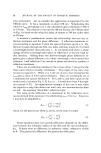
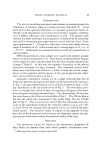
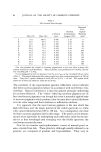
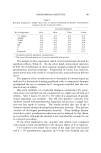
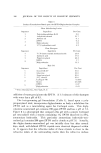
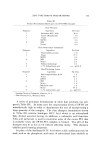
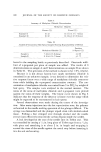
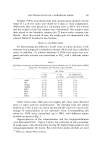
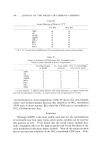
130 JOURNAL OF THE SOCIETY OF COSMETIC CHEMISTS Table III Sward Hardness of Films a at 75 øF 17% RH 24% RH AMP 66 64 AB 72 70 AEPD 66 66 AMPD 66 64 MEA 64 64 DEA 66 66 TEA 68 68 TIPA 64 66 3.8 X 10 -a cm dry films of VEM resin 90% neutralized with various amino alcohols. Table IV Clarity of Solutions of VEM Resin 90% Neutralized with Various Amino Alcohols at Room Temperature • 50% Total Solids 3% Total Solids 35%' 5% Total Solids in EtOH in EtOH 65%:12/11-35/65 AMP 0 0 0 AB 0 0 0 AEPD 0 0 0 AMPD 0 0 0 MEA 3 2 DEA 3 2 TEA 0 0 0 TIPA 0 0 0 • 0, clear solution 1, slightly cloudy solution with small separation 2, slightly cloudy solu- tion with no separation in 2 weeks 3, cloudy solution with no separation in 2 weeks. was determined at room temperature. Table IV shows that only ethanol- amine and diethanolamine decrease the solubility of 90% neutralized VEM resin in these systems. But when the VEM resin is neutralized to 65%, all solutions are clear. SUMMARY Although AMPD is the most widely used base for the neutralization of carboxylic-type hair spray resins, other amino alcohols can be used for this purpose as well. It was found that the tested amino alcohols have only a negligible effect on the hygroscopicity and Sward Hardness of the resin neutralized with these amino alcohols. Most of the amino alcohols do not decrease the solubility of the 90% neutralized VEM resin. If de-

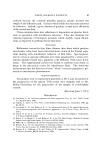
NEUTRALIZATION OF CARBOXYLIC RESIN 131 sired, the pH value can be adjusted by selecting from different amino alcohols, even at the same percentage of neutralization of the resin. (Received June 4, 1971) REFERENCES (I) Wcitz, P., Vinyl copolymer in the cosmetic cosmos, J. Soc. Cosmet. Chem., 11, 29'1 (1960). (2) Miccelli, A. L., Koehler, F. T., Polymer properties influencing curl retention at high humidity, Ibid., 19, 863 (1968). (3) Root, M. J., and Bohac, S., A new terpolymer for hair spray resin, Proc. Sci. Sect. Toilet Goods Ass., 42, 32-5 (Dec. 1964). (4) Bohac, S., and Root, M. J., Neutralized terpolymeric resin of vinyl pyrrolidone, alkyl acrylate or mcthacrylate and unsaturated monocarboxylic acid, U.S. Patent 3,405,084 (October 8, 1968). (5) Root, M. J., and Bohac, S., Hygoscopicity and hardness of hair spray resins at varying humidities, ]. Soc. Cosmet. Chem. 17, 595 (1966). (6) Bohac, S., Conductometric testing and corrosion study of nonanhydrous ethanol systems for hair spray, Ibid., 19, 149 (1968).
Purchased for the exclusive use of nofirst nolast (unknown)
From: SCC Media Library & Resource Center (library.scconline.org)