J. Soc. Cosmet. Chem., 23, 299-311 (May 23, 1972) Some Physical Aspects of Foam ROBERT LEMLICH, M.Ch.E., Ph.D., P.E.* Presented December 13, 1971, New York City Synopsis--The PHYSICAL STRUCTURE of FOAM is reviewed. Bubble size, shape, fit, and movement are discussed. Some methods for MEASURING liquid content and bubble size are considered. The difference between the true frequency distribution of sizes in the bulk foam and the apparent distribution at the containing wall is analyzed. Adsorption and its role in foam STABILITY are discussed. The two types of coalescence are reviewed, namely, that which results from surface tension driven gas diffusion between bubbles, and that which involves the rupture of bubble walls. Models for interstitial DRAINAGE of liquid are summarized. Finally, the phenomenon and technique of foam FRACTIONATION are reviewed, and the role of coalescence as reflux is examined. INTRODUCTION Foam is involved in cosmetics in two general ways. Firstly, in the chain of steps leading to an ultimate formulation, certain of the ingredi- ents or their precursors may foam. A number of substances are quite surface-active. Secondly, the actual use of a product may involve a foam. Examples of the latter include soap, shaving cream, shampoo, and bubble bath, as well as some depilatories, hair colorings, home permanents, foundations, rouges, creams, and leg makeup. Accordingly, the present paper will review certain physical considerations which are related to the manner in which foams behave or may be utilized. STRUCTURE A foam is a more or less persistent dispersion of a gas in a liquid that is, the liquid is the continuous phase. Thus, in a sense, a foam is the op- posite of a fog or aerosol. * Department of Chemical and Nuclear Engineering, University of Cincinnati, Cincin- nati, Ohio 45221. 299

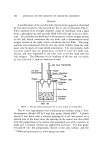
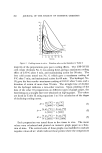
300 JOURNAL OF THE SOCIETY OF COSMETIC CHEMISTS Foams vary in their physical behavior. Wet foams, meaning foams of high liquid content, are likely to drain rapidly, unless the liquid vis- cosity is high. Similarly, wet foams are likely to be internally mobile. The high liquid content minimizes interbubble contact and packing, thus allowing movement (slippage) between bubbles. In the extreme case, when the liquid content is so high that the bubbles are completely spherical and mobile except for liquid viscosity effects, the dispersion is no longer a true foam but is rather a "gas emulsion" (1). If sufficiently stable, a wet foam will drain to become a dry foam, meaning a foam of low liquid content. In a dry foam, the bubbles press together to form blunted polyhedra. Interbubble slippage is then mini- mal. However, an increase in the degree of inhomogeneity in bubble size can shift the behavior of dry foam toward that of wet foam, especially in the matter of mobility. Small bubbles can fit among larger bubbles, thus diminishing the flattening of the bubble walls. This, in turn, re- duces the tendency to form polyhedra and, consequently, loosens the pack- ing and increases the mobility of the bubbles. Based on geometric considerations for close-packed spheres, bubbles of uniform size should be mobile when the liquid content of the foam exceeds 26% by volume. However, in practice, bubble mobility can oc- cur at substantially lower liquid fractions, chiefly because of actual in- homogeneity in bubble size. In a vertical glass column of rising foam produced by bubbling gas through a spinnerette submerged in a liquid pool at the bottom, bubble mobility in the foam was reported to begin at a superficial gas velocity of about 160 cm/min, corresponding to breaks in the plots of pressure drop and foam liquid carryover versus gas rate (2). When bubble mobility is absent, the foam ascends in plug flow by slipping readily along the glass walls (3). The bubbles themselves can be produced by sparging (bubbling gas through) a liquid pool, by the release of dissolved gas, by the chemical production of gas, or by mechanical means such as shaking or beating. The resulting bubble sizes depend on complex hydrodynamic factors. For foams generated by a high-speed mixer, the distribution of initial bubble sizes may be approximated by eq 1, 6 br• F(r,) = (1 q- br,2) 4 (1) where F(r•) is the frequency distribution function, re is the bubble radius, and b is the distribution parameter (4). Bubbling prehumidified nitro-
Purchased for the exclusive use of nofirst nolast (unknown)
From: SCC Media Library & Resource Center (library.scconline.org)