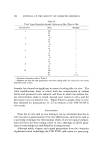
POLYAMIDE RESINS FOR HAIR 325 5 min and the tresses were then rinsed thoroughly, blotted to a moist condition with a towel, wound on curlers, and dried under a home-type dryer. To evaluate the durability of the improvement and shampoo resis- tance of the new conditioner, treated tresses were shampooed four times, each time with normal drying, and finally curled on standard curiers while wet. Comparator tresses were given identical treatments including the glycolate and bromate treatments, but with water only a,t the resin application step. Observers were asked to comment on coded samples of tresses. Resin-treated samples were readily identified by differences the observers described in terms of the stiffness or "springiness" of the treated tresses. Quantitative comparisons were made by wet curling five tresses that had been shampooed twice, combing them out after drying, and then measuring the curl length immediately and after exposure for 2 hours in a room at 75øF/75% RH. These data are summarized in Table I. Table I Effect of Conditioner on Curl Retention After 1 hr at After Combing 75 øF/75 % RH Control • 4•/• in. 7a/• in. Treated • 4•/• in. 6•/• in. "Average of five. An analytical procedure involving the determination of adipic acid by hydrolysis and gas chromatography made it possible to distinguish between polyamide conditioner and hair protein. By this method, the amount of conditioning resin on the hair after the original treatment and subsequent shampooings was accurately defined. Hair containing 0.18% resin after treatment still contained 0.16%, 0.15%, and 0.15% resin after 1, 2, and 4 shampoos, respectively. Thus, only a small amount of conditioner is lost after the first shampoo treatment and the balance is then retained. The initial loss may be due to unreacted conditioner not being thoroughly rinsed off or due to loss of conditioner bonded only by salt formation, not by the shampoo-resistant thioether linkages. Styling Lotion Resin The effects observed on curl or style retention, ease of combing, and improved body suggested use of the resin, or a similar polyamide, in a

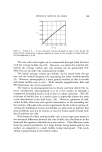
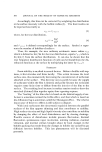
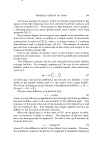
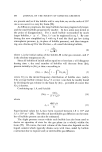
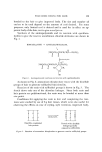
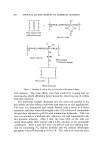
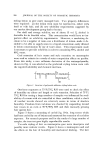
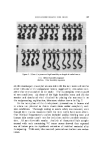
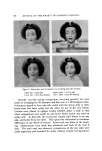
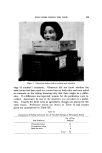
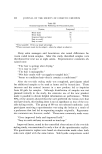
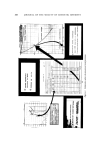
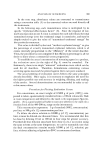
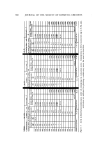
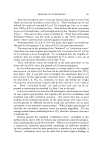
326 JOURNAL OF THE SOCIETY OF COSMETIC CHEMISTS styling lotion to give easily managed hair. Two property differences were required: (a) the lotion resin must be nonreactive, either withi itself or with hair, and (b) new solubility requirements suggested by our market development group had to be met. For shelf and storage stability, use of about 15 vol % alcohol is desirable for its biocidal value. This concentration would have no im- portant effect on solubility requirements. However, a marketing de- cision to be a supplier of resin--not a distributor of lotion--made it de- sirable to be able to supply resin in a liquid concentrate easily diluted to lotion concentration by use of water alone. This requirement made it necessary to provide solubility in solvent containing 40% alcohol and 60% water. Curl retention of hair tresses and style retention on mannequins were used as criteria in a study of resin composition effects on quality. From this study, a new sulfonate derivative of the aminopolyamide, shown in Fig. 4, was selected as the preferred styling lotion resin with the required solubility and chemical inertness. H• '• NHC (CH2)4 CNHCH2CH2N-- CH2CH2NH • [_ 0 0 CH2•HCH2SO0 'i x OH Figure 4. Structure of polyamide sulfonate styling lotion resin One-hour exposures at 75øF/75% RH were used to check the effect of humidity on either curl length or style retention. Selection of 75øF/ 75% RH for testing a large number of samples was influenced by avail- ability of a room with air controlled at these conditions, which a check of weather records showed are relatively severe in terms of absolute humidity. Freedom from tackiness was checked by suspending treated hair tresses in an oven at 90øF/90% RH and then manually pressing hair against hair. Figure 5 shows a mounting of curled 2-g, 10-in. long tresses which had been curled by use of lotions and measured for retention of curl after exposure. For research purposes and for the study of a large number of samples, the tress test gave highly reproducible results. Two-side styling of hair on mannequins gave more descriptive and possibly more realistic results. Figure 6 shows a mannequin used and the effects on the hair of humidity and mechanical shaking. The hair
Purchased for the exclusive use of nofirst nolast (unknown)
From: SCC Media Library & Resource Center (library.scconline.org)