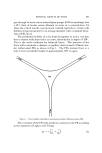
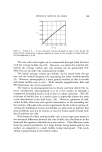
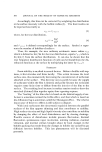
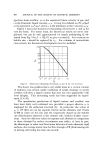
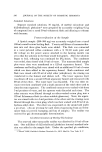
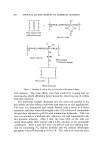
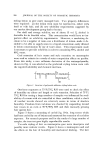
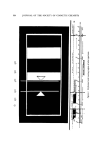
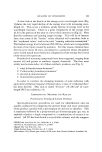
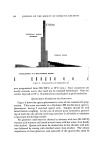
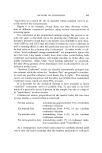
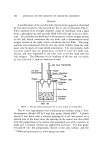
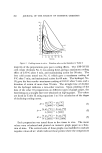
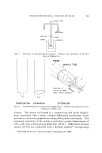
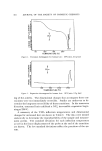
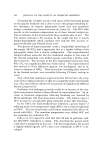
PHYSICAL ASPECTS OF FOAM 301 gen through an extra-coarse sintered-glass sparger (0.02-cm openings) into a 12-1. flask of bovine serum albumin in water at a concentration 3.6 times the critical micelle concentration resulted typically in a foam with bubbles of approximately 0.1-cm average diameter with a standard devia- tion of 0.05 cm (3). The polyhedral bubbles of a dry foam fit together in such a way that their common walls meet three at a time, theoretically at angles of 120 ø. This is the stable condition for balanced forces. The junction of the three walls constitutes a channel or capillary often termed a Plateau bor- der (abbreviated PB), as shown in Fig. 1. The PB's intersect four at a t•me to form tetrahedral angles of approximately 109 ø in space. ß Figure 1. Three bubble walls (fihns) intersecting to form a Plateau border (PB) The curvature of the PB walls produces a suction in the PB according to the equation of Laplace and Young, /1 1\ 6p =q, •} q-/•2) (2)

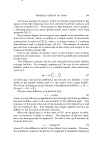
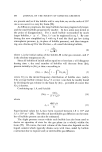
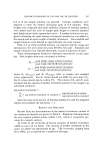
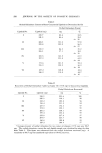
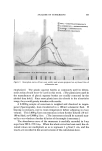
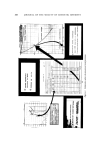
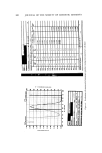
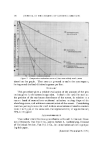
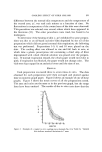
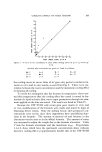
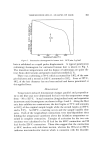
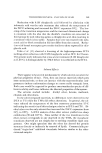
$02 JOURNAL OF THE SOCIETY OF COSMETIC CHEMISTS where ap is the pressure difference across the interface, •, is the surface tension, and R• and R2 are the radii of orthogonal curvatures of the inter- face. For a straight PB, R2: •o, so that ap -- -,//R•. This suction causes the capillaries to hold most of the liquid in the foam. It also pulls at the bubble walls, tending to draw them in where the walls are locally thicker (5). This results in some very complicated patterns of movement in the walls of draining foam bubbles (6). MEASUREMENT Movement in. a bubble wall often can be observed by the motion of the colored patterns that result from the mutual interference of light which is reflected off the two interfaces. The progression of successive colors, taken in reverse order, can be used to determine the wall (film) thickness at a given time (5). Upon thorough draining, the final color by daylight is silver-white. This corresponds to a film thickness of the order of 10 -5 cm. Bits of black film may then appear, corresponding to thicknesses of the order of 10 -6 cm. Being thinner, and therefore lighter in weight, the black film rises within the bubble face, subject to viscous drag. This drag stems chiefly from the surface viscosity, vs. Thus, by timing the rate at which such bits of black film rise within the surrounding thicker film, and by substituting in a two-dimensional analog for transverse drag around a cylinder, one can obtain a rough quantitative value for v8 in the bubble wall (5). For example, v8 for the nonionic surfactant Triton X-100 ©* in water was found to be 10 -4 dyne sec/cm (6). Of course, not all bubble walls are so mobile. Protein films, for instance, can be quite rigid. The average liquid content in a foam can be found simply and di- rectly by weighing the foam, or by measuring the volume after complete collapse. For local determinations in situ, the liquid fraction can be found from measurements of the electrical conductivity of the foam (3, 7-10). Figure 2 relates the volumetric fraction of liquid in the foam to the conductivity of the foam. The liquid fraction in a column of rising foam differs from that in the overflow from the top. For a very stable foam, theory (9, 11) predicts the former to be about twice the latter, as a result of interstitial drainage back down through the rising foam. However, experiments show an average of thrice, perhaps partly because of some coalescence at the over- flow bend which then increases the back drainage. The aforementioned theory will be discussed further later. * Rohm and Haas Co., Philadelphia, Pa.
Purchased for the exclusive use of nofirst nolast (unknown)
From: SCC Media Library & Resource Center (library.scconline.org)