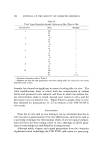
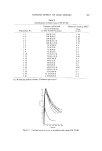
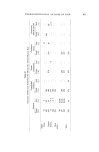
THERMOMECHANICAL ANALYSIS OF HAIR 369 Reduction with 0.1M thioglycolic acid followed by alkylation with iodoacetic acid was the only treatment that reduced the temperature of the 242øC softening and increased the 256øC expansion 59%. The low- ering of the transition temperature and the increased dimensional change is consistent with the idea that the disulfide crosslinks are converted to thiol groups by such reducing agents as thioglycolic acid, thus resulting in a structure which is less stable. Samples that were not reacted with iodo- acetic acid to block reoxidation did not differ from the control. Reduc- t:on with benzyl mercaptan gave results similar to those reported for thio- glycolic acid. Felix et al. (11) observed a lowering of the high-temperature DTA meltings after reduction with 0.3M thioglycolic acid at 50øC for 2 hours. The present study indicates that a less severe treatment (0.1M thioglycolic acid, 25øC) is distinguishable by TMA before it is reflected in the DTA. Solvent Effects There appear to be several mechanisms by which solvents can alter the physical properties of hair. First, they can extract materials which play some structural role, or they can interact with the macromolecular com- ponents to induce conformation changes to a more stable energetic form. Both cases would be expected to produce macromolecular species of dif- ferent stability and hence influence the thermal properties of the system. The solvents studied include: diethyl ether, hexane, methanol, ethanol, and chloroform. In the solvent-exposed materials, no differences were observed in the DTA or TG while the TMA did reflect alterations. In general, the sol- vents reduced the temperature of the first transverse penetration 15øC indicating the sensitivity of this technique relative to DTA and TG. Di-• ethyl ether was the only solvent that increased the 256øC expansion from 54% to 102%. A DTA analysis of the ether extract yielded two sharp, endotherms (36 and 142øC). Since neither of the two transitions in the. ether extra,ct corresponds to any observed in the TMA, the viscoelastic transitions observed are not simply due to melting crystalline lipid com- ponents. One might speculate that the ether has altered the protein structure directly or indirectly by removal of lipids. Commercially pur- chased "virgin hair" exhibited viscoelastic behavior similar to the ether- extracted samples.

370 JOURNAL OF THE SOCIETY OF COSMETIC CHEMISTS CONCLUSIONS Thermomechanical analysis ot5 hair complements other thermoana- lyrical techniques and in many situations TMA monitors temperature- dependent properties which are not sensed by gravimetric (TG) or en- thalpic (DTA, DSC) thermal analyzers. The reproducibility of the dis- tinct viscoelastic and dimensional transitions in hair is indicative ot5 the high degree ot5 macromolecular structure ot5 hair. Since TMA probes these structures, the technique and resulting information should be of use to those involved in hair chemistry. (Received February 23, 1972) REFERENCES (1) Encyclopedia of Polymer Science and Technology, Vol. 8, John Wiley & Sons, Inc., New York, 1968, p. 1-44. (2) Humphries, W. T., and Wildnauer, R. H., Thermomechanical analysis of stratum corneum Technique, J. Invest. Dermatol., 57, 32-7 (July 1971). (3) Humphries, W. T., .and Wildnauer, R. H., Thermomechanical analysis of stratum corneum Application, Ibid., 58• 9-13 (Jan. 1972). (4) Crighton, J. s., and Happy, F., Symposium on Fibrous Proteins, Butterworths, Australia, 1967, p. 409. (5) Menefee, E., and Yee, G., Thermally induced structural changes in wool, Text. Res. J., 35, 801 (1965). (6) Schwenker, R. F., and Dusenbury, J. H., Differential thermal analysis of protein fibers, Ibid., 30, 800 (1960). (7) Crighton, J. s., Finder, W. M., and Happy, F., Int. Wool Text. Res. Conf. (4th), Inter- science, New York, 1971, p. 847. (8) Reddie, R. N., and Nich.olls, C. H., Some reactions between wool and formaldehyde, Text. Res. J., 41, 841 (1971). (9) Reddie, R. N., and Nicholls, C. H., Absorption of formaldehyde by wool, Ibid., 41, 303 (1971). (10) Deem, D. E., and Rieger, M. M., Mechanical hysteresis of chemically modified hair, ]. Soc. Cosmet. Chem., 19, 410 (1968). (11) Felix, D. W., McDowall, M. A., and Eyring, H., The differential thermal analysis of nat- ural and modified wool and mohair, Text. Res. ]., 33, 465 (1963).
Purchased for the exclusive use of nofirst nolast (unknown)
From: SCC Media Library & Resource Center (library.scconline.org)