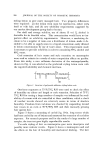
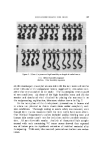
PHYSICAL ASPECTS OF FOAM 305 Activation energies of rupture, which are directly proportional to the square of the film thickness, have been derived by several workers, and critically examined (15). Fluctuations in film thickness, which produce a thinning process that grows spontaneously until rupture, have been proposed (16, 17). Once rupture begins, the hole grows very rapidly at an essentially con- stant linear velocity which, according to a simple model of momentum conservation, is equal tox/•y/tt•, where y is surface tension, t is uniform film thickness, and t• is liquid density (18, 19). The number of ruptures per unit time is thought to be kinetically of first order with respect to the number of bubbles present (20). Even in the absence of rupture, there is still another cause of foam instability and coalescence. It is the interbubble gas diffusion mentioned briefly above. This diffusion is pressure driven, and takes place from small bubbles to larger bubbles. For example, applying eq 2 to each of two spherical bubbles which are surrounded by a common liquid, and subtracting, yields eq 5, /Xpb = 2-r (• - /) (5, in which •xp, is the pressure difference between the two bubbles, r is the radius of the smaller bubble, and r' is the radius of the larger bubble. The factor of 2 appears in eq 5 because, with spherical bubbles, r = Rx __ R, and r' = The rate of gas diffusion, q, is given by eq 6, q = --JAbApo (6) where A • is the effective perpendicular area through which the gas diffuses between bubbles, and J is the permeability of the diffusion path. The resistance of this path is the sum of the resistances of the liquid layer and the two interfaces (21). The negative sign simply signifies that the gas diffuses in the direction of pressure decrease. When the liquid layer is of the order of 10 -4 cm or greater in thick- ness, its resistance is likely to control. The resistance of the two inter- faces can then generally be neglected. In such a case, eq 6 becomes e[ fectively Fick's law, q = --DA•Ap•/Ht (7) where D is the diffusivity and H is the Henry's law constant. However, the interfacial resistance should not be neglected if insoluble monolayers

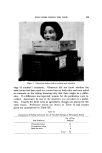
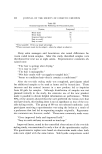
306 JOURNAL OF THE SOCIETY OF COSMETIC CHEMISTS are present and/or if the bubble wall is very thin, say on the order of 10 -5 cm as can occur in a very dry foam (20). As diffusion progresses, the large bubbles become progressively larger, and the small bubbles progressively smaller. In fact, some may shrink to the point of disappearance. For a small bubble surrounded by much larger bubbles, r 44 r'. Thus, 1/r' can be neglected in eq 5. By com- bining the now-simplified eq 5 with eq 6 and the ideal gas law (using atmospheric pressure, pa, in place of bubble pressure), and then integrat- ing, one obtains eq 8 for the lifetime, r, of a small shrinking bubble, r i2p a r -- 4q•JR T (8) where r• is the initial radius of the bubble, R is the gas constant, and T is the absolute temperature (4). Since all bubbles of initial radius equal to or less than ri will disappear during time •-, the total number of bubbles will decrease from (•n)0 present initially to (•n)vat time •- according to (Zn), = (2n)0 I1 - fr'F(ri)dri] (9) where F(r•) is the initial frequency distribution of bubble sizes (radii). The average bubble volume 4=ra,0a/3 at time •- can then be readily found by dividing the gas volume in the foam by (ln) , provided of course that F(r 0 is known. Combining eqs 1, 8, and 9 yields (Zn)0 (Zn)• = (1 + kay-) 3 (10) where 4RT?Jb ka - (11) Pa Experimental values for ka have been reported between 1.0 X 10 -a and 3.3 X l0 a sec -1 (20). The effect of interbubble gas diffusion on the num- ber of bubbles present can thus be estimated. The slight pressure excess within each bubble has also been used to derive an equation of state for the gas phase (as a whole) within the foam (22). Of course, the total volume of the foam also depends on the liquid content which typically drains away with time, aided by bubble coalescence due to rupture and/or interbubble gas diffusion.
Purchased for the exclusive use of nofirst nolast (unknown)
From: SCC Media Library & Resource Center (library.scconline.org)