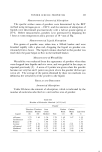
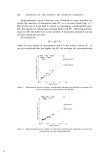
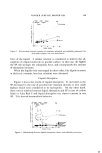
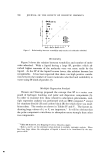
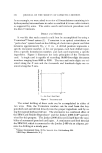
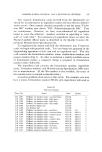
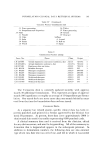
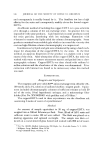
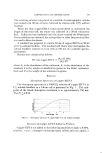
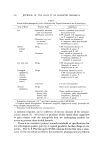
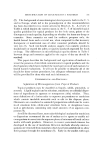
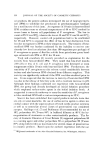
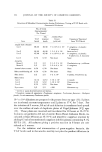
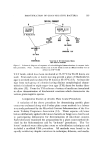
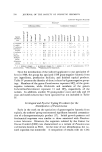
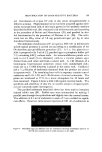
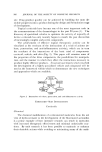
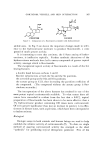
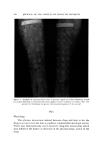
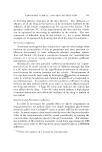
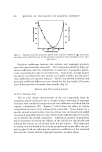
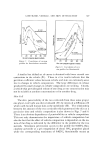
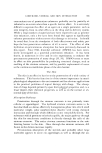
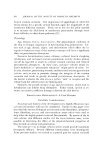
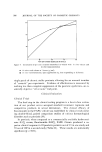
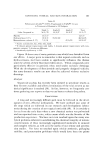
53O JOURNAL OF THE SOCIETY OF COSMETIC CHEMISTS I • (• Inethanoi • ß • ß n propanol i / VI acetone I • ß benzene I • • c¾clo.hexane /• ß n hexane Nu•er of Molecules •s•bed •x10'a/cm • ) Figure 5. Relationship between wettabilit¾ and number of molecules adsorbed Wettability Figure 5 shows the relation between wettability and number of mole- cules adsorbed. With a liquid having a large SP, powders which ad- sorbed higher amounts of the molecule were wet more easily by the liquid. As the SP of the liquid became lower, this relation became less recognizable. It has been reported that there was high positive correla- tion between the number of water molecules adsorbed and wettability to water using 20 kinds of powder (3). Multiple Regression Analysis Hansen and Skaarup proposed the concept that SP is a vector co•n- posed of hydrogen bonding, and polar and dispersion components (5). In order to examine how these related to adsorption phenomena, mul- tiple regression analysis was performed with an IBM computer,* except for titanium dioxide (B) and carbon black (B) for which there was insuf- ficient data. The results are shown in Tables IV and V. The factors in- dicating large values of to or Fo are important.* It will be obvious that the polar component contributes to adsorption more strongly than other two components. * IBM 360 Model 40, 2-12 Roppongi 3 Chome Miuatoku, Japan. * Both to and Fo are the statistical values defined in multiple regression analysis. When they have large values, the adsorption of liquids is found to be contributed by the com- popent of SP.

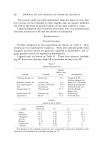
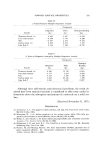
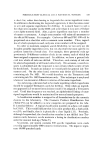
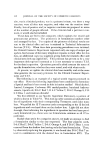
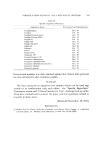
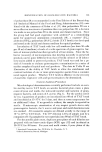
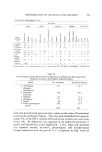
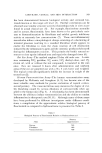
POWDER SURFACE PROPERTIES Table IV to Values Found by Multiple Regression Analysis 531 Component Dispersion Polar Hydrogen Bonding Powder (•D) (•v) (•H) Titanium dioxide (A) 0. 469 3. 967 -- 0. 092 Iron oxide hydrate --0. 418 1. 741 0. 288 Talc -- 0. 569 2. 276 -- 0. 433 Carbon black (A) 0.254 4. 511 1. 337 Lake Red C 0.156 1.960 --0.947 Table V Ratio in Dispersion Analysis by Multiple Regression Analysis Component Powder Hydrogen Dispersion Polar Bonding (&,) (&,) (•) Titanium dioxide (A) 0. 220 15. 738 0. 853 Iron oxide hydrate 0.175 3. 031 0. 083 Talc 0. 324 5.180 0.188 Carbon black (A) 0. 064 20. 346 1.788 Lake Red C 0. 024 3. 841 0. 897 Although there still remain some theoretical problems, the result ob- tained here from statistical analysis is considered to offer some useful in- formation about the adsorption mechanism of a molecule on a solid sur- face. (Received Nove•nber 11, 1971) REFERENCES (1) Zettlemoyer, A. C., The pigment-vehicle interface, Off. Dig., Fed. Paint Varn. Prod. Clubs, 29, 1238-71 (Dec. 1957). (2) Murayama, H., et al., Surface properties of the ternary system Al•Oa--TiO.,--SiOe pre- pared by the hydrolysis of metal alkoxides, Zairyo, 19 (201), 533-6 (1970). (3) Mitsui, T., and Takada, S., On factors influencing dispersibility and wettability of powder in water, ]. Soc. Cosmet. Chem., 20, 335-51 (1969). (4) Hildebrand, J. H., and Scott, R. L., The Solubility of Nonelectrolytes, 3rd Ed., Reinhold Publishing Corp., New York, 1950. (5) Hansen, M., and Skaarup, Klemen, The three dimensional solubility parameter-key to paint component affinities. III. Independent calculation of the parameter components, ]. Paint Technol., 39, 511-4 (1967).
Purchased for the exclusive use of nofirst nolast (unknown)
From: SCC Media Library & Resource Center (library.scconline.org)