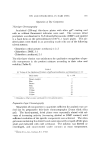
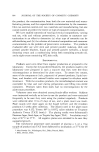
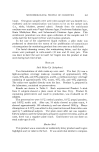
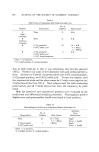
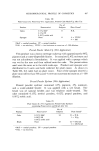
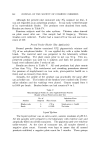
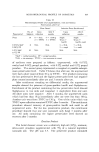
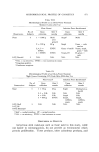
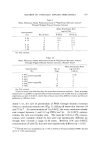
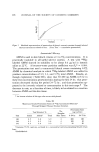
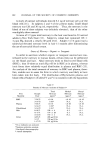
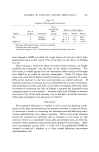
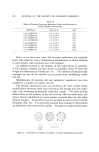
MICROBIOLOGICAL PROFILE OF COSMETICS Table VIII Microbiological Profile on an Oil-in-Water Nonionic Moisture Lotion after Use 871 Plate Count" Isolation From Enrichment" No. of Upon After 3 Upon After 3 Preservative Subjects collection months collection months None 6 I = 1000/g Mold over growth 2 -- 150/g 40/g 3, 4, 5 = TNTC TNTC 6 = TNTC TNTC 0.2% Dowicil 5 N.R. N.R. Staph b Mold Staph Gram -- rods sarcina Gram + bacilli Yeasts, staph, gram -- rods Yeasts, Ps c Ps, gram -- rods N.R. N.R. "N.R. = no recovery TNTC = too numerous to count. b Coagulase-positive. • Pseudomonas aeruginosa. Table IX Microbiological Profile of an Oil-in-Water Nonionic Night Cream Containing 10% Fresh Skim Milk after Use Preservative" Plate Count * Isolation From Enrichment • No. of Upon After 3 Upon After 3 Subjects collection months collection months None 0.2% MeP 0.1% PP 0.01% Bronopol 5 1 = 30/g 20/g Staph Mold, gram+ bacilli 2-3 = N.R. N.R. N.R. N.R. 4 = N.R. N.R. Staph N.R. 5 = 800/g TNTC Staph, Staph, coliform, coliform, yeasts yeasts 5 N.R. N.R. N.R. N.R. "MeP = methyl paraben PP = propyl paraben. * N.R. = no recovery TNTC = too numerous to count. DISCUSSION OF RESULTS Anhydrous stick make-ups such as those used in this sludy, while not hostile to microorganisms, do not provide an environment which permits proliferation. These products, other anhydrous products, and

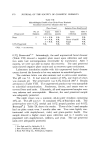
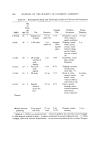
872 JOURNAL OF THE SOCIETY OF COSMETIC CHEMISTS those of low moisture content can be classified as products which are not microbiologically susceptible. There appears to be little danger of user contamination becoming a hazard, or of the user contamination causing undesirable odor or physical changes in such products. Preservatives, which do not function in such systems, may not be necessary for either product or consumer protection. Our results showed that the level of consumer contamination of these products was very low and innocuous. The same is essentially true of very low moisture pressed products which are applied dry, e.g., powder blushers, powder eyeshadows, face powder, pressed powder. Our experience has been that the consumer contamination of all types of pressed products and stick products is on the surface only. Products which are applied by wetting may support microbiological proliferation depending on composition and the conditions of use, that is, remaining wet. In these types of products, preservatives play a more useful role. Reasonable levels of personal hygiene by the consumer regarding sponges, brushes or other wet applicators would seem the best method of reducing the microbial load applied to the skin when these types of products are used. Because of the method of use of liquid eyeliner (small skin area and small brush), we observed a minimal contamination level by the user. This may explain why the product with marginal preservative levels of 0.075% methyl paraben and 0.04% propyl paraben protected the product during the study even though this type of unpreserved formula was microbiologically susceptible. Since this type of product has an extended consumer use life, a more optimum preservation level is indi- cated. We found coagulase-positive Staphylococcus in unpreserved units after use, lending importance to adequate preservation. Based on these laboratory preservative studies, the higher preservative level used in the liquid liner study should protect against gross consumer contamination and abuse for an extended period of time. It is interesting that heavy levels of contamination were not observed in our study as reported for used eye make-up products by Wilson (2). Emulsion products which are applied by scooping out the product with the fingers are exposed to a heavier inoculation. A greater variety of contaminants was found in these products and yeasts and fungi grew copiously in the unpreserved moisturizing lotion product. While it was demonstrated that despite heavy consumer inoculation, the emulsion products studied could be adequately preserved and appeared to be self-
Purchased for the exclusive use of nofirst nolast (unknown)
From: SCC Media Library & Resource Center (library.scconline.org)