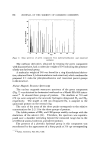
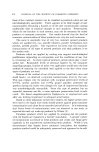
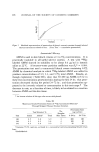
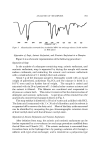
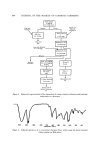
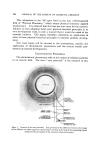
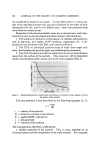
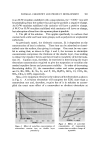
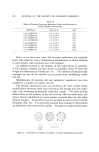
902 JOURNAL OF THE SOCIETY OF COSMETIC CHEMISTS be considered to consist of two parts' (a) the Stern layer (1) which con- sists of the adsorbed counter-ions and has a thickness in the order of ionic dimensions (few •_) and (b) the diffuse layer, where the potential drop away from the surface occurs. Properties of this electrical double layer are reviewed below and corre- lated to the day-to-day developmental observations in the laboratory. 1. The stability or resistance to flocculation of colloids, solid particles, such as pigments, iron oxides, O/W emulsions, suspensions, etc., is de- pendent on the thickness of the EDL and is determined by it. 2. The EDL on individual particles tends to make these repel each other, thus keeping the particles apart and stabilizing the suspension. 3. The electrical potential will eventually drop to zero at some distance away from the surface of the particle. This, however, will be dependent on the concentration of the counter-ions in the external phase (Fig. 3). ' •4b ..... x ....... 0 0,• 1•0 !•$ ,2•0 Z• Figure & Relationship be•een double layer potential ½ as a function of the distance X from the s•face of the particle The zeta potential is best described by the following equation (2, 3)' 4• •- DE • = velocity of the particle D = dielectric constant of the medium E = applied EMF, volts per cm • = zeta potential • = viscosity of the medium The zeta potential, therefore, is affected by' 1. Surface potential of the particle. This, in turn, depends on its chemical nature and the composition of the bulk solution. For example,

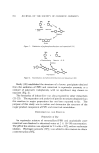
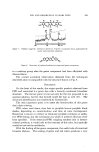
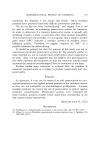
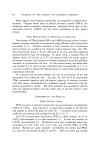
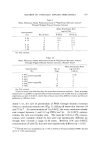
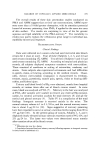
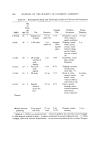
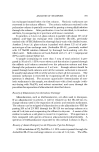
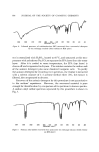
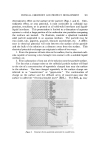
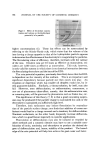
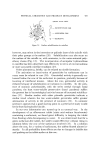
PHYSICAL CHEMISTRY AND PRODUCT DEVELOPMENT 903 in an O/W emulsion stabilized with a soap solution, the --COO- ions will be protruding from the surface thus giving the particle a negative charge. An O/W emulsion stabilized with cationics will have a positive charge. A W/O or O/W emulsion stabilized with nonionics will have no charge, but adsorption of ions from the aqueous phase is possible. 2. The pH of the solution. This applies specifically to surfaces that contain both acidic and basic ionic groups, such as polymers or amphoteric surfactants. As previously stated, the dielectric constant, D, is dependent on the concentration of ions in solution. These ions can be adsorbed or chemi- sorbed onto the surface, thus giving it a charge. One must be very care- ful in noting that, as shown in Figs. 4 and 5, the increase in electrolyte concentration compresses the thickness of the double layer, thus tending to reduce the repulsive forces and hence lead to instability of the formula- tion (4). Caution must, therefore, be exercised in determining the exact electrolyte concentration required to give the suspension or emulsion the needed repulsive forces and permanent stability. In order of decreasing flocculating ability (5), the monovalent cation and anion progressions are Cs, Rb, NH4, K, Na, Li, and F, IOa, H2PO4, BrOa, C1, C1Oa, Br, NOa, C10•, I, CNS, respectively. Also, a very important element is the valency of the electrolyte as shown in Fig. 6. A trivalent electrolyte will compress the EDL more than a monovalent one and, therefore, require less of it in solution to accom- plish the exact same effect of a monovalent or divalent electrolyte at Figure 4. Effect of mole/liter concentrations of monovalent counter ions on double layer potential •k . •' 25' .•' Fzgure 5. Effect of mole/liter concentration of monovalent counter ions on surface charge of a particle
Purchased for the exclusive use of nofirst nolast (unknown)
From: SCC Media Library & Resource Center (library.scconline.org)