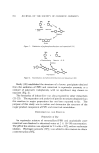
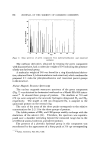
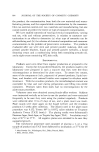
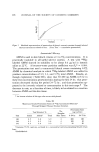
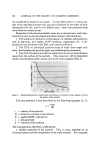
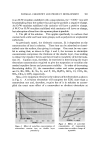
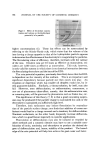
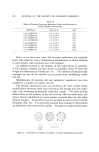
904 JOURNAL OF THE SOCIETY OF COSMETIC CHEMISTS Figure 6. Effect of electrolyte concen- tration and valency on the double layer potential • of a pa•icle t0 higher concentrations (6). These ion effects can be systematized by referring to the Schulz-Hardy rule, which states that the valence of the ions having a ch•ge opposite to that of the hydrophobic particle appears to determine the effectiveness of the electrolyte in coagulating the particles. The flocculating value of efficiency, therefore, increases with the valence of the ions. Div•ent ions are 10 times as effective as monov•ent tri- valent •e 1,000 times as effective as monov•ent. This rule, however, is only valid for systems in which there is no chemical interaction between the flocculating electrolyte and the ions of the EDL. The zeta potenti• equation, previously described, shows that the EDL is dependent on the viscosity of the medium. This is an important and significant dependency because particle size then comes into play. An emulsion or dispersion which has smiler oil droplets would not, by it- self, guarantee stability. Simil•ly, a viscous solution, by itself, may •so fail. However, once deflocculation, or sedimentation, commences, a new set of phenomena takes effect namely, that the sedimentation rate, or creaming rate, will be governed by phenomena such as Stokes law, etc. The significance of this theory (7, 8) is that a good nonc•ing suspen- sion may be produced if the particle charge is maintained low and/or the electrolyte is maintained at a su•ciently high level. Therefore, ionic surfactants may induce flocculation by neutraliza- tion of the particle surface charge one finds that addition of excess sur- factant would lead to a charge reversal and a tendency for deflocculation. Nonionic surfactants, on the other hand, •equently increase defloccula- tion, which is a good feature especi•ly in cosmetic applications. Flocculation or defiocculation may •so be induced or retarded by other methods and a cosmetic chemist may have to use a suitable com- bination of ionics, nonionics, and electrolytes to produce the desired de- gree of deflocculation and, hence, stab•ity of the product. The knowl- edge of the zeta potenti• will help him achieve his go• easier and faster.

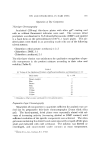
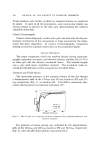
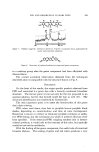
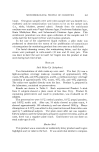
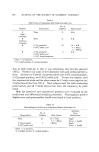
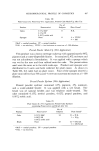
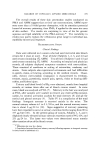
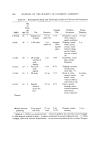
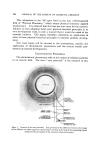
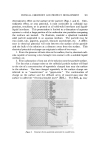
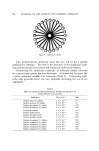
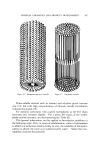
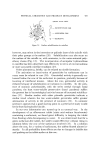
PHYSICAL CHEMISTRY AND PRODUCT DEVELOPMENT 905 Figure 7. Micelle structure CRITICAL MICELLE CONCENTRATION The critical micelie concentration (cmc) is that point or range at which the constitution of the surfactant solute changes from a disperse state to an equilibrium between molecules (or ions) and aggregates (mi- celies) (Fig. 7). Below this concentration, surfactant molecules are unas- sociated above it, almost all additional solute forms micelies. These micelles may comprise from tens to thousands of units and vary in shape from lamellar to spherical to "log boom" (Figs. 8-11). This change in solution character is reflected in a number of physical properties, many of which are important to the product development chemist. Some of the properties that show an abrupt change at the cmc include surface tension, interfacial tension, degree of foaming, conductivity, turbid- ity, refractive index, viscosity, flocculation rate, and solubilization. All of these changes have been used to determine cmc. Figure 8. Lameliar micelie
Purchased for the exclusive use of nofirst nolast (unknown)
From: SCC Media Library & Resource Center (library.scconline.org)