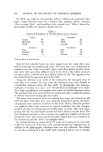
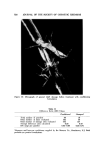
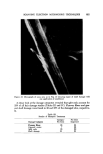
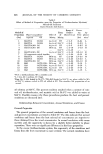
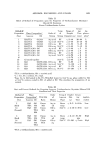
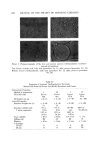
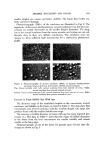
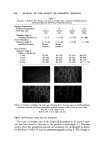
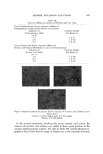
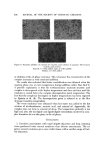
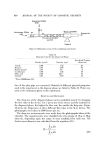
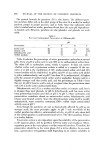
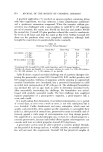
622 JOURNAL OF THE SOCIETY OF COSMETIC CHEMISTS Table IV Results of Conditioner Treatment Category Per Cent Damage Category Per Cent Improved Flyaway fibers from cuticle 28 94 Exposed cortex 8 93 Split ends 35 95 General shaft damage 26 92 Miscellaneous 3 80 This study demonstrates improvement of all damage types after treatment. For example, based on a minimum reduction of one damage point in our rat- ing system, over 90% of the damaged site improved after treatment with the hair conditioning formulation. In fact, the conditioner actually dosed 60% of the split ends (improved to zero column). The shampoo formulation tested improved all types of hair damage (Table III). This study not .only demon- strates improvement of damage sites but reveals the products' ability to repair different types of damages. SU1VI•ARY A systematic approach to evaluate hair care products using the SEM has been developed. The technioue, employing a rot. ating hair stage (RHS) al- lows for maximum rotational freedom of the hair in the SEM. The hair, while still attached to the scalp, may be removed and re-introduced into the SEM as often as necessary. The difference ratio (DR), a numerical system showing the degree of change, revealed significant improvement of damaged sites after treatment with a hair conditioner and shampoo. ACKNOWLEDGMENT The author is grateful to Dr. C. Garber, President of Structure Probe Inc., for his continuing efforts and suggestions. All micrographs shown were taken at Structure Probe Inc. ( Received January 29, 1973) REFERENCES (1) Fraser, R. D. B., and Rogers, G. E., Aust. ]. Biol. Sci., 8, 129 (1955). (2) Barnes, R. B., Burton, C. J., and Scott, R. G., Electron microscopical replica technique for the study of organic surfaces, J. Appl. Phys., 16, 730 (1945). (3) Wolfram, J. L., and Lindemann, M. K. O., Some observations on the hair cuticle, ]. Soc. Cosmet. Chem., 22, 839 (1971). (4) Swift, J. A., New developments in electron microscopy, Ibid., 22, 477 (1971). (5) Ayer, P. A., and Thompson, J. A., Scanning electron microscopy and other new approaches to hair spray evaluation, Ibid., 23, 617 (1972).

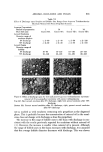
J. Soc. Cosmet. Chem., 24, 623-637 (September 16, 1973) The Relationship between Emulsions and Foams. Aerosol II. Aqueous Triethanolamine Myristate / Mineral Oil / Freon Propellant Systems PAUL A. SANDERS, Ph.D.* Synopsis-The purpose of this investigation was to determine the relationships between EMULSION cncentrates, AEROSOLS prepared from the concentrates, and FOAMS obtained from the aerosols. Two emulsion concentrates were prepared by 14 methods. Enmlsion quality was judged by PHOTOMICROGRAPHS and PHASE SEPARATION TIMES. Aerosols were prepared from the best and poorest emnlsions from each of the two concentrates by adding prope]lant. Concentrates with the smallest droplet size and the longest separation times produced the most stable aerosols. The most stable aerosols, in turn, gave the most stable foams with the least drainage and the smallest range of bubble sizes. The best cmu]sicn concentrates were obtained by adding aqueous triethanolamine at rozm temperature to the myristic acid-mineral oil solution at 54.4øC. A theory to ac- count for the efficiency of this procedure is proposed which involves the formation of a triethano]amine myristate/myristic acid complex during the initial addition of the aqueous phase. INTRODUCTION Cosmetic and pharmaceutical aerosol foam products are normally formu- lated as oil-in-water emulsions. When the product is discharged, the dispersed propellant droplets vaporize, creating the foam. There are two general types of aerosol oiLin-water emulsions. In the first, the propellant is essentially the only component of the dispersed organic phase (1, 2). The second involves concentrates which themselves are oil-in-water emulsions such as an emulsion of mineral oil in water. When the propellant is added to the emulsion con- centrate, it is assumed that the liquefied propellant droplets combine with the already dispersed oil droplets. * "Freon" Products Laboratory, E. I. du Pont de Nemours & Co., Inc., Wilmington, Del. 19898. 623
Purchased for the exclusive use of nofirst nolast (unknown)
From: SCC Media Library & Resource Center (library.scconline.org)