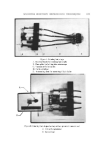
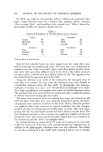
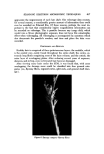
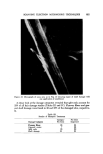
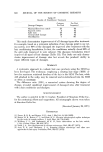
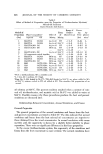
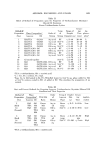
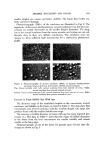
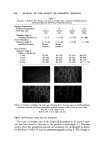
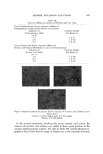
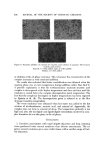
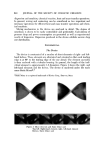
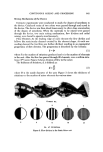
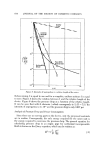
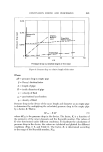
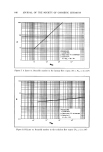
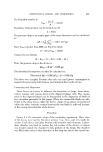
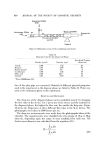
CONTINUOUS MIXING AND PROCESSING 641 Mixing Mechanisms of the Device Extensive experiments were conducted to study the degree of mixedness in the device. Catalyzed resins of two colors were passed through and cured in the device. The device was then sliced transversely to allow dose examination of the degree of mixedhess. When the materials to be mixed were passed through the device, two main mixing mechanisms, flow division and radial mixing, were found to operate simultaneously. Flow Division-At the leading edge of each element the flow divides and follows the semicircular channel created by the element shape. At each suc- ceeding element the two flows are further divided, resulting in an exponential progression of flow division. The progression is described by the formula: S=•." (1) where S is the number of sh'iations produced and n is the number of elements in the unit. After the floxv has passed through 20 elements, over a million stria- tions (2 "ø) exist. Figure 2 shows division of flow in the mixer. The thickness of sh'iations, d, is defined as: D d=9,- (2) where D is the inside diameter of the unit. Figure 3 shows the thickness of striations vs. the number of mixer elements for various sizes. E1 ement lto. 2 3 Z 4 8 4 5 !6 32 lto. of $trtattons Figure 2. Flow division in the Static Mixer unit

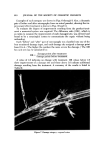
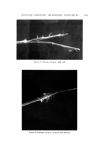
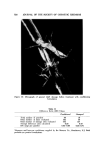
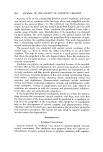
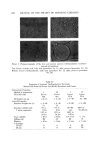
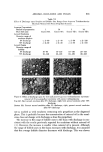
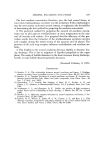
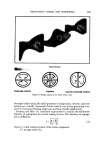
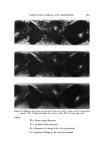
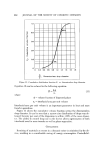
642 JOURNAL OF THE SOCIETY OF COSMETIC CHEMISTS 12 ' 10" ß • • I r• _ v,', lb,, 1" 2" 3" 4"•6" 0.01 ix O. 1 100• 0.1ram 1ram 10mm d, Striation thicknes• Figure 3. Striation thickness rs. number of Static Mixer elements For Iaminar mixing the degree of mixedness is related to the scale of in- vestigation, defined as that parameter of mix quality (in this case, strata thick- ness) beyond which additional mixing causes no distinguishable improvement or change in the quality of the product. If the scale of investigation is shown to be a 1-./• strata thickness, this degree of mixing can be predictably achieved according to Fig. 3 by utilizing the correct number of mixer ele- ments for a given mixer size. Radial Mixing-In either laminar or turbulent flow, rotational circulation of a processed material around the hydraulic center of each semicircular chan- nel causes radial mixing of the material, thus forcing the material from the diameter to the outer wall of the channel. At the same time, the flow reverses its rotation at each element junction due to the alternate right and left-hand alignment of the elements. It may be observed that the fluid rotation in a given element is opposite the rotational hand of that element. For example, in a right-hand element, each semicircular channel of the fluid contained within that element rotates counterclockwise. Figure 4 shows the rotation of flow in each element and at the interface of the two elements. The overall effect of radial mixing is to cause the stream to be continuously and com- pletely inverted radially so that particles entering at the center of the stream are forced to the outer wall and back again on a continuous basis. Because of
Purchased for the exclusive use of nofirst nolast (unknown)
From: SCC Media Library & Resource Center (library.scconline.org)