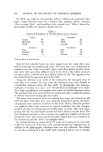
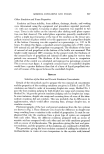
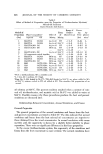
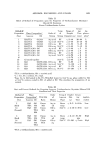
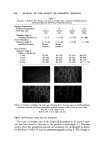
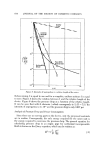
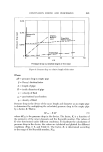
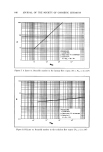
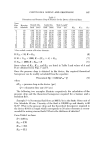
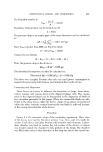
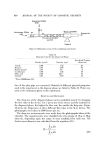
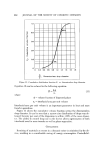
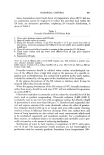
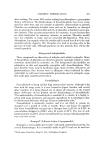
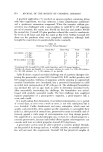
CONTINUOUS MIXING AND PROCESSING 647 Table I Dimensions and Pressure Drop K Factors for the Device of Several Sizes Noln. Pipe Size Housing Outside Dia. Inside Dia. Mod. Length • Schedule Inch (mm) Inch (mln) Feet (m) KoL K'o•, ro T 1/.• 40 0.84 21.34 0.62 15.75 0.51 0.16 6.00 0.075 1 40 1.32 33.53 1.05 26.67 0.90 0.27 5.79 0.069 I 80 1.32 33.53 0.96 24.38 0.85 0.26 5.57 0.062 2 40 2.38 60.45 2.07 52.58 1.71 0.52 5.70 0.068 2 80 2.38 60.45 1.94 49.28 1.67 0.51 5.54 0.062 4 40 4.50 114.30 4.03 102.36 3.37 1.03 5.08 0.058 4 80 4.50 114.30 3.83 97.28 3.18 0.97 5.16 0.060 10 40 10.75 273.05 10.02 254.51 7.79 2.37 5.07 0.060 12 40 12.75 323.85 11.94 303.28 9.66 2.94 4.88 0.056 40.7 36.3 31.4 35.1 31.6 26.9 28.2 27.8 24.8 One module consists of 6 mixer elements. If NRE 10, K = KoL If 10 Nm•: 2000, K = (K'oL X A) + Ko• If NR• 2000, K = Ko•, x B (6) (7) (s) Some values of Kote, K'oL, and Ko•, are listed in Table I and values of A and B are obtained from Figs. 7 and 8. Once the pressure drop is obtained in the device, the required theoretical horsepower can be readily calculated from the equation: Theoretical Hp = 0.262 AP,• ß Q (9) where AP•s•u = pressure drop in the device (psi) Q = volumetric flow rate (fta/sec) The following two examples illustrate respectively the calculation of the pressure drop and the theoretical horsepower required for a laminar and a turbulent flow. Example I-A NewtonJan fluid flows at 500 lb/hr in the Static Mixer unit of g-in. Schedule 40 size. Viscosity of the fluid is 100,000 cp and density is 60 lb/fl a . What is the pressure drop and the theoretical horsepower required in the device 6.84 ft in length which corresponds to 24 mixer elements as recom- mended for mixing viscous fluids? What is the thickness of striation? From Table I we have D = 2.07 in. KoL = 5.70 K'o• = 35.1 Ko•, = 35.1

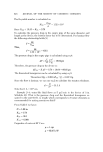
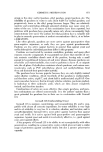
648 JOURNAL OF THE SOCIETY OF COSMETIC CHEMISTS The Reynolds number is calculated as: Nrta - Dvp _ 1.52 X 10 -2 Since Nn• 10, K = Kot, = 5.70 To calculate the pressure drop in the empty pipe of the same dia•neter and length as the device, the friction factor has to be determined. For laminar flow the following relationship holds ( 9 ) 64 rhus• 64 f = 1.52 x 10 -2 -- 4211 The pressure drop in the empty pipe is calculated using eq 4: L pt9 2 AP = f D 2 g• -- 10.64 psi Therefore, the pressure drop in the device is: APs•t = K AP = 5.70 x 10.64 = 60.65 psi The theoretical horsepower can be calculated by using eq 9. Theoretical Hp --- 0.262 APs.•r ' Q = 0.037 Since the flow is laminar, we can use eq 2 to calculate the striation thickness. D d - - 31.3 A Note that 1 A -- 10 -s cm. Example 2-A water-like fluid flows at 5 gal/min in the device of 1-in. Schedule 40. What is the pressure drop and the theoretical horsepower re- quired in the unit 0.9 ft. in length which corresponds to 6 mixer elements as recommended for mixing nonviscous fluid'? From Table I we have: D -- 1.05 in. Kon = 5.79 Kov ---- 36.3 K'on ---- 0.069 Properties of water at 20øC are: /• = 1 cps p = 62.4 lb/ft a
Purchased for the exclusive use of nofirst nolast (unknown)
From: SCC Media Library & Resource Center (library.scconline.org)