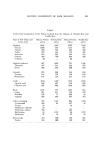
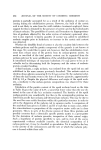
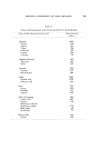
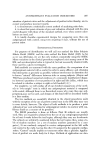
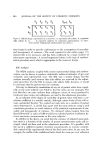
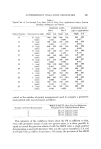
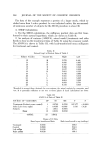
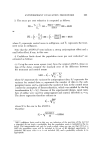
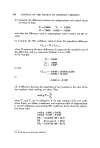
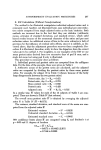
252 JOURNAL OF THE SOCIETY OF COSMETIC CHEMISTS protein is partially accounted for as a result of the oxidation of cystine oc- curring during the solubilization process. However, the bulk of the cysteic acid is not likely to arise from the mild oxidative treatment employed. Some support for this is obtained by the presence of cysteic acid in the hydrolyzates of intact melanin. The possibility of cysteic acid formation via disproportiona- tion of products effected by the redox system of melanin's quinonoid struc- ture is also rejected. A known quantity of cystinc was added to solubilized melanin samples prior to hydrolysis no increase in the cysteic acid content was detected. Whether the disulflde bond of cystinc is also the covalent link between the melanin polymer and the protein component of the granule is not known at this stage. We would like to point out, however, that the solubilization treat- ment does release some of the protein from its melano-protein moiety. As much as one-third of the total protein content can be separated from the melanin polymer by mere acidiflcation of the solubilized pigment. The recent- ly introduced technique of enzymatic hydrolysis (8) may prove to be an in- valuable tool in determining both the frequency and the nature of melanin- protein covalent bonding. A third melanin, a sepia melanin, was isolated from the squid ink sac and solubilized in the same manner previously described. This melanin exists as electron dense spheres measuring 0.1 to 0.3/zm across (9) the melanins isolat- ed from the hair keratin were in the form o[ discrete granules, approximately 0.35 by 1.0 ,/•. Despite the physical difference and origin of the squid mela- nin, a similarity in the melano-protein compositions was observed for these melanins. Calculation of the protein content of the squid melanin based on the data in Table II gave the value of 4.3%, a somewhat lower value than the one ob- tained in the case of the ha:r melanins examined. The basicity of the squid melano-protein was considerably less than in the corresponding proteins iso- lated from poodle hair melanin and Oriental hair melanin. This may be due to the need for more acidic functions within th'.'s particular structure in order to aid in the dispersion of the melanin ink in aqueous media. A comparison of the analytical data given in Tables I and II reveals that in many cases, either the concentrations or proportions of the respective amino acids are in close proximity. This is in sp'•te of the diverse sources of these three proteins and possibly connotes that a chemically specific protein matrix is a prerequisite for the formation of melanin granules, irrespective of their animal origin. Such a hypothesis of protein specificity is new, and in view of the scarce experimental evidence available (namely, the chemical composition of 3 melano-prote•ns), it may be classified as speculation. Yet it might be the key to the activity of the melanosomes and the rate at which the melanin poly- mer is formed within these cells.

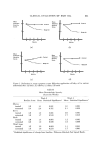
PROTEIN COMPONENT OF HAIR MELANIN 253 Table II Amino-Acid Composition of the Protein Isolated from Squid Melanin Type of Side Chain and Amino Acid Melano-Protein t•M/g Aliphatic 2669 Glycine 975 Alanine 461 Valine 352 Isoleucino 327 Leucine 526 /•-A]anine 28 Aliphatic Hydroxyl 462 T•hreonine 228 Serine 234 Aromatic 623 Tyrosine 237 Phenylalanine 386 Acidic 2002 Aspartic acid 1158 Glutamic acid 844 Basic 887 Lysine 240 Histidine 144 Arginine 503 Sulfur Containing 663 Cysteic acid 287 Taurine 163 Methionine sulfoxide ... Methionine sulfone 139 Half-cystine nil Methionine 74 Heterocyclic 400 Proline 400
Purchased for the exclusive use of nofirst nolast (unknown)
From: SCC Media Library & Resource Center (library.scconline.org)