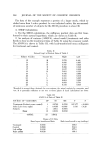
256 JOURNAL OF THE SOCIETY OF COSMETIC CHEMISTS workers appear to have been the first to introduce the concept of using a test material in one axilla of each subject while leaving the other untreated as a control. For a period of time before the initial use of the actual test materials, they made daily sweat collections from both axillae of each subject taking part in the test. They• then calculated pretest ratios (i.e., milligrams of sweat from "•: J 'V •' . the right axillae'2m•lhgrams of sweat from the left axillae) for each sub- ject. These pretest or control ratios were subsequently compared with posttest right/left ratios, the magnitude of the differences being taken as indicative of the degree of efficacy of the antiperspirant material under test. Fredell and Longfellow in 1958 (2) suggested standardization of some of the test condi- tions, but continued to use right/left ratios in the same way. However, meth- ods of calculation were not clearly defined, and although several pretest de- terminations were recommended, the number was not made explicit. Also in 1958, Daly (3) described a ratio method of calculation, but his procedur e was not clear. Laboratory protocols used by most workers today are similar to those de- scribed by these early workers, but the ratio which now appears to be univer- sal is that of milligrams of sweat from treated axilla per milligrams from control axilla, regardless of the side treated. The pretest ratio in this case, of course, would be that of milligrams yielded by the axilla destined to be treated per milligrams yielded in the opposite axilla. The method of adjust- ing posttest ratios with the pretest ratios has been described by Majors and Wi'id (4). The methods used by the older workers employing right/left ratios were not entirely clear. In the literature, we have been unable to find a description of the evolution of the modern axillar evaluation procedure using ratios, but protocols for tests of antiperspirant with contiol, as well as the computation and use of treated side/control side ratios, are discussed in the Majors and Wild paper (4). One of the authors (5) has described the analysis of gravimetric data col- lected in experiments resembling those discussed by Majors and Wild, but without the use of pretest ratios. In that paper, certain aspects of the popula- tion distributions of axillar milligram data were discussed, and a statistical model was proposed. Although the differences between that procedure and the ratio method do not seem to have artraced much attention, we believe it possible to show conclusively that that method is superior to the ratio method on the bases of statistical rigor, ease of correct computation, simplicity, and economy. The purposes of this paper are as follows: 1. to propose a standard method for comparing an antiperspirant with a control, which does not require the use of pretest ratios, and which will give statistically correct and unbiased estimates of per cent reduction and confi- dence intervals 2. to show that commonly used data analys•s methods, involving the deter-

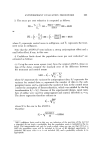
ANTIPERSPIRANT EVALUATION PROCEDURES 257 mination of pretest ratios and the adjustment of posttest ratios thereby, are in- correct and produce incorrect results 3. to demonstrate a statistically correct method of analyzing ratio data 4. to show that point estimates of per cent reduction obtained with the ratio model disagree with those of the standard method, even when correct calcu- lations are used and 5. tc briefly describe experimental designs for comparing more than one antiperspirant with control, using tests requiring 5 days, without the use of pretest ratios. EXPERIMENTAL •ROCEDURE For purposes of identification we will call our method the Sides Subiects Effects Model (SSEM) and the ratio method the Ratio Model (RM). As far as we can determine, we are the only workers consistently using the SSEM. Minor variations in the clinical procedures employed exist among users of the RM, and our description below is typical of, but not necessarily identical with, those used by a given investigator. Both methods are concerned with the same problem: the comparison of an antiperspirant material with a control in order to assess efficacy and obtaining this information as precisely as possible, without interference or distortion due to known "natural" differences between sides or among subiects (Maiors and Wild have produced numerical evidence of a commonly hypothesized dispar- ity between quantities of sweat produced in right and left axillae, which may be related to whether a subject is right or left handed (4)). •, For simplicity, we will confine all of our detailed comparisons of the meth- ods to "two-sample" tests in which one antiperspirant material is compared with control, although there is no theoretical reason why more than one anti- perspirar•l •!vay not be used, and designs of this kind will be described briefly in a later, section. The two methods are essentially identical in the clincal procedures used, with the exception of the use of pretest control runs in the RM they may vary in some details, however. The .object of both methods is to produce a point estimate of per cent reduction for antiperspirant relative to control, with con- fidence limits as a measure of its precision. The SSEM procedure is done as follows. First 36 subjects are usually used. They are required to abstain from the use of any antiperspirant product for at least 4 weeks before the test begins, although they may use deodorants. The subjects are arbitrarily numbered before the t,qst begins then, using a ta- ble of random numbers (or a set of random numbers generated by a com- puter), 18 are randomly assigned to receive antiperspirant in the left axilla and control in the right, leaving the other 18 assigned to the opposite configu- ration. "Control" usually implies no treatment rather than a placebo. Applica- tions of product are made daily for 4 days. Methods of application are stan-
Purchased for the exclusive use of nofirst nolast (unknown)
From: SCC Media Library & Resource Center (library.scconline.org)