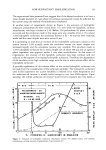
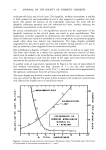
138 JOURNAL OF THE SOCIETY OF COSMETIC CHEMISTS have not been very successful. Aluminum chlorhydrate, the most widely used antiperspirant agent, tends to precipitate and become inactive in the presence of stearate soaps (6). Complex salts, such as sodium aluminum chlorhydroxylactate, can be used (6), but these are not as effective antiperspirants as the chlorhydrate (7). What is needed is a neutral oil-wax carrier which would suspend the aluminum chlorhydrate salt and which would provide adequate product deposition ("payoff "), pleasant tactile effects on application, and leave a dry, non-oily residue so that the antiperspirant salt can be activated by skin moisture and become effective. The introduction of volatile silicones provided an impetus for the development of these so-called suspensoid sticks. As the oil phase of the system, they soften the wax matrix, provide "slip" and payoff and, most importantly, they gradually evaporate from the skin after application, leaving a dry, non-oily residue which simulates the dryness of an aerosol antiperspirant. Suspensoid sticks are quite different from their predecessors and little has been published on their formulation details or on the effect of various materials on final stick properties. This paper presents the results of a study that was carried out on the formulation of antiperspirant sticks and describes various aspects of their casting, as well as the effect of additives on their ultimate physical properties. DISCUSSION I. PHASE RELATIONSHIPS A volatile silicone (cyclic dimethyl polysiloxane tetramet or pentamer) is the major component of suspensoid antiperspirant sticks. The wax matrix that is used with it should be compatible, cosmetically acceptable, and should have a low melting point to conserve the silicone during processing. Stearyl alcohol is the most widely used matrix and is preferred over stearic acid, for example, because of its lower melting point (58.5øC vs. 70øC). Likewise, the cyclic pentamer is preferred over the tetramer because of its higher boiling point (190-200øC vs. 171øC). Additives are often used with the stearyl alcohol to improve the aesthetic characteristics. Aluminum chlorhydrate powder is used as the antiperspirant agent, generally at a concentration of around 20%. Thus, present antiperspirant sticks have an overall formulation structure of approxi- mately: Volatile Silicone = 50% Stearyl Alcohol plus additives = 30% Aluminum Chlorhydrate = 20% We were interested in the many factors involved in making these sticks and in the effect of additives on their ultimate physical properties. We began our work with a study of the phase relationships between stearyl alcohol and cyclic pentamer. A. Freezing Point Curves Freezing points were obtained for a series of volatile silicone-stearyl alcohol mixtures using a dupont Differential Scanning Calorimeter. The mixtures were first heated to 65øC and then cooled to -70øC with liquid-to-solid transitions being recorded as the temperature dropped. The procedure was then reversed, i.e., the mixtures were heated

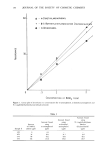
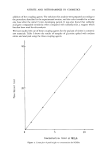
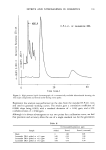
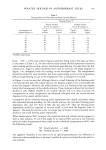
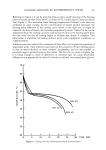
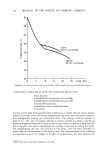
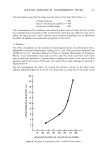
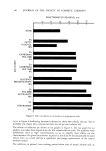
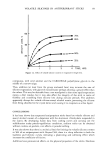
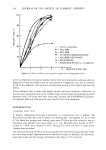
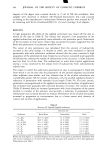
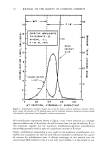
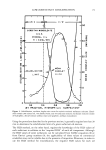
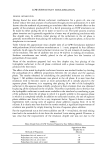
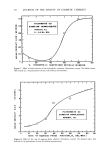
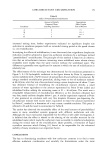
VOLATILE SILICONES IN ANTIPERSPIRANT STICKS 139 Table I Freezing Points of Volatile Silicone-Stearyl Alcohol Mixtures Freezing Points, øC Stearyl Alcohol (Curve A in Figure 1) Volatile Silicone (Curve B in Figure 1) Concentration of Liquid Solid to Liquid Solid to Volatile Silicone, % to Solid Liquid to Solid Liquid 0 58 61 - - 20 49 58 -49 -49 40 48 57 -49 -49 60 48 58 -44 -44 80 50 55 --48 --48 90 47 55 -44 -44 95 48 53 -47 -47 100 -- -- --66 • --43 'Probable supercooling. from --70øC d- 65øC, with solid-to-liquid transitions being noted. The data are listed in this order in Table I, i.e., the first column under stearyl alcohol represents transitions upon cooling and the second column, transitions upon heating. The data from the first columns (i.e., liquid to solid transitions) were used to construct the phase diagram in Figure 1 to correspond with the cooling curves developed later. The temperatures should be similar for each transition, but since supercooling occurs as the temperature falls and superheating occurs as the temperature rises, a divergence is normal. In Figure 1 it can be seen that, although there is a small lowering of the freezing point of stearyl alcohol with 20% volatile silicone, the liquidus (upper) curve is essentially fiat across the diagram. Likewise, the solidus (lower) curve is a horizontal line just slightly below the freezing point of the volatile silicone. These findings indicate that the stearyl alcohol is only slightly soluble in the volatile silicone and vice versa, and that the compositions at room temperature are saturated solutions with the excess silicone dispersed in the stearyl alcohol lattice. Comparison of the observed freezing point depressions with ideally calculated values also indicated limited solubility. At 20% volatile silicone, the calculated freezing point depression, ATf, was 2.5 ø. Even at 50%, ATf was only 6.5 ø. Thus the freezing point depressions would be expected to be very small, in line with the liquidus curve in Figure 1. The main factor here is the very large heat of fusion of stearyl alcohol which results in very small freezing point depressions. When heated above 58øC, however, the stearyl alcohol and volatile silicone appear to form a clear solution. To see if this might be an optical effect and not a true solution, refractive index measurements were made on the individual components at 60øC, with the following results: "60 Stearyl alcohol = 1.4380 %0 Volatile silicone = 1.3800 For apparent solubility in the melt to be an optical phenomenon, the difference in refractive indices would have to be much smaller it can be concluded that the melt is a true solution.
Purchased for the exclusive use of nofirst nolast (unknown)
From: SCC Media Library & Resource Center (library.scconline.org)