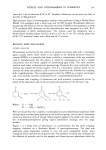
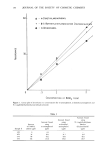
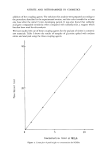
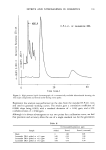
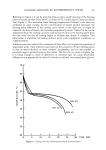
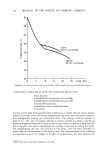
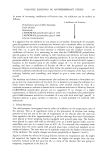
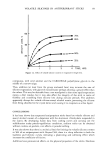
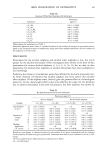
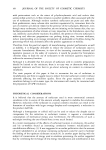
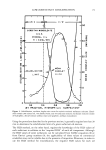
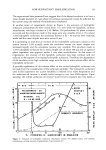
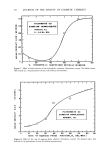
140 JOURNAL OF THE SOCIETY OF COSMETIC CHEMISTS 60 50 40 '• I 20 lO o -10 -20 -30 -40 VO LATI LE SILICONE 1 I .1 I I- I • _ I I I 100 10 20 30 LIQUID A LIQUID + SOLID ß SOLID I I 40 50 B I I I I 6O 7O 80 90 100 COMPOSITION, % STEARYL ALCOHOL Figure 1. Freezing points vs. composition for volatile silicone-stearyl alcohol mixtures. Finally, X-ray diffraction patterns were obtained on stearyl alcohol alone and in a 50/50 mixture with volatile silicone cast from a melt. These showed that the mixture contained crystalline stearyl alcohol, an amorphous material (presumably the volatile silicone) and a second crystalline substance that was not identified. All of these findings indicate that the stearyl alcohol and volatile silicone form a solution in the melt but a dispersion in the solid phase. Tin and silicon form a'similar system which is classified by the term monotectic (8), and this term could be applied equally as well to the volatile silicone-stearyl alcohol system. B. Cooling Curves In order to cast uniform sticks, it is necessary to have information on the fusion characteristics of these mixtures. Accordingly, cooling curves were developed first for 20, 50 and 75% volatile silicone (the balance being stearyl alcohol) and then for mixtures containing various additives. The data for the cooling curves are plotted in Figure 2. Individual points were omitted because of the proximity of the curves.

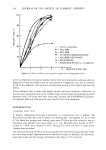
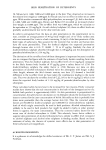
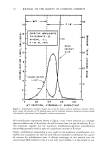
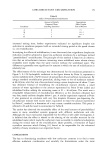
VOLATILE SILICONES IN ANTIPERSPIRANT STICKS 141 Referring to Figure 2, it can be seen that there is only a small lowering of the freezing point of stearyl alcohol (from 58.5øC to about 53øC), confirming the thermal analysis data (Figure 1). The somewhat lower freezing temperatures obtained in the latter are attributed to super cooling. As the concentration of stearyl alcohol decreases, the freezing point inflection in the cooling curve moves to the right and, as might be expected, the time of fusion, Atf, becomes progressively shorter. Values for Atf can be determined from the cooling curves by subtracting the time at the freezing point from the time when the rate of cooling begins to increase after fusion is complete. This information is important for casting uniform sticks under equilibrium conditions, as explained below. Additives were then selected for evaluation of their effect on the physical properties of suspensoid sticks. Their selection was based on the proximity of their melting points to that of stearyl alcohol, on their cosmetic acceptability, and on their present or potential usage in products now on the market. The list is by no means complete, but it is broad enough to show if differences in chemical type can cause discernable differences in properties of the sticks. It includes an alcohol, two polyethylene glycols, 60 55 5O 45 40- 35- 30, 0 75% VS 25% VS 50% VS I I I I I I 5 10 15 20 25 30 TIME, MIN. Figure 2. Cooling curves for volatile silicone-stearyl alcohol mixtures.
Purchased for the exclusive use of nofirst nolast (unknown)
From: SCC Media Library & Resource Center (library.scconline.org)