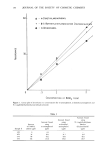
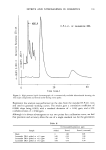
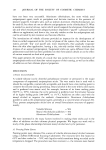
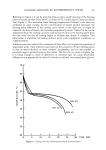
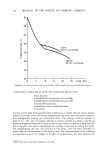
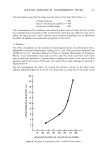
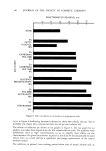
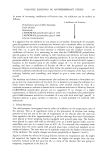
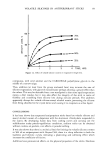
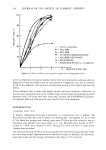
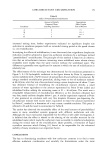
154 JOURNAL OF THE SOCIETY OF COSMETIC CHEMISTS 5O 4O 3O lO I I I 1 2 3 o = CETYL ALCOHOL ß = PEG 1540 ß = PEG 1000 • = CLYCEROL MONOSTEARATE [] = PEG 6000 DISTEARATE ß = STEARAMIDE •' = STANDARD STICK (i.e., no additive) I 4 HEATING TIME, HRS. Figure 13. Effect of additives on evaporative weight loss of antiperspirant sticks. seems to depend on the type of additive rather than its concentration, whereas lubricity depends on both the additive and its concentration. Evaporation rate was accelerated by all of the additives, with glycerol monostearate giving a little higher rate than the others. Those additives that co-fuse with stearyl alcohol and give hardness, coefficients of friction and evaporation rates in the middle ranges of the scales will probably give well balanced sticks. Of those that were tried, cetyl alcohol and CARBOWAX polyethy- lene glycols 1000 and 1540 were the ones that fell into these categories. EXPERIMENTAL I. FREEZING POINT DATA A dupont Differential Scanning Calorimeter in conjunction with a dupont 990 Recorder-Controller was used to obtain the thermal data. Atmosphere was air at 0.08 ft •/hr. Both the heating and cooling rates were 5øC/min and the reference was an aluminum pan. Sample size varied from 14-21 mg. Mixtures were heated to 65øC, ,-,-,,-,I,•1 t•, _70oc, then reheated to 65øC. All liquid to solid and solid to liquid phase changes were recorded. The value for the heat of fusion of stearyl alcohol was derived by taking the area under the curve from initial displacement from baseline to return to baseline. Six determina- tions were made and the average calculated as 66 cal/g or 17.8 k cal/mol.

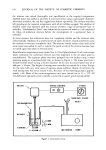
VOLATILE SILICONES IN ANTIPERSPIRANT STICKS 155 II. COOLING CURVES One hundred gram batches of the various stearyl alcohol-volatile silicone mixtures were melted in a glass beaker at 65øC (110øC for stearamide) and allowed to cool to room temperature at the rate of about 3øC/min to the initial freezing point. Temperatures were recorded at 1-min intervals with a 3-in immersion centigrade thermometer reading to 1 ø III. HARDNESS A Humboldt Universal Penetrometer reading to 0.1 mm was used for hardness measurements. ASTM D-1321-70 was followed using a 100-g load with a needle rest period of 5 sec. All sticks were conditioned to 70øF for 24 hr before taking measurements. Each formulation was made up twice and two sticks were cast from each. The sticks were divided into quadrants and measurements taken in the center of each quadrant and in the center of the stick. Reproducibility was well within the ASTM limits. IV. LUBRICITY A sliding friction tester was constructed of a 6" x 30" glass plate anchored to a plywood base. The glass plate was covered with holland cloth (a starch-impregnated linen). Sticks were drawn across the holland cloth by a Zeromax Model 2 constant speed motor under a 130-g load at a rate of 6 in/min. The force required to move the total weight (dead load plus weight of the stick) was measured with a Chatilion strain gauge indicating 2-g units. All sticks were conditioned at 70øF for 24 hr before testing. Tests were only run on freshly shaved surfaces. V. EVAPORATION TESTS Small (0.5 g) shavings of the sticks were placed in 50-ml weighing bottles equipped with ground glass stoppers. After the initial weight was determined on a Mettier H31 analytical balance, the bottles were placed in a petri dish, the stoppers removed, the dish covered with a raised glass plate to avoid excessive drafts, and the dish placed in a Precision Scientific forced draft oven at 40øC. At 1-hr intervals, the samples were withdrawn, sealed with the ground glass stoppers and cooled in a desiccator before weighing. After weighing, the samples were uncovered and returned to the oven for additional evaporative heating. These measurements were generally within _+ 0.9%. ACKNOWLEDGEMENTS The authors are indebted to R. L. Polhamus and L. G. Dowell for calorimeter and X-ray diffraction studies, respectively, and to V. A. Washington and H. Milley for assistance in carrying out the experimental work.
Purchased for the exclusive use of nofirst nolast (unknown)
From: SCC Media Library & Resource Center (library.scconline.org)