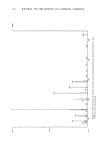
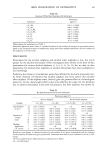
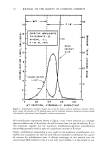
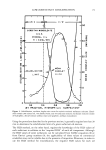
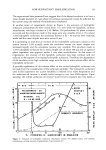
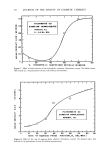
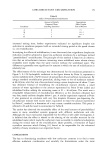
LOW-SURFACTANT EMULSIFICATION 171 The droplet size distributions of the emulsions were obtained by taking Polaroid pictures of the emulsions with an optical microscope through a calibrated scale. Arithmetic averages of droplet diameters were used as a measure of the fineness of emulsions. The photomicrographs were taken within 5 min after emulsification. All surfactants and oils used were commercial grades without further purification. The hydrocarbon used in most experiments was light mineral oil (Carnation © White Mineral Oil, Witco Chemical Corporation, Sonneborn Division, New York, NY 10017) N.F. grade with 65/75 Saybolt viscosity. RESULTS AND DISCUSSION SURFACTANT VARIATION A large number of surfactants including anionics, cationics, nonionics and their mixtures were employed in this series of experiments together with mineral oil and many other synthetic and natural oils commonly used in cosmetic formulation. Due to the space limitation, however, only some of the representative results will be shown to demonstrate the principle of application. Typical solubilization and emulsification data obtained for mixtures of hydrophilic- lipophilic nonionic surfactants are represented in Figure 2. The hydrophilic surfactant used for this experiment was polyoxyethylene (20) sorbitan monolaurate, which is a very common cosmetic surfactant commonly referred to as polysorbate-20 (Tween © 20, ICI Americas Inc., Wilmington, DE 19897). The lipophilic surfactant was sorbitan monolaurate (Span © 20, ICI Americas Inc., Wilmington, DE 19897). The abscissa of the graph represents the weight fraction of polysorbate-20 in the binary surfactant mixture. The solubilization limit in Figure 2 shows a maximum value corresponding to 0.45 weight fraction of the hydrophilic surfactant. The droplet size measurements of the emulsions made by varying surfactant mixture using the standard emulsification procedure described in the experimental section also indicated a formation of an emulsion with smallest mean droplet size at this point. Below 0.35 weight fraction of the hydrophilic surfactant, the emulsions obtained were W/O type as indicated both by sudden changes in electric conductivity and the viscosity of the emulsion. The point of phase inversion is shown by a vertical dashed line in the figure. The correspondence of the solubilization maximum and the point of optimum emulsification in terms of the fineness of emulsion droplet size is not accidenta.1 it is true in many emulsified systems tested using different types of surfactants and oil mixtures. Another example of the solubilization-emulsification relationship can be seen in Figure 3 in which combinations of hydrophilic, anionic, surfactant, dioctyl sodium sulfosuccinate (D.S.S.) (Solusol©--100%, Cosmetic Grade, American Cyanamid Co., Fine Chemical Department, Pearl River, NY 10965) and a relatively lipophilic, nonionic, surfactant, sorbitan monooleate (Arlacel © 80, ICI Americas Inc., Wilming- ton, DE 19897) were used in emulsification. The figure clearly shows that the range of surfactant combinations which gives greatest solubilization also approximately corre- sponds to the range which produces finest droplets upon emulsification.

172 JOURNAL OF THE SOCIETY OF COSMETIC CHEMISTS L i 5o • 14 -[ $ORSIT•N I•GNOLAUR•TE 5 -I ,=.,,o ,,,,,..,,,,,,,,,. / ] '" - I I[ SIZE /.• • $ OLIJBILI ZATlON LIMIT I z (:3 _1 0 0 0 0.2. (3. 4 o. 6 0.8 WT. FRACTION, HYDROPHILIC SURFACTANT _1 20,'• z IO Figure 2. Solubilization, emulsion droplet size curves for binary nonionic surfactant mixtures. (Emul- sions contain 20% mineral oil, 75% distilled water, and 5% surfactant mixtures. Surfactant mixtures consist of hydrophilic, polysorbate-20 and lipophilic, sorbitan monolaurate.) All emulsification experiments shown in Figure 2 and 3 were obtained at a constant aqueous addition rate of 40 ml/min. As will be shown later, the rate of addition, R, is a very important variable, but the maximum solubilization-optimum emulsification relationship generally holds in spite of a significant variation in R values. Clearly, solubilization relationship is very useful in low-surfactant emulsification, as it enables one to pinpoint the ratio of most efficient emulsifier combination for a given oil mixture for solubilization data. A definite advantage of this method over the conventional HLB method is that it is not only more reliable, it is also simple to use.
Purchased for the exclusive use of nofirst nolast (unknown)
From: SCC Media Library & Resource Center (library.scconline.org)