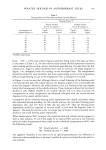
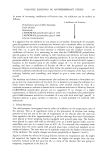
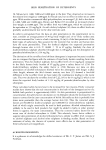
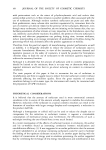
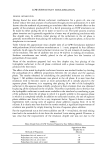
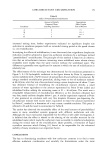
162 JOURNAL OF THE SOCIETY OF COSMETIC CHEMISTS Table V Rat Skin Penetration Of Nonionic Surfactants Penetration 0zg/cm 2) Variable n C•2 E3 n C•2 E 6 n C•2 E•o n C•5 E 3 Concentration 0.2 0.73 ___ 0.09(4) 0.77 ___ 0.06(3) 0.20 ___ 0.05(3) 4.18 4- 1.09(3) (% w/v) 0.5 1.90 4- 0.14(4) 3.16 4- 0.26(3) 0.51 4- 0.13(3) 6.19 4- 3.94(3) 1.0 4.38 4- 0.54(4) 4.89 q- 0.36(3) 0.85 q- 0.26(3) 14.06 q- 2.16(3) 2.0 n.d. 7.71 ñ 0.86(3) 1.89 ñ 0.30(3) 19.64 4- 2.48(3) Duration 1 3.1 4- 0.9(3) a 4.66 ñ 2.0(3) 0.87 4- 0.23(3) 2.13 4- 0.21(3) of Contact 5 4.3 ñ 0.3(3) a 4.32 4- 0.13(3) 1.23 4- 0.27(3) 7.94 q- 1.66(3) (min) 10 5.9 q- 1.4(3) a 6.48 q- 0.99(3) 1.05 4- 0.15(3) 8.30 4- 1.39(3) 20 8.4 4- 0.8(3) a 7.80 4- 1.18(3) 2.26 4- 0.45(3) 10.52 4- 0.93(3) Multiple 1 5.9 4- 1.4(4)• 5.34 4- 0.29(4) 0.96 4- 0.21(4)$ 4.19 4- 0.44(4) Application 2 n.d. 7.14 q- 0.69(4) 2.11 q- 0.16(4):• 5.60 4- 0.45(4) (X 5 mins) 4 10.4 ñ 1.5(4)$ø5 8.71 4- 0.44(4) 3.09 4- 0.19(4):• 7.19 4- 1.69(4) Results are mean figures q- standard deviation for the number of rats given in parenthesis and are corrected for the excretion of radioactivity given parenterally. Treatments were with 1% (w/v) surfactant in 1% (w/v) LAS, except a2% (w/v) and :•0.5% (w/v). •'--aqueous test solution without LAS. Abbreviations for surfactants as in Table 1. n.d.--not determined. the skin in hand-washing and home-usage studies (37). Thus, although alcohol ethoxylates are better able to penetrate through skin, their biological activity must be low to account for the lesser response of skin. Bettley (38) has proposed that skin irritation is a function of penetration and cellular toxicity. In a general review of the toxicological properties of surfactants, Gloxhuber (39) showed that in a variety of systems, a chain length of twelve carbons usually conferred greatest effectiveness. Longer chain lengths or a greater degree of ethoxylation reduced biological activity. In acute toxicity studies Gale and Scott (40) found a maximum effect in a homologous series of alcohol sulphates with dodecyl sulphate, but in chronic toxicity studies various investigators reported a lack of effect from alcohol sulphates, alcohol ether sulphates and alcohol ethoxylates (41). More specifically, in a 13 week feeding study in rats with dodecyl sulphate at 40, 200, 1000 and 5000 ppm, Walker et al. (42) reported an increased liver weight in female, but not male, rats at 5000 ppm, but no effect at 1000 ppm in males or females, a level which we calculate as 67 mg/kg/d. In our laboratory, a 13-week feeding trial in rats fed dodecyl sulphate at 0.07, 0.14, 0.28, 0.56, 1.13 and 2.25% in the diet, resulted in an increased liver weight and liver cell hypertrophy at 0.28% dodecyl sulphate and above. The no-effect level was 0.14% in the diet, equivalent to 116 mg/kg/d (Gellatly and Munday, unpublished). In an identical feeding study in rats with dodecyltriethoxy sulphate, Walker et al. (42) concluded that the no-effect level was 1000 ppm or 67 mg/kg/d. In both studies (42) the no-effect level is probably underestimated because of the dose interval of the detergents in the diet. Dodecyltriethoxy sulphate fed for 1 yr and 2 yr at 0.1 and 0.5% in the diet (43), caused no significant alteration in blood and urine analysis, nor any microscopic evidence of tissue damage (43). We calculate these dietary levels of dodecyltriethoxy sulphate to be equivalent to 50 and 250 mg/kg/d, respectively. For alcohol ethoxylates, Brown and Benke (37) reported a 13-week feeding study in rats of one commercial alkyl polyethoxylate, on average C•3E6, at 0, 5,

SKIN PENETRATION OF DETERGENTS 163 50, 500 and at 0, 1,000, 5,000 and 10,000 ppm in the diet. They observed an increase in the relative liver weight at 5,000 ppm for female rats, but no effect in either sex at 1,000 ppm. With another commercial alkyl polyethoxylate, on average C•4E 7 fed in the diet at 0, 1,000, 5,000 and 10,000 ppm, Brown and Benke (37) recorded an increased relative liver weight at 10,000 ppm. The no-effect level was 5,000 ppm, which we calculate to be equivalent to 335 mg/kg/d. As with dodecyl sulphate (42), these no-effect levels are probably underestimated due to the dose intervals used. In order to extrapolate from the data on skin penetration in the experimental rat to man, consider an average person of 70 kg body weight and 1.8 m 2 body surface area who was immersed for 5 min in a bath containing 1% (w/v) of the best penetrant of the three types of surfactants. Also assume for the moment that rat skin and human skin have the same permeability. Then for dodecyl sulphate the expected penetration through human skin is 0.26 X 18,000 + 70 or 67 /zg/kg. Similarly the dose of dodecyltriethoxy sulphate absorbed through skin is 100/zg/kg and the absorption for pentadecyltriethoxylate is 2.134 mg/kg. The derivation of the no-effect level of these detergents is important because it enables one to compare this figure with the estimate of total body burden resulting from skin penetration. Thus for dodecyl sulphate, the no-effect level of 116 mg/kg/d compared to the likely human body burden of 67 /zg/kg gives a safety factor of 1,730. For dodecyltriethoxy sulphate the safety factor is 2,500. Because our data on skin penetration of alcohol ethoxylates showed twice the absorption with longer n-alkyl chain length, whereas the 90-d chronic toxicity test data (37) showed a five-fold difference in the no-effect level, we have taken the combination leading to the worst case. Thus we calculate the no-effect level of C•3E 6 (37) to be 67 mg/kg/d, which is 30 times the expected body burden of 2.134 mg/kg of pentadecyltriethoxylate by skin absorption. These calculated safety factors have to be increased for two reasons. Firstly consumer studies have shown that the real concentration in the bath of the detergent active of a bubble bath product is approximately 0.01%. As skin penetration is proportional to concentration, the safety factor calculation on 1% detergent should be increased by 100 times to correct for the user concentration of 0.01%. Secondly rat skin is probably four times more permeable than the average human skin (24). Thus the corrected safety factors are 692,000 for dodecyl sulphate and 1,000,000 for dodecyltriethoxy sulphate, both of which might conceivably be used in bath products. Alcohol ethoxylates are unlikely to be used in bath products but might be added to baths in other product forms to approx. the same concentration. Thus the corrected safety factor for the worst case of alcohol ethoxylates is 12,000. This relatively lower factor reflects a superior skin penetration of alcohol ethoxylates but a similar no-effect level compared to alcohol sulphates and alcohol ether sulphates in feeding studies. Based on these estimates of safety, the chances of systemic toxic effects due to skin penetration of these surfactants are insignificant. ACKNOWLEDGEMENTS. It is a pleasure to acknowledge the skilled assistance of Mr. C. T. James and Mr. S.J. Fordham.
Purchased for the exclusive use of nofirst nolast (unknown)
From: SCC Media Library & Resource Center (library.scconline.org)