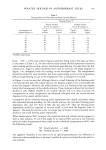
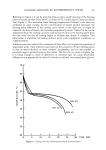
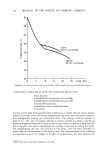
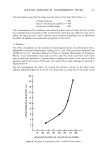
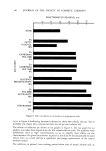
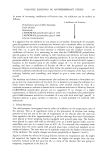
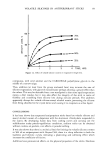
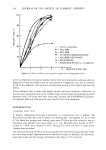
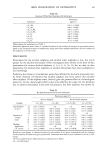
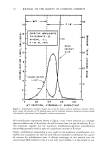
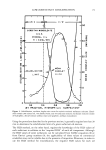
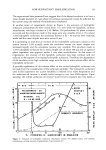
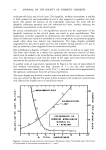
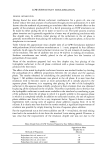
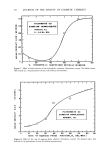
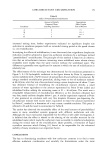
LOW-SURFACTANT EMULSIFICATION 179 Table II Effect of Presolubilized Emulsification Emulsions Amount of Initially Approximate Dispersed Water Mean Droplet (ml/100 g Emulsion) Size in Microns A 0 7.5 B 2 0.5- C 3 O.5- D 6 200 increased mixing time further experiments indicated no significant droplet size reduction in emulsions prepared with an extended mixing period at the speed chosen for the emulsification. In studying the effects of solubilization, it was discovered that a significant droplet size reduction could be achieved in many low-surfactant emulsions by a technique termed "presolubilized" emulsification. The principle of this method is based on an observa- tion that an oil-surfactant mixture containing some solubilized water almost always emulsifies more readily than the same mixture without the solubilized water. The difference is generally more significant for systems in which the rate of solubilization is relatively low. The effectiveness of this technique was demonstrated for the emulsions presented in Figure 5. A 2.5% hydrophilic surfactant in the figure shown by Point A, represents a system stabilized with a 50/50 mixture of polysorbate-20 and sorbitan monolaurate. By using a standard emulsification procedure, adding water to the oil-surfactant mixture at 40 ml/min, a fair but not a fine emulsion having a mean droplet size of about 7.5/am was obtained. Instead of emulsifying the oil-surfactant mixture directly, a small amount of water equivalent to the amount represented by Point B was added and solubilized before adding the remaining water at R = 40 ml/min. The result was a remarkable enhancement of emulsification efficiency as the emulsion obtained had very fine, nearly uniform droplets below 1/am. A similar experiment repeated at Point C also produced an emulsion with very fine droplets. However pre-dispersing the oil-surfactant mixture with excess water, equivalent to twice the amount represented by Point C, resulted in a formation of a very coarse, unstable emulsion. This point is referred to D and the result is summarized in Table II. The author has observed the remarkable effect of the small amount of presolubilized water in many emulsified systems prepared with different surfactants and oils. Although the exact mechanism responsible for the effect is still under investigation, it is believed that the effect is related to the altering of the miceliar structure by the solubilized water which made the surfactant more accessible to interfacial adsorption during the critical state of the emulsification. Quite possibly, a formation of liquid crystalline structure which Friberg (11) found to be responsible for the enhanced stability of many emulsions is an important factor. CONCLUSION The key to formulating emulsions with low surfactant contents is to find a more effective surfactant combination and emulsify the formulations under the most

180 JOURNAL OF THE SOCIETY OF COSMETIC CHEMISTS favorable conditions. The solubilization technique presented here is believed to be very useful in finding such a combination as well as in designing a most effective processing method. Naturally there are other factors not discussed here which must be considered in finding the most favorable process conditions. For example, in determining the emulsification temperature for emulsions stabilized with nonionic surfactants, consid- eration of PIT (phase inversion temperature) suggested by Shinoda may be also very important (12). However the proposed solubilization technique adds another dimen- sion which will facilitate finding an optimum process condition and allow the formulator to substantially reduce the level of surfactant concentration. It should be noted that the method suggested here is particularly useful for reducing the surfactant contents in practical emulsions without an adverse increase in the mean droplet size. Naturally, maintaining the mean droplet size would not, in itself, guarantee maintaining the stability of the emulsion. Since commercial emulsions are complex mixtures of many raw materials, it would be advisable to conduct the usual long-range stability tests when any part of the formulation is altered. ACKNOWLEDGEMENT The author gratefully acknowledges the experimental assistance of Lily Lin, Ken Lin and Ted Lin. REFERENCES (1) D. L. Wedderburn, Preservation of emulsions against microbial attack in "Advances in Pharmaceuti- cal Sciences 1," H. S. Bean, A. H. Beckerr, J. E. Carless, Eds., Academic Press: New York, 1964 pp 195-268. (2) M. G. deNavarre, Preservation in "The Chemistry and Manufacture of Cosmetics," 2nd ed., D. Van Nostrand: New York, 1962 Vol. 1, pp 257-298. (3) T.J. Lin, H. Kurihara and H. Ohta, Effect of phase inversion and surfactant location on the formation of o/w emulsions,J. Soc. Cosmet. Chem., 26, 121-139 (1975). (4) T.J. Lin, H. Kurihara and H. Ohta, Prediction of optimum o/w emulsification via solubilization measurements,J. Soc. Cosmet. Chem., 28, 457-479 (1977). (5) T.J. Lin, Low-energy emulsification I principles and applications, J. Soc. Cosmet. Chem., 29, 117-125 (1978). (6) T. j. Lin, T. Akabori, S. Tanaka and K. Shimura, "Low-energy emulsification II evaluation of emulsion quality," presented at Society of Cosmetic Chemists Annual Scientific Meeting, December 1977, New York. (7) T.j. Lin, unpublished data. (8) W. C. Griffin, Classification of surface-active agents by HLB,J. Soc. Cosmet. Chem., 1,311-326 (1949). (9) P. Sherman, "Emulsion Science," Academic Press: London, 1968 pp 140-153. (10) P. Becher, "Emulsions: Theory and Practice," 2nd ed., Reinhold Publishing Corp.: New York, 1966 pp 267-278. (11) S. Friberg, P. L. Jansson and E. Cederberg, Surfactant association structure and emulsion stability,J. Colloid Interface Sci., 55, pp 614-623 (1976). (12) K. Shinoda, The correlation between the dissolution state of nonionic surfactant and tke type of dispersion stabilized with the surfactants,J. Colloid Interface Sci., 24, pp 4-9 (1%7).
Purchased for the exclusive use of nofirst nolast (unknown)
From: SCC Media Library & Resource Center (library.scconline.org)