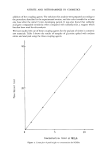
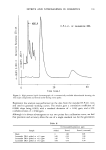
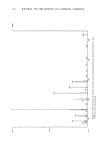
NITRITE AND NITROSAMINES IN COSMETICS 135 of a day-to-day working curve using the y intercept as zero. NDE1A levels can then be calculated using this standard curve. As with any chromatographic determination, there is always the possibility of a coeluting peak. This possibility was checked by collecting the area containing the suspected NDE1A peaks and re-injecting into the H.P.L.C. The collected area was further resolved with no additional peak being observed. The NDEIA peak was gaussian in distribution. In order to determine if NDE1A was being formed during sample preparation, an alkanolamide sample containing a known amount of NDE1A was spiked with 100 ppm of sodium nitrite. No increase in NDE1A level was seen when re-injected into the H.P.L.C. The sample was then spiked with 100 ppm of sodium nitrite and an excess of diethanolamine. Upon re-injection of this sample into the H.P.L.C., no increase in the NDE1A level was seen. Finally, the pH of the alkanolamide aqueous methanol/water solution was 10.9. At this pH, the formation of NDE1A should be extremely slow, if at all. Qualitative identification of NDE1A has been accomplished on finished products containing this cosmetic raw material. A shampoo formulated with an alkanolamide was diluted in aqueous methanol/water and, using H.P.L.C., an area collection was made. The collected area was evaporated, silylated and NDE1A was identified by G.C.-flame ionization. A G.C.-M.S. or G.C.-E.C. quantitative method using this procedure is being pursued and should be able to detect NDEIA in the low ppb In conclusion, our approach to nonvolatile nitrosamine analysis in cosmetic raw material and finished product matrices has been to utilize H.P.L.C. separation and collection followed by qualitative and quantitative ancillary techniques. This metho- dology should eliminate or minimize sample preparation and extraction/concentration steps, which can be very difficult and time-consuming to perform on the many varied cosmetic matrices. REFERENCES (1) N-nitroso compounds analysis and formation, "IARC Scientific Publication No. 14," International Agency for Research on Cancer: Lyon, France, 1972. (2) N-nitroso compounds in the environment, "IARC Scientific Publication No. 9," International Agency for Research on Cancer: Lyon, France, 1974. (3) Environmental aspects of N-nitroso compounds, "IARC Scientific Publication No. 19," International Agency for Research on Cancer: Lyon, France, 1978. (4) P. Griess, Ber., 12,426 (1879). (5) J. H. Wiersma, 2, 3-Diaminonaphthalene as a spectrophotometric and fluorometric reagent for the determination of nitrite ion, Analytical Letters, 3, (3), 123-132 (1970). (6) T. Y. Fan, J. Morrison, D. P. Rounbehler, R. Ross, and D. H. Fine, N-nitroso-diethanolamine in synthetic cutting fluids: a part-per-hundred impurity, Science, 196, 70 (1977). (7) I. Schmaltz, S. Abidi and D. Hoffman, Tumorigenic agents in unburned processed tobacco: N-nitrosodiethanolamine and 1, l-dimethylhydrazine, Cancer Letters, 2, 125-132 (1977). (8) T. Y. Fan, U. Goff, L. Song, D. H. Fine, G. P. Arsenault and K. Breman, N-nitrosodiethanolamine in cosmetics, lotions, and shampoos, Food Cosmet. ToxicoL, 15,423-430 (1977). (9) Private communication with the Mid-West Research Institute, Kansas City, Missouri.

j. Soc. Cosmet. Chem., 30, 137-156 (May/June 1979) Volatile silicones in suspensoid antiperspirant sticks R.J. SCOTT and M. E. TURNEY, Union Carbide Corporation, Tarrytown Technical Center, Tarrytown, NY 10591. Received December 6, 1978. Synopsis A phase diagram study of a VOLATILE SILICONE-stearyl alcohol system showed that stearyl alcohol is only slightly soluble in volatile silicone, and vice versa, and that the system at room temperature consists of a saturated solution with excess silicone dispersed in the stearyl alcohol lattice. It was found that additives, which are frequently used with these sticks, have pronounced effects on their physical properties. It is postulated that those additives, which co-fuse with stearyl alcohol and give hardness, coefficients of friction and evaporation rates in the middle ranges of the respective scales, would probably yield the best balanced STICKS. INTRODUCTION The cosmetic stick is one of the oldest systems known for delivering dyes, pigments, emollients, deodorants, astringents and numerous other beneficiating (and some not-so-beneficiating) agents to the human body. Even Neanderthal man may have used them, and stick cosmetics have been found in Egyptian tombs (1). As long ago as the first century A.D., the basic combination of oils, waxes and pigments had been developed (2), and many products are not much different today. One of the long established applications for sticks has been personal deodorants. Although they have historically constituted a small part of the total deodorant- antiperspirant market, the decline of the fluorocarbon-propelled aerosol antiperspirant sparked a 110% growth in sticks in 1976 (3). There are no data on a breakdown between the deodorant and antiperspirant types, but a good part of the growth is certainly due to the new suspensoid antiperspirants. The traditional deodorant stick is based on sodium stearate, often made by the neutralization of stearic acid in ethanol solution with NaOH (4). A perfume, bacteriostat and humectant can be added, and solvents other than ethanol also can be used (5) a commercial stick now on the market is based on propylene glycol. Overall, however, the function of a deodorant stick is accomplished by inhibiting the growth of odor-causing bacteria with a germicide, and by use of a relatively large concentra- tion of perfume. Until recent years, attempts to market sticks that would provide antiperspirant action 137
Purchased for the exclusive use of nofirst nolast (unknown)
From: SCC Media Library & Resource Center (library.scconline.org)