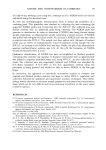
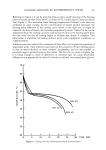
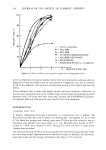
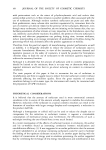
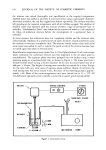
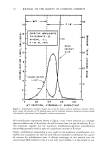
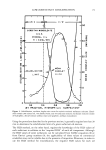
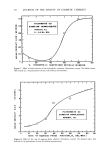
LOW-SURFACTANT EMULSIFICATION 173 w/0 0/w 5O Ol5 N -- =1o o SORI:11 TAN MONOOLEATE D. S. $. MINERAL OIL R = 40ML/MIN SOLU BILI ZATI ON LIMIT MEAN DROPLET SIZE 40 N 3O m o 2O 0.2 0.4 0.6 0.8 0..9 WT. FRACTION, HYDROPHIL. IC $URFACTANT IO Figure 3. Solubilization, emulsion droplet size curves for anionic-nonionic surfactant mixtures. (Emul- sions contain 20% mineral oil, 73% distilled water, and 5% surfactant mixtures. Surfactant mixtures consist of hydrophilic, dioctyl sodium sulfosuccinate and lipophilic, sorbitan monooleate.) Using the procedure described in the previous section, it generally requires less than 20 rain to determine the solubilization limit of a given surfactant-oil mixture. The HLB method, on the other hand, requires the knowledge of the HLB values of each surfactant in addition to the "required HLB" of each oil component. Although the HLB values of some surfactants can be calculated from Gri•n's equations (8) or from Davies' group numbers (9), the applicability of these values to commercial emulsifiers may not be reliable due to the presence of impurities. Moreover, in order to use the HLB method for emulsification, the required HLB values for each oil

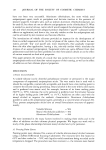
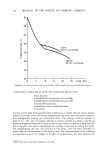
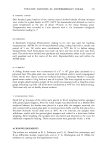
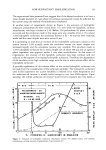
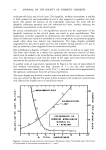
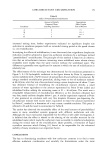
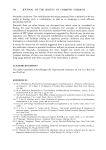
174 JOURNAL OF THE SOCIETY OF COSMETIC CHEMISTS components are also needed. Unlike the HLB's, published required HLB values are scarce for cosmetic raw materials and the values given in the literature are often conflicting. To determine the minimum level of surfactants required for emulsification, varying amounts of surfactants were employed to carry out a series of emulsifications. Figure 4 presents the results of droplet size and solubilization data for a series of emulsions in which the lipophilic surfactant, sorbitan monolaurate, was varied from 2 to 4 g per 100-g emulsion. The hydrophilic surfactant, polysorbate-20, and water in the emulsion were kept constant at 2.5 g and 75 g, respectively. The amount of mineral oil was adjusted to compensate for the variation in sorbitan monolaurate. Solubilization limits were obtained for the oil-surfactant mixtures corresponding to each lipophilic surfactant level. A comparison of the two curves in Figure 4 reveals that as the absolute quantity of lipophilic surfactant is increased, the amount of the aqueous solubilization also increased and the mean droplet size of the emulsion decreased. However, when the amount of the lipophilic surfactant was increased to 4%, the phase inversion occurred and further increase of sorbitan monolaurate promoted W/O type emulsions. Due to the limited resolution of the optimal microscope and BrownJan movements, accurate droplet size determination was difficult for emulsions with submicron droplets. For this reason, it was not apparent if there was a significant difference in the emulsion obtained at 3.25-3.75% lipophilic surfactant range even though the continued increase in the solubilization limit would suggest a further improvement. ' I I I ' I ' ' • O/W =- '•- W/O • •lõ-- -- o o - t - MEAN DROPLET SIZE 0 ) - --I I - ,_. I I - I -io I --IO • POLY$ORBATE-20 _ '7 / • $ORlalTAN MONOLAURATE I I I I I , I I - I I - I _ I I -- I I - I _ I I - I -- I I 5 0 2 2 5 5 •u5 4.0 4.5 % LIPOPHILIC SURFACTANT IN EMULSION 15 z o -- o z Figure 4. Variation of lipophilic surfactant. (Emulsions contain 75% distilled water, 2.5% polysorbate-20, varying amounts of sorbitan monolaurate and mineral oil.)
Purchased for the exclusive use of nofirst nolast (unknown)
From: SCC Media Library & Resource Center (library.scconline.org)